
Policy Brief's (Basic Health Services in Nepal), 2026
Policy Brief's (Basic Health Services in Nepal), 2026
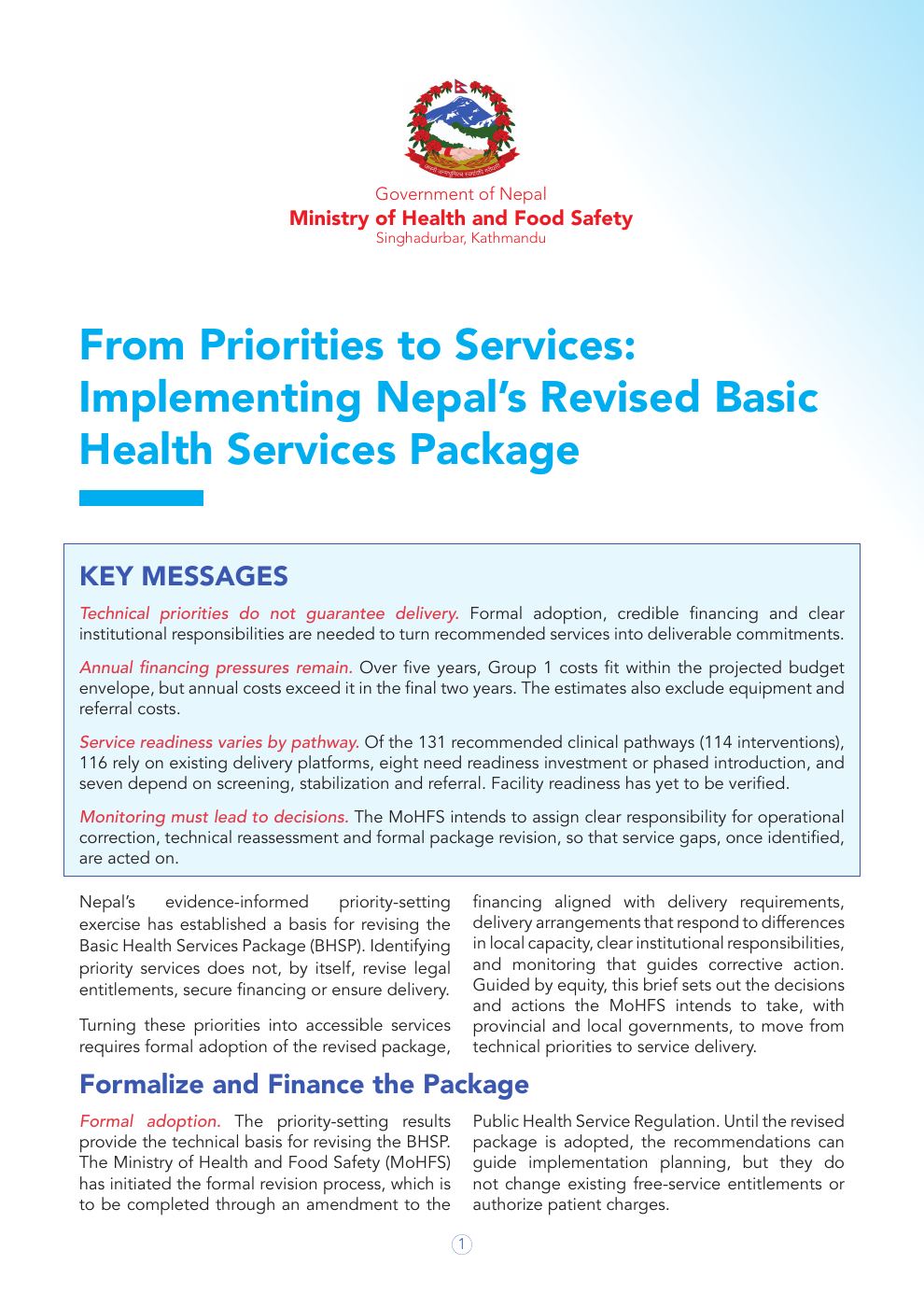
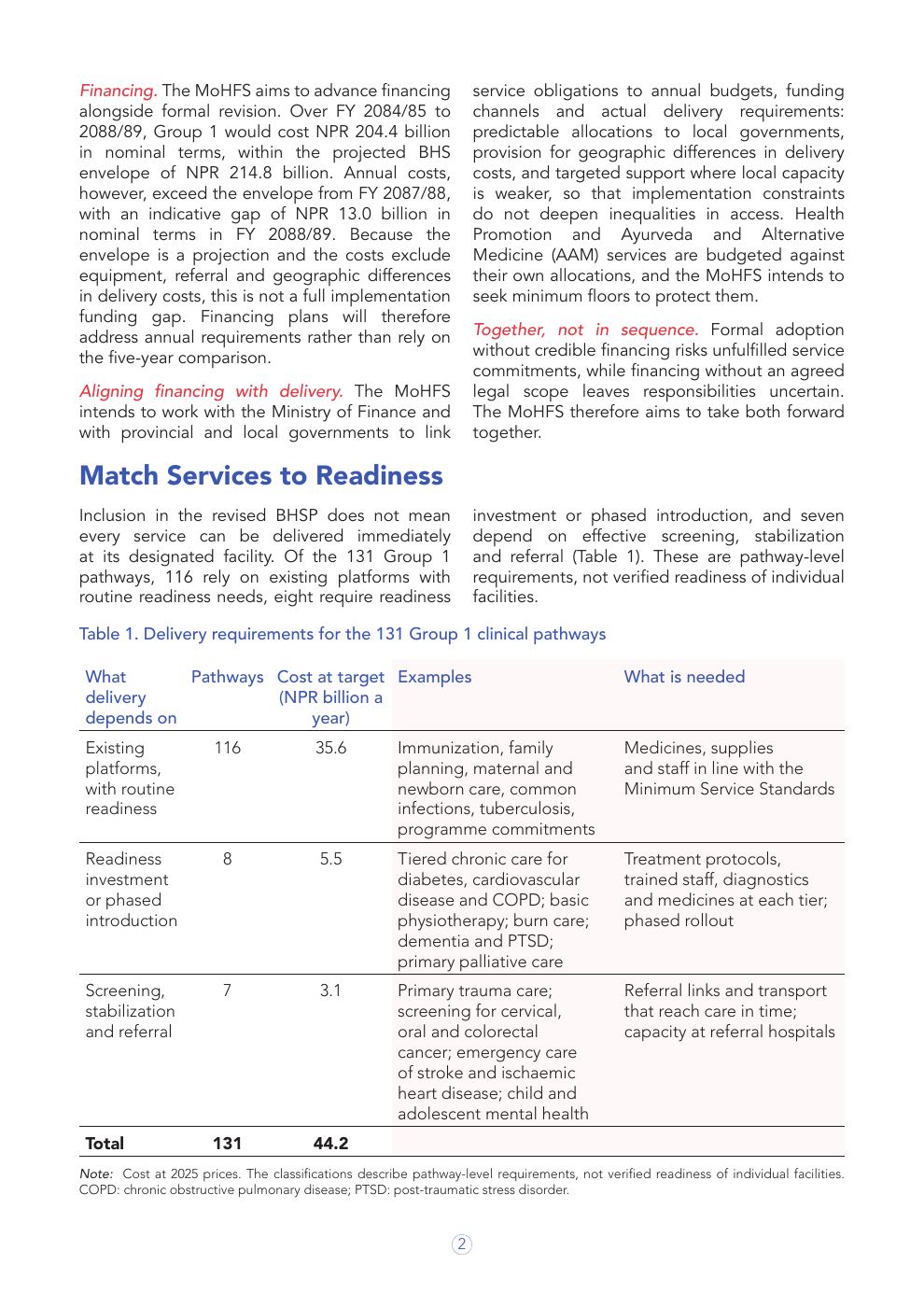
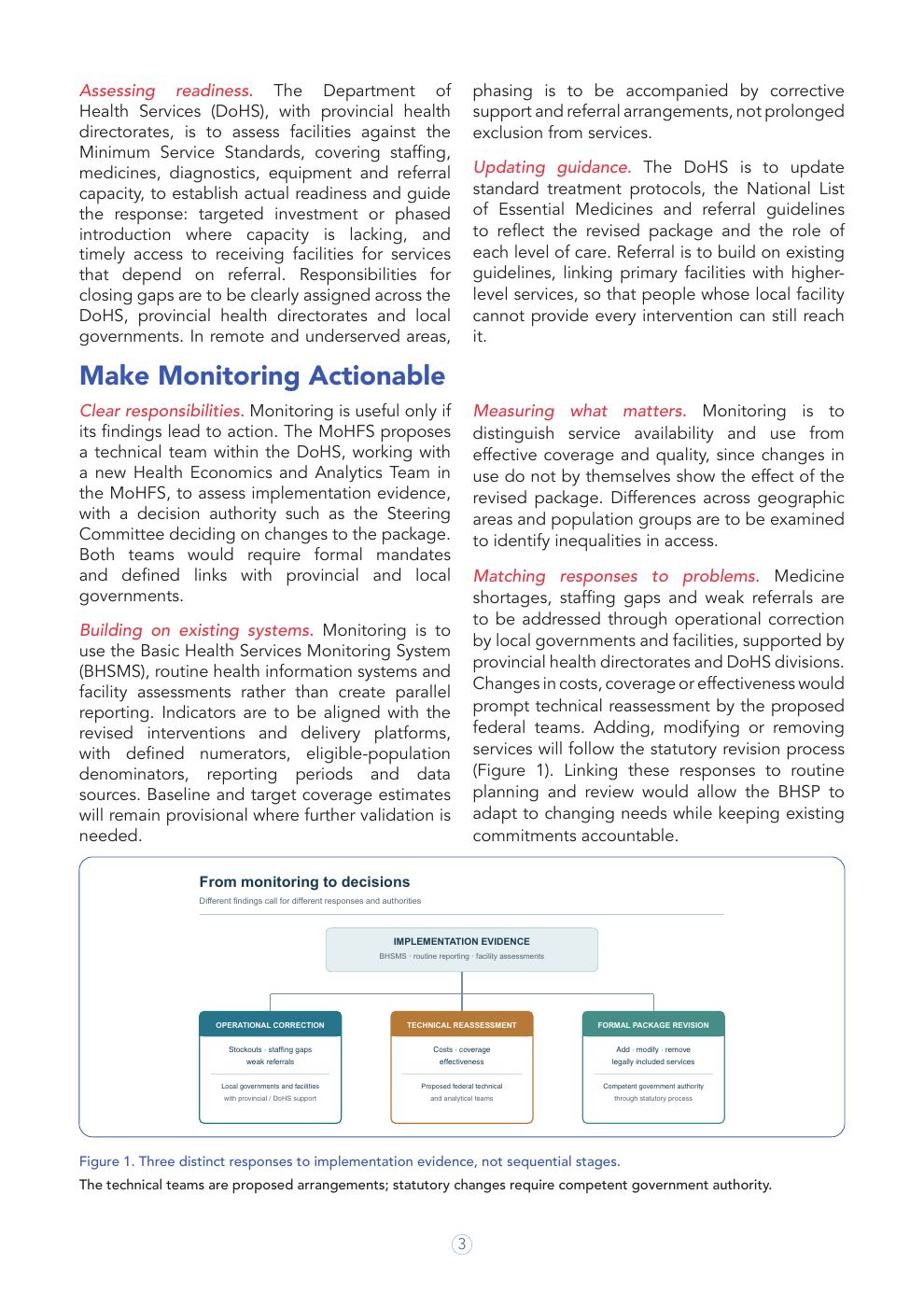
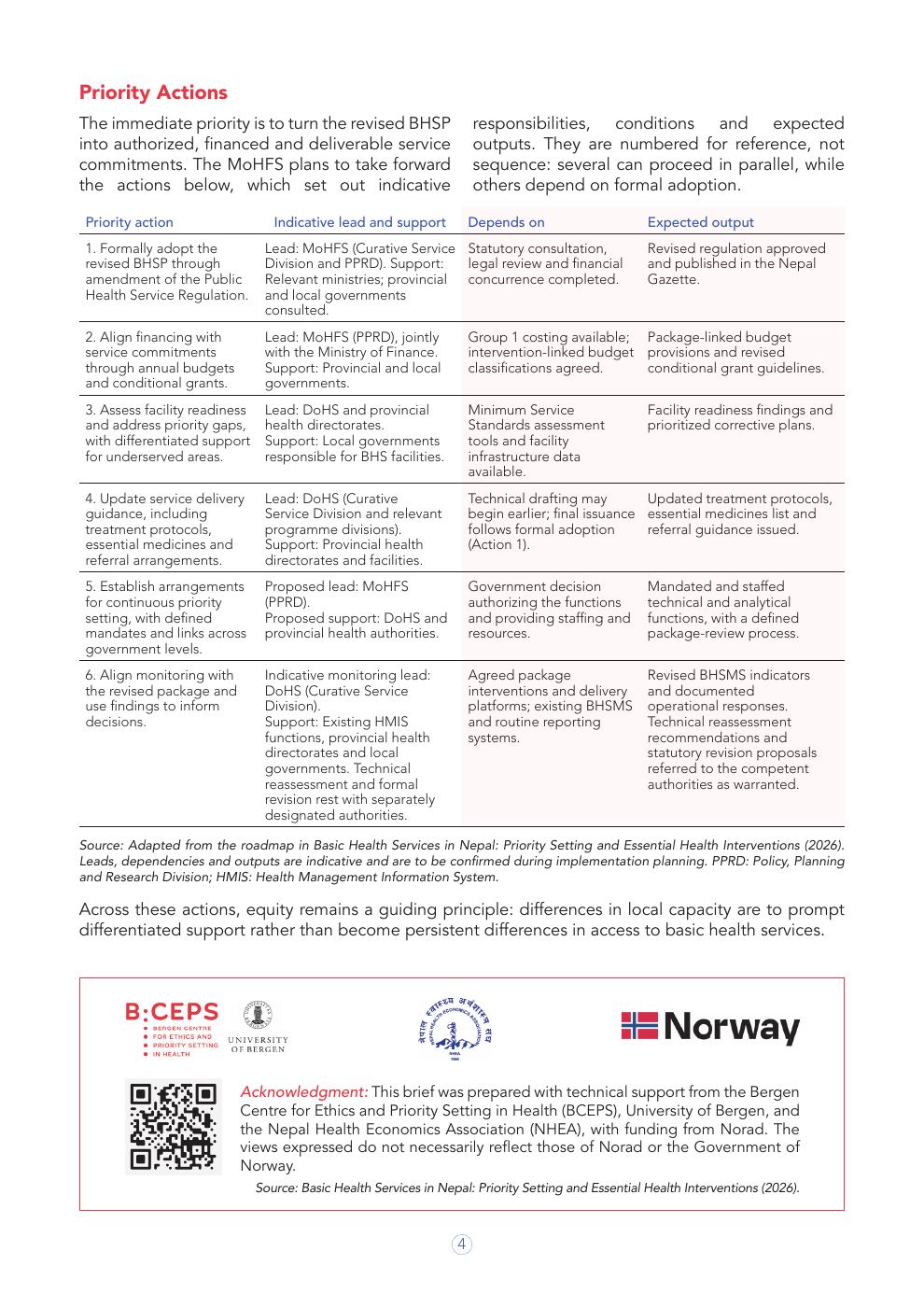
Documents 1
- merged_c20p4so.pdfPDF · 12 pages · 2.9 MBDownload
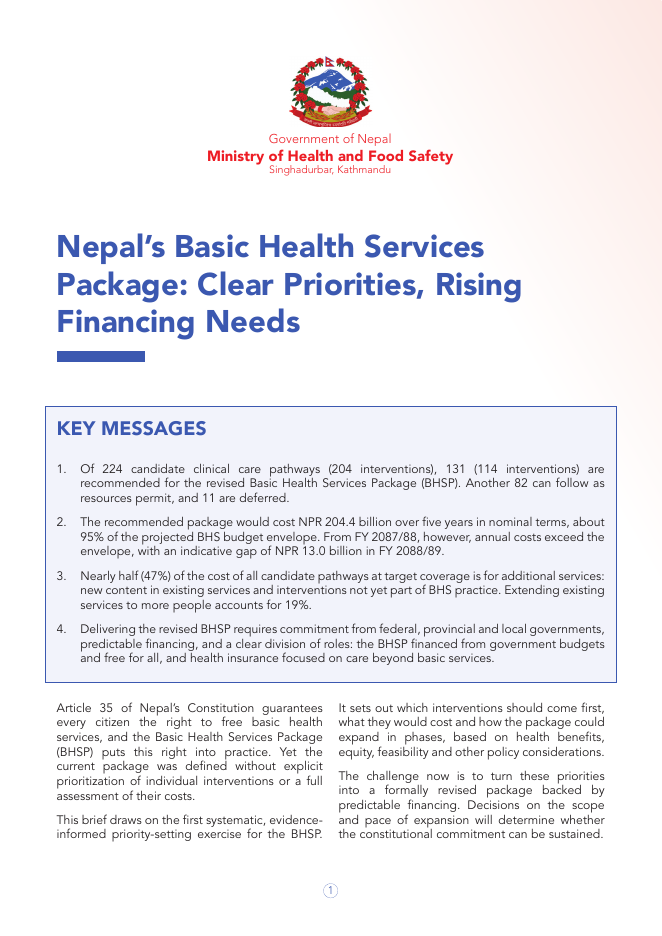
Text extracted from the PDF: merged_c20p4so.pdf
Machine-extracted for search and accessibility. It may contain errors and is not the official text; the attached document is the authoritative version.
Government of Nepal

Ministry of Health and Food Safety
Singhadurbar, Kathmandu

Nepal’s Basic Health Services
Package: Clear Priorities, Rising
Financing Needs
KEY MESSAGES
1.

Of 224 candidate clinical care pathways (204 interventions), 131 (114 interventions) are
recommended for the revised Basic Health Services Package (BHSP). Another 82 can follow as
resources permit, and 11 are deferred.

2.

The recommended package would cost NPR 204.4 billion over five years in nominal terms, about
95% of the projected BHS budget envelope. From FY 2087/88, however, annual costs exceed the
envelope, with an indicative gap of NPR 13.0 billion in FY 2088/89.

3.

Nearly half (47%) of the cost of all candidate pathways at target coverage is for additional services:
new content in existing services and interventions not yet part of BHS practice. Extending existing
services to more people accounts for 19%.

4.

Delivering the revised BHSP requires commitment from federal, provincial and local governments,
predictable financing, and a clear division of roles: the BHSP financed from government budgets
and free for all, and health insurance focused on care beyond basic services.

Article 35 of Nepal’s Constitution guarantees
every citizen the right to free basic health
services, and the Basic Health Services Package
(BHSP) puts this right into practice. Yet the
current package was defined without explicit
prioritization of individual interventions or a full
assessment of their costs.

It sets out which interventions should come first,
what they would cost and how the package could
expand in phases, based on health benefits,
equity, feasibility and other policy considerations.
The challenge now is to turn these priorities
into a formally revised package backed by
predictable financing. Decisions on the scope
and pace of expansion will determine whether
the constitutional commitment can be sustained.

This brief draws on the first systematic, evidenceinformed priority-setting exercise for the BHSP.

1

What Comes First: Priority Clinical Services, Health
Promotion and AAM
The
exercise
assessed
300
candidate
interventions: 204 clinical, 36 Health Promotion
and 60 Ayurveda and Alternative Medicine
(AAM). For costing and prioritization, the 204
clinical interventions were specified as 224 care
pathways. Of these, 131 form Group 1, the
recommended priority package; 82 form Group
2, to be added as resources become available;
and 11 are deferred (Group 3).

were assessed on their budget impact and the
same criteria, through structured deliberation.
Health Promotion and AAM. All 36 Health
Promotion and 60 AAM interventions were
retained after separate assessments. These
rested on different evidence and policy
considerations, so each category is retained on
its own merits rather than on a common measure
of effectiveness.

More than cost-effectiveness. Cost-effectiveness
estimates were available for some clinical
interventions. They were weighed alongside
disease severity, equity, policy relevance and
social impact. Pathways without such estimates

Status. The three groups are technical
recommendations on the scope and sequencing
of the revised BHSP. They do not change existing
legal entitlements until formally adopted.

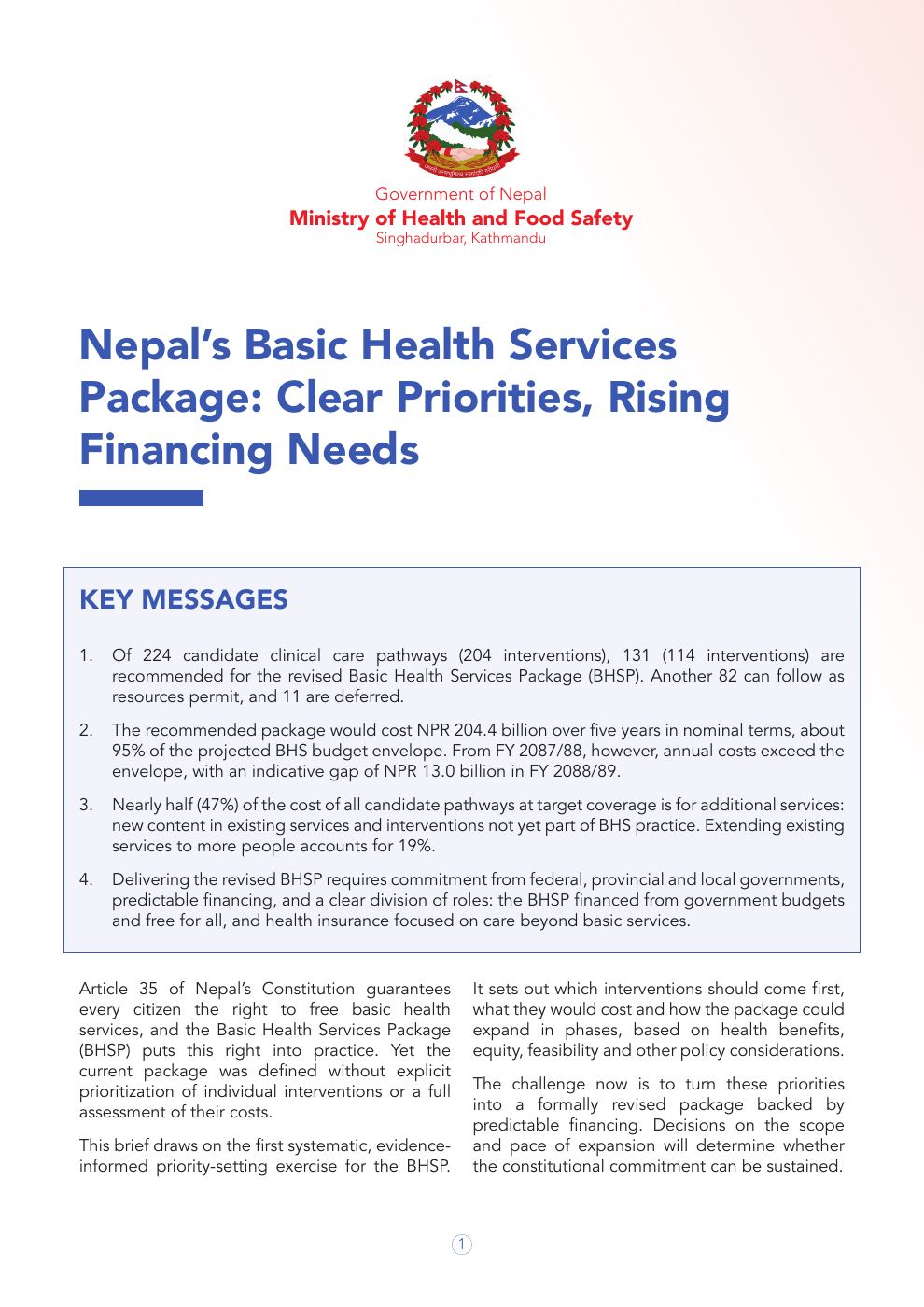
From 300 candidates to clinical priority groups

300

candidate interventions

36

Health Promotion

204

Clinical interventions

60

Ayurveda and Alternative Medicine

Specified for costing

224

clinical care pathways

131

82

11

GROUP 1

GROUP 2

GROUP 3

Recommended

Conditional on resources

Deferred

Health Promotion and Ayurveda/Alternative Medicine were assessed separately.
Priority groups are technical recommendations, not changes to legal entitlements.

Figure 1. From candidate interventions to BHSP clinical priority groups.
Note: Some clinical interventions comprise more than one pathway. Health Promotion and AAM interventions were assessed
separately. The groups are technical recommendations, not changes to legal entitlements.

Costs Fit the Five-Year Budget Projection, but Not Every
Year
Group 1 would cost NPR 44.2 billion a year at
target coverage (2025 prices). As coverage scales
up over FY 2084/85 to 2088/89, it would need
NPR 204.4 billion in nominal terms, about 95% of
the projected BHS envelope of NPR 214.8 billion.

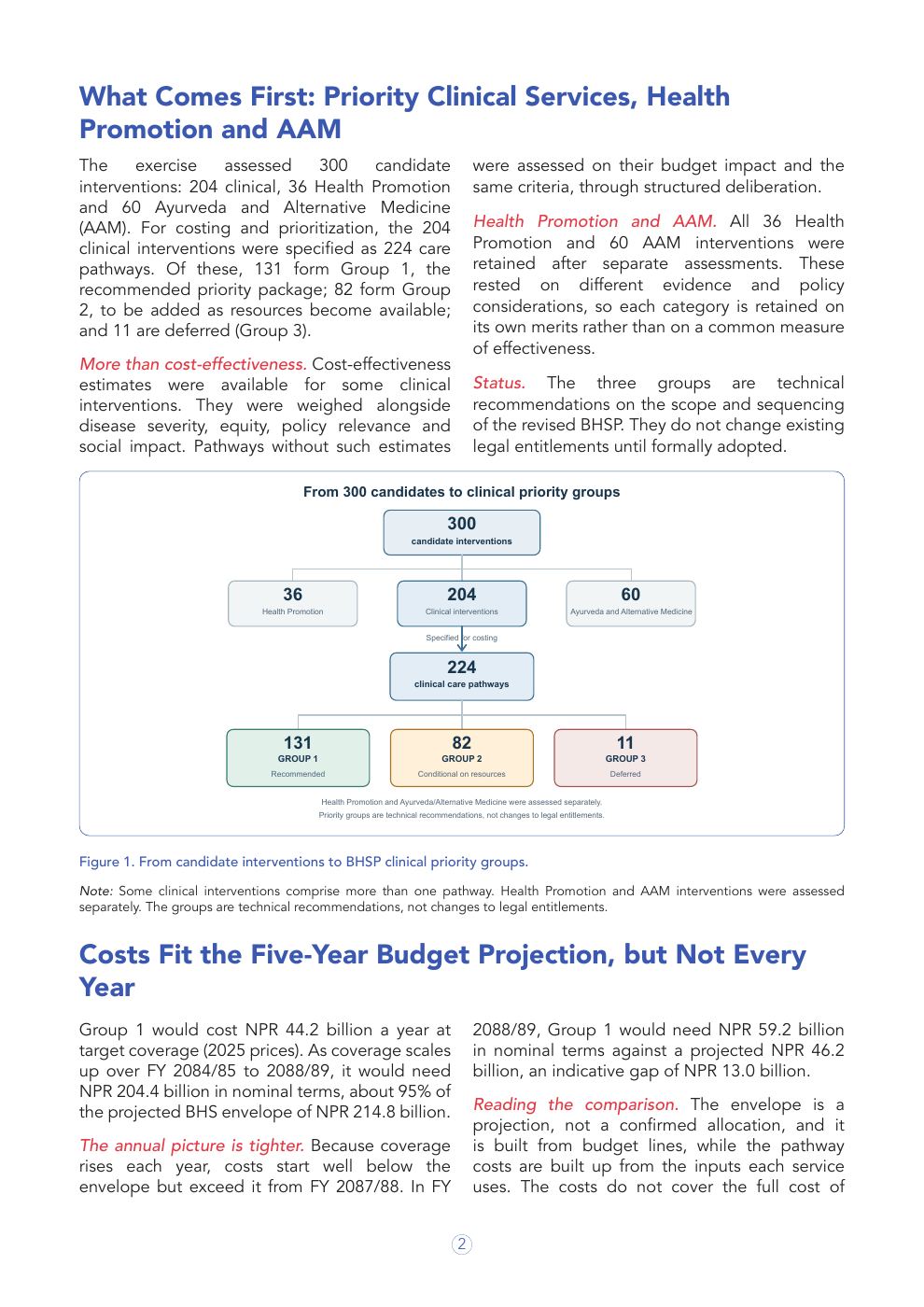
2088/89, Group 1 would need NPR 59.2 billion
in nominal terms against a projected NPR 46.2
billion, an indicative gap of NPR 13.0 billion.
Reading the comparison. The envelope is a
projection, not a confirmed allocation, and it
is built from budget lines, while the pathway
costs are built up from the inputs each service
uses. The costs do not cover the full cost of

The annual picture is tighter. Because coverage
rises each year, costs start well below the
envelope but exceed it from FY 2087/88. In FY
2

implementation and exclude Health Promotion
and AAM, which are budgeted against their
own existing allocations rather than costed. The
comparison is therefore indicative: it neither
confirms affordability nor measures the additional

public funding needed.
Implication. Sustaining Group 1 at target
coverage requires the BHS envelope to grow
faster than currently projected.

Annual clinical costs and projected BHS financing
NPR billion, nominal | FY 2084/85–2088/89
Group 1 clinical requirement

NPR bn

Central projected BHS envelope

59.2

60

50

46.2
40

FY 2088/89 gap

NPR 13.0 billion
30

20
2084/85

2085/86

2086/87

2087/88

2088/89

Group 1 exceeds the projected annual envelope beginning FY 2087/88.
Indicative comparison; projected financing is not a confirmed allocation.

Figure 2. Group 1 clinical costs exceed the projected BHS budget envelope from FY 2087/88.
Note: Nominal estimates for FY 2084/85–2088/89. The envelope is a central projection, not an approved allocation; pathway
costs and budget categories are not fully comparable. Health Promotion and AAM are not included in the clinical costs. They are
budgeted against their own existing allocations: the Ayurveda allocation within the BHS envelope (NPR 1.9 billion over five years,
nominal) and the allocation for health promotion and preventive services (NPR 50.8 billion, nominal), which overlaps with the BHS
envelope and is not additive.

Reaching More People and Adding Services Carry Different
Costs
The package can grow in two ways: by reaching
people who lack access to existing services, and
by adding new content to existing services or new
interventions to the package. Both need public
financing, but they differ in cost and in what they
do for coverage and equity.

with existing services is a direct route to greater
equity, without the full set of new inputs. New
content can also bring health and equity gains
but widens the scope of publicly financed care.
The assessment therefore supports emphasizing
coverage expansion in the early years, with
additional services introduced gradually.

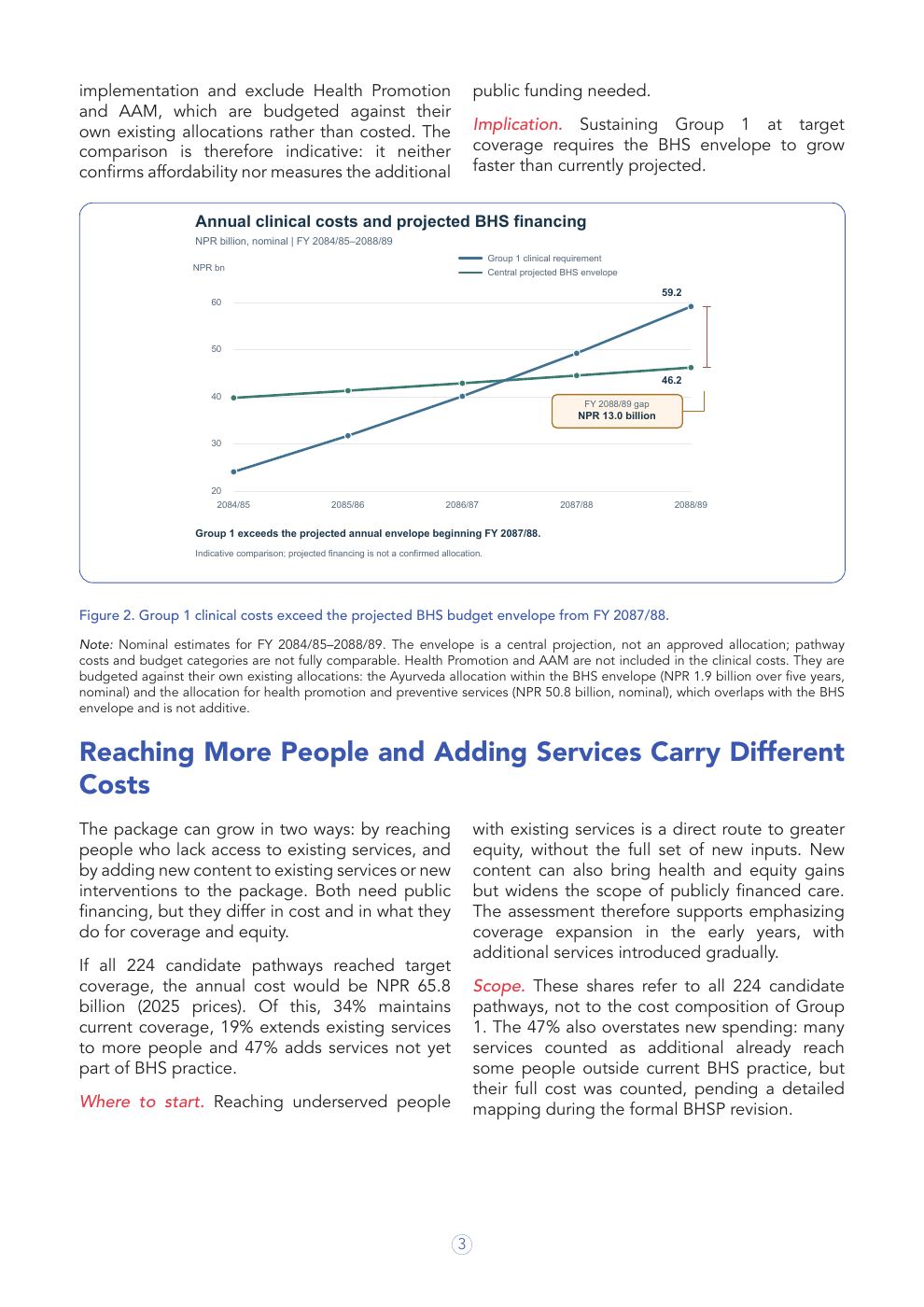
If all 224 candidate pathways reached target
coverage, the annual cost would be NPR 65.8
billion (2025 prices). Of this, 34% maintains
current coverage, 19% extends existing services
to more people and 47% adds services not yet
part of BHS practice.

Scope. These shares refer to all 224 candidate
pathways, not to the cost composition of Group
1. The 47% also overstates new spending: many
services counted as additional already reach
some people outside current BHS practice, but
their full cost was counted, pending a detailed
mapping during the formal BHSP revision.

Where to start. Reaching underserved people

3

What drives the cost of candidate clinical pathways?
Annual cost at target coverage | 2025 prices | All 224 clinical pathways

NPR 65.8 billion
34%

NPR 22.4B

19%

47%

NPR 12.5B

NPR 30.8B

Maintaining current coverage
Existing service use

Expanding existing coverage
Reaching additional people

Adding service content
Medicines, tests and procedures

Cost composition is for all candidate pathways, not the recommended Group 1 package.

Figure 3. Additional service content accounts for nearly half of the estimated cost of all candidate clinical pathways.
Note: Annual cost at target coverage, 2025 prices, for all 224 candidate pathways. Additional services comprise new medicines,
tests and procedures within services already provided and interventions not yet part of current BHS practice, many of which already
reach some people through other programmes. Figures are rounded.

From Priorities to Policy: Three Actions
1. Formally adopt the priorities
through revision of the BHSP.

Promotion and Ayurveda services, so that
interventions that were not costed are not
crowded out when budgets tighten. Working
with the Ministry of Finance, the MoHFS will
work towards aligning conditional grants
with the revised package, so that local
governments receive resources that match
their service responsibilities.

The recommendations give a technical
basis for the revised package. The MoHFS
intends to consult across the three tiers of
government and complete the statutory
approval process. Implementation could
then be phased: Group 1 first, extending
existing services to people not yet reached
before adding new content, and Group 2 as
fiscal space grows.

3. Define clear roles for the BHSP and
health insurance.
BHSP services are to remain financed from
government budgets and free at the point
of use for everyone, with health insurance
concentrating on referral and specialized care
beyond basic services. The MoHFS intends
to map services now provided through
free programmes and review the insurance
benefit package once the revised BHSP is in
place, to reduce duplication and fragmented
spending.

2. Secure predictable financing for the
revised BHSP.
The MoHFS aims to secure a protected
minimum allocation for basic health services,
linked to the Medium-Term Expenditure
Framework, with the cost of Group 1 along
its scale-up path as the benchmark. It also
intends to seek minimum floors for Health

Acknowledgment: This brief was prepared with technical support from the Bergen
Centre for Ethics and Priority Setting in Health (BCEPS), University of Bergen, and
the Nepal Health Economics Association (NHEA), with funding from Norad. The
views expressed do not necessarily reflect those of Norad or the Government of
Norway.
Source: Basic Health Services in Nepal: Priority Setting and Essential Health Interventions (2026).

4

Government of Nepal

Ministry of Health and Food Safety
Singhadurbar, Kathmandu

Beyond Cost-Effectiveness: How
Nepal Set Priorities for Basic Health
Services
KEY MESSAGES
1.

Six criteria, endorsed by the MoHFS, guided priority setting: health maximization, disease severity,
equity, policy relevance, social impact and feasibility.

2.

All 224 clinical care pathways (204 interventions) had unit cost and budget impact estimates,
and 92 (81 interventions) also had cost-effectiveness ratios. Where health gains could not be
modelled, the other criteria and structured deliberation guided the decisions.

3.

The priority groups set a recommended sequence for financing and scaling up services. They
do not judge lower-ranked services to lack value, and they do not by themselves change legal
entitlements.

4.

The recommendations will be updated as local evidence on costs, coverage and effectiveness
improves.

Revising the Basic Health Services Package (BHSP)
required more than finding the interventions that
give the greatest health gain for the resources
available. The priority-setting exercise combined
economic analysis with explicit criteria and

structured deliberation, because the evidence
available differed widely across interventions.
This brief explains the criteria, the evidence and
the decision process behind the priority groups,
and how the results should be read.

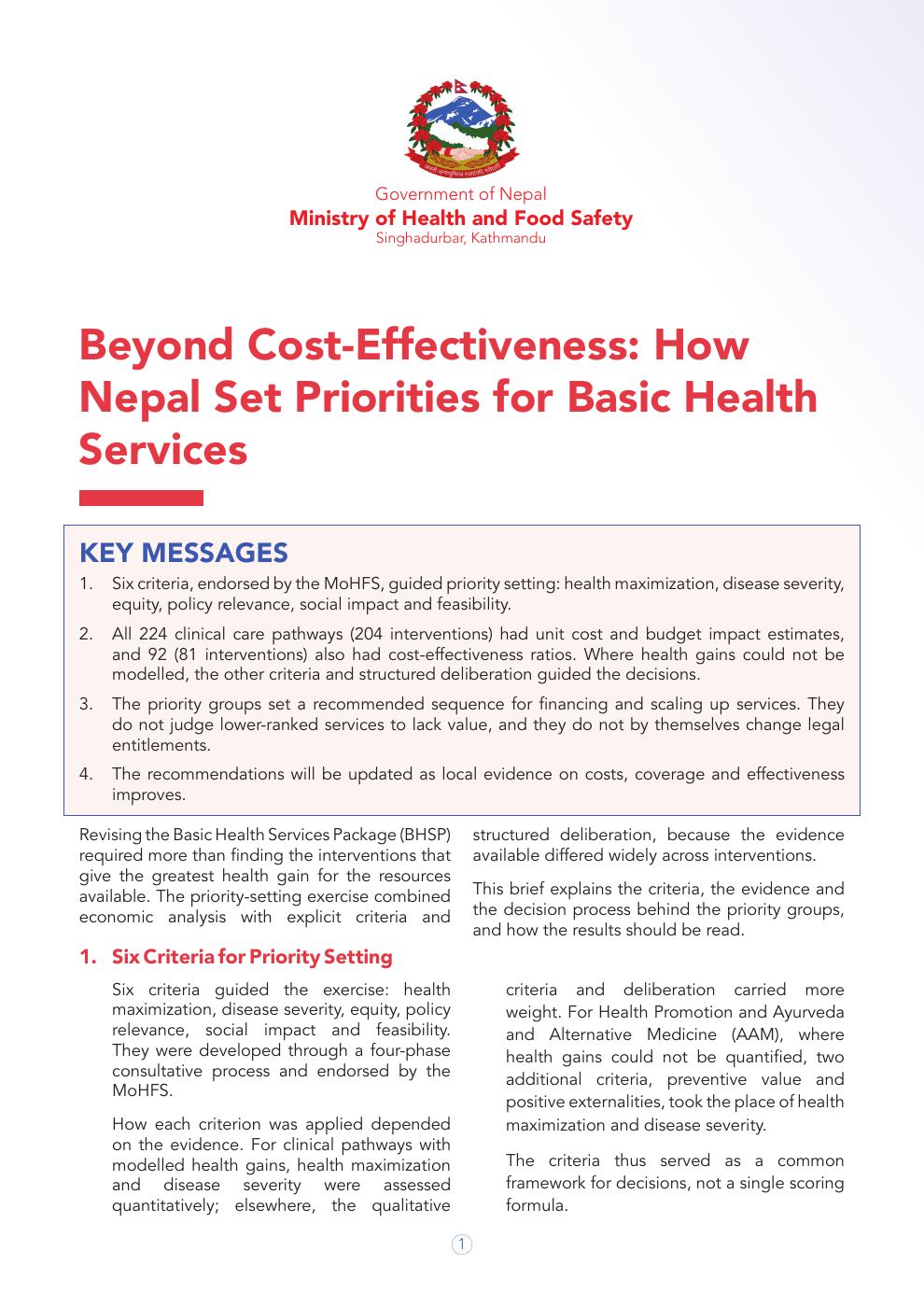
1. Six Criteria for Priority Setting
Six criteria guided the exercise: health
maximization, disease severity, equity, policy
relevance, social impact and feasibility.
They were developed through a four-phase
consultative process and endorsed by the
MoHFS.

criteria and deliberation carried more
weight. For Health Promotion and Ayurveda
and Alternative Medicine (AAM), where
health gains could not be quantified, two
additional criteria, preventive value and
positive externalities, took the place of health
maximization and disease severity.

How each criterion was applied depended
on the evidence. For clinical pathways with
modelled health gains, health maximization
and disease severity were assessed
quantitatively; elsewhere, the qualitative

The criteria thus served as a common
framework for decisions, not a single scoring
formula.
1

Figure 1. Six Criteria for Priority Setting

2. The Reach of Economic Evidence
The 204 clinical interventions were costed
as 224 care pathways, because some
interventions cover more than one condition
or method. Every pathway has a unit cost and
a budget impact estimate, so its resource
needs could be assessed even where health

gains could not be modelled.
Unit costs and budget impact. Unit costs
value the staff time, medicines and supplies
needed to deliver each service. Budget
impact adds the population in need and the
target coverage.

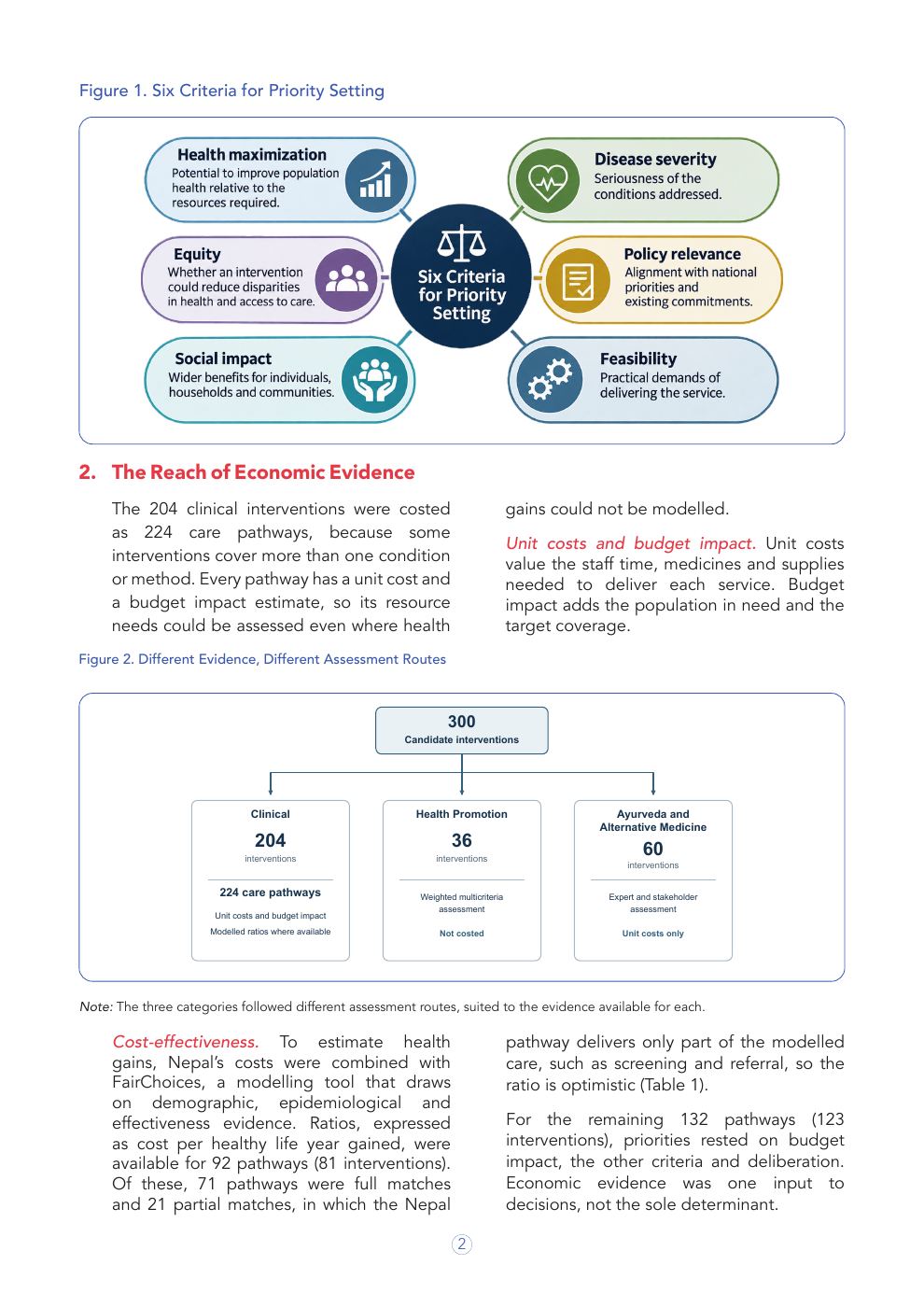
Figure 2. Different Evidence, Different Assessment Routes

300

Candidate interventions

Clinical

204

interventions

224 care pathways
Unit costs and budget impact
Modelled ratios where available

Health Promotion

36

interventions

Ayurveda and
Alternative Medicine

60

interventions

Weighted multicriteria
assessment

Expert and stakeholder
assessment

Not costed

Unit costs only

Note: The three categories followed different assessment routes, suited to the evidence available for each.

Cost-effectiveness. To estimate health
gains, Nepal’s costs were combined with
FairChoices, a modelling tool that draws
on demographic, epidemiological and
effectiveness evidence. Ratios, expressed
as cost per healthy life year gained, were
available for 92 pathways (81 interventions).
Of these, 71 pathways were full matches
and 21 partial matches, in which the Nepal

pathway delivers only part of the modelled
care, such as screening and referral, so the
ratio is optimistic (Table 1).
For the remaining 132 pathways (123
interventions), priorities rested on budget
impact, the other criteria and deliberation.
Economic evidence was one input to
decisions, not the sole determinant.
2

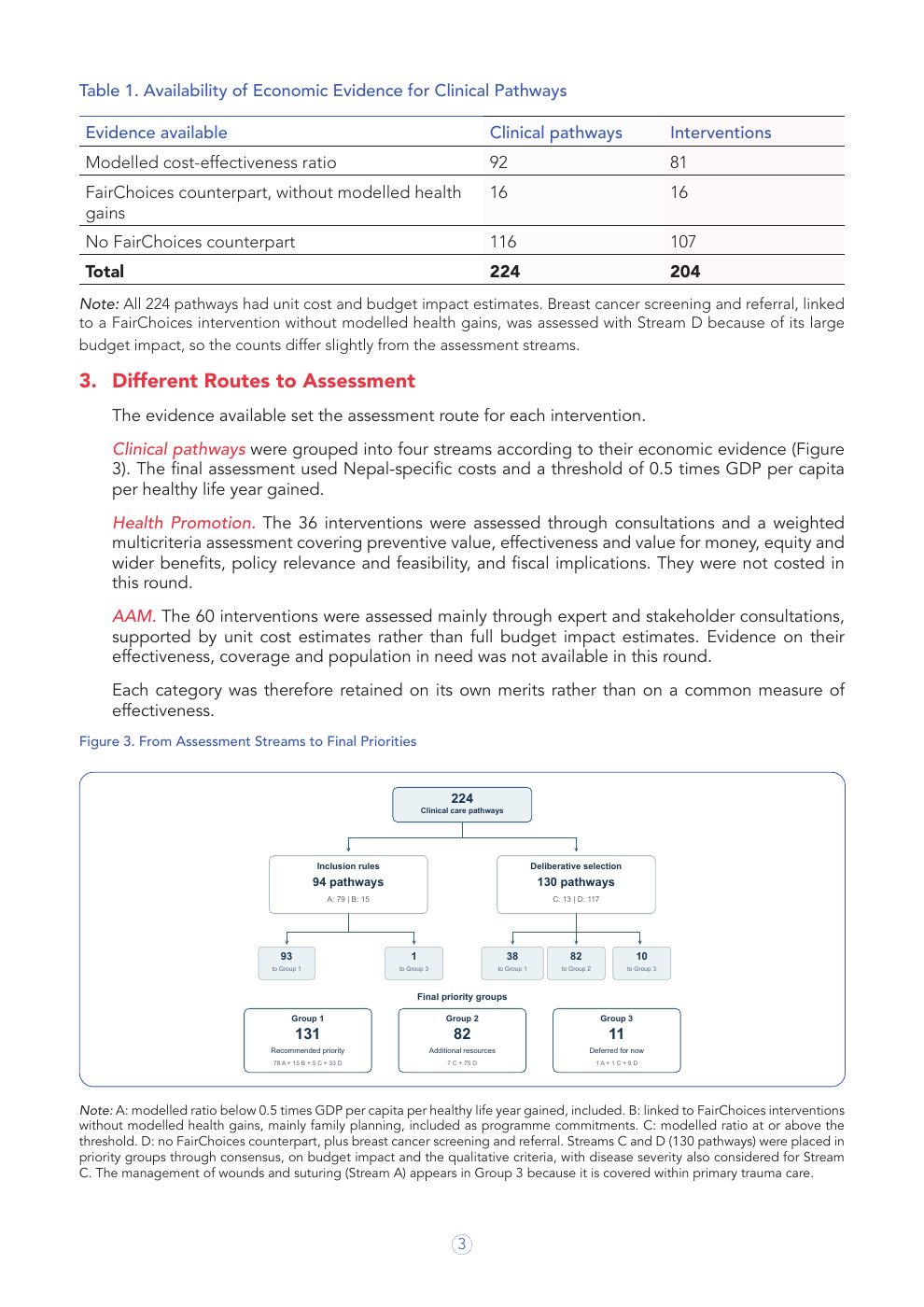
Table 1. Availability of Economic Evidence for Clinical Pathways
Evidence available

Clinical pathways

Interventions

Modelled cost-effectiveness ratio

92

81

FairChoices counterpart, without modelled health
gains

16

16

No FairChoices counterpart

116

107

Total

224

204

Note: All 224 pathways had unit cost and budget impact estimates. Breast cancer screening and referral, linked
to a FairChoices intervention without modelled health gains, was assessed with Stream D because of its large
budget impact, so the counts differ slightly from the assessment streams.

3. Different Routes to Assessment
The evidence available set the assessment route for each intervention.
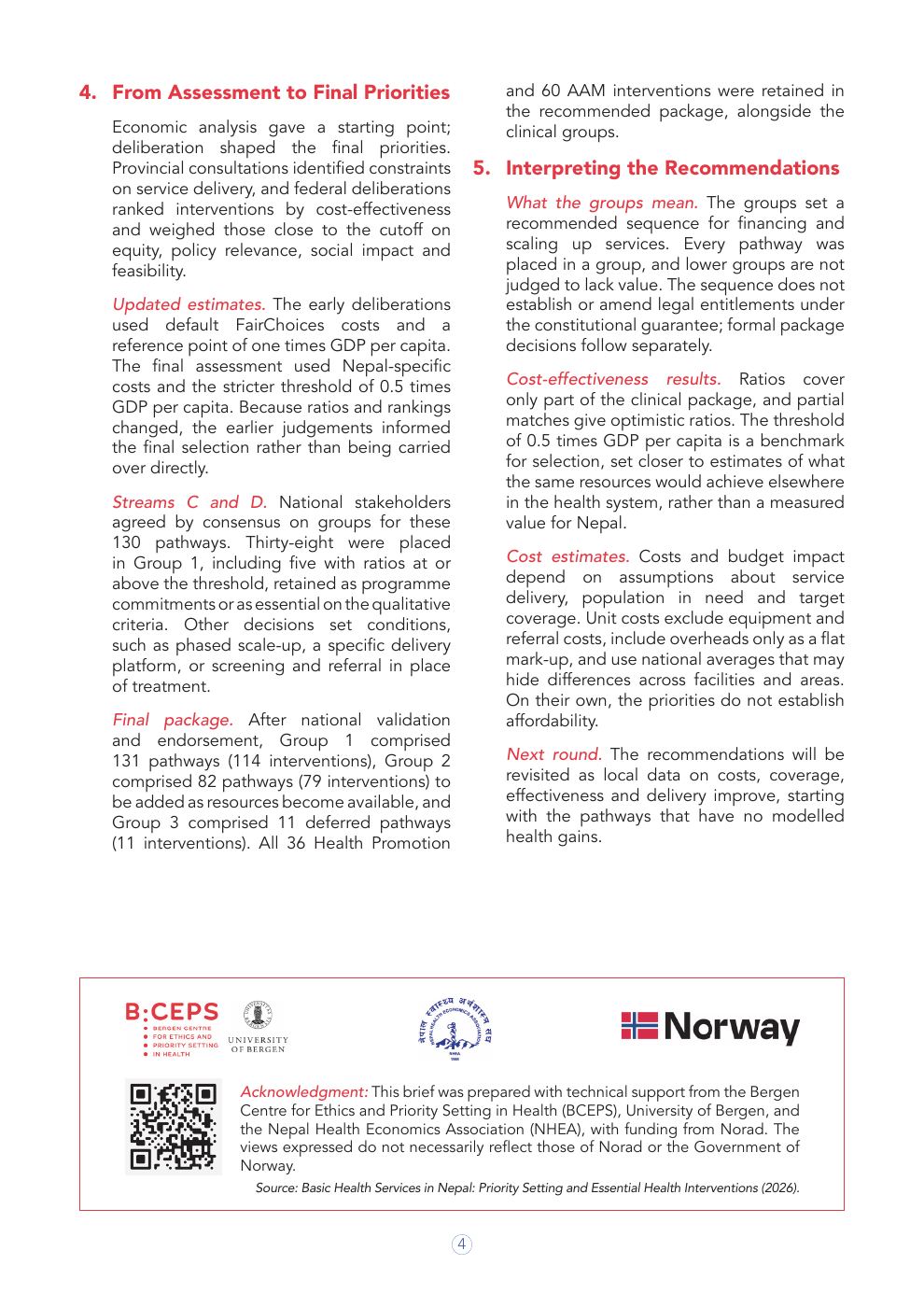
Clinical pathways were grouped into four streams according to their economic evidence (Figure
3). The final assessment used Nepal-specific costs and a threshold of 0.5 times GDP per capita
per healthy life year gained.
Health Promotion. The 36 interventions were assessed through consultations and a weighted
multicriteria assessment covering preventive value, effectiveness and value for money, equity and
wider benefits, policy relevance and feasibility, and fiscal implications. They were not costed in
this round.
AAM. The 60 interventions were assessed mainly through expert and stakeholder consultations,
supported by unit cost estimates rather than full budget impact estimates. Evidence on their
effectiveness, coverage and population in need was not available in this round.
Each category was therefore retained on its own merits rather than on a common measure of
effectiveness.
Figure 3. From Assessment Streams to Final Priorities

224

Clinical care pathways

Inclusion rules

Deliberative selection

94 pathways

130 pathways

A: 79 | B: 15

C: 13 | D: 117

93

1

38

82

10

to Group 1

to Group 3

to Group 1

to Group 2

to Group 3

Final priority groups
Group 1

Group 2

Group 3

Recommended priority

Additional resources

Deferred for now

78 A + 15 B + 5 C + 33 D

7 C + 75 D

1A+1C+9D

131

82

11

Note: A: modelled ratio below 0.5 times GDP per capita per healthy life year gained, included. B: linked to FairChoices interventions
without modelled health gains, mainly family planning, included as programme commitments. C: modelled ratio at or above the
threshold. D: no FairChoices counterpart, plus breast cancer screening and referral. Streams C and D (130 pathways) were placed in
priority groups through consensus, on budget impact and the qualitative criteria, with disease severity also considered for Stream
C. The management of wounds and suturing (Stream A) appears in Group 3 because it is covered within primary trauma care.

3

4. From Assessment to Final Priorities

and 60 AAM interventions were retained in
the recommended package, alongside the
clinical groups.

Economic analysis gave a starting point;
deliberation shaped the final priorities.
Provincial consultations identified constraints
on service delivery, and federal deliberations
ranked interventions by cost-effectiveness
and weighed those close to the cutoff on
equity, policy relevance, social impact and
feasibility.

5. Interpreting the Recommendations
What the groups mean. The groups set a
recommended sequence for financing and
scaling up services. Every pathway was
placed in a group, and lower groups are not
judged to lack value. The sequence does not
establish or amend legal entitlements under
the constitutional guarantee; formal package
decisions follow separately.

Updated estimates. The early deliberations
used default FairChoices costs and a
reference point of one times GDP per capita.
The final assessment used Nepal-specific
costs and the stricter threshold of 0.5 times
GDP per capita. Because ratios and rankings
changed, the earlier judgements informed
the final selection rather than being carried
over directly.

Cost-effectiveness results. Ratios cover
only part of the clinical package, and partial
matches give optimistic ratios. The threshold
of 0.5 times GDP per capita is a benchmark
for selection, set closer to estimates of what
the same resources would achieve elsewhere
in the health system, rather than a measured
value for Nepal.

Streams C and D. National stakeholders
agreed by consensus on groups for these
130 pathways. Thirty-eight were placed
in Group 1, including five with ratios at or
above the threshold, retained as programme
commitments or as essential on the qualitative
criteria. Other decisions set conditions,
such as phased scale-up, a specific delivery
platform, or screening and referral in place
of treatment.

Cost estimates. Costs and budget impact
depend on assumptions about service
delivery, population in need and target
coverage. Unit costs exclude equipment and
referral costs, include overheads only as a flat
mark-up, and use national averages that may
hide differences across facilities and areas.
On their own, the priorities do not establish
affordability.

Final package. After national validation
and endorsement, Group 1 comprised
131 pathways (114 interventions), Group 2
comprised 82 pathways (79 interventions) to
be added as resources become available, and
Group 3 comprised 11 deferred pathways
(11 interventions). All 36 Health Promotion

Next round. The recommendations will be
revisited as local data on costs, coverage,
effectiveness and delivery improve, starting
with the pathways that have no modelled
health gains.

Acknowledgment: This brief was prepared with technical support from the Bergen
Centre for Ethics and Priority Setting in Health (BCEPS), University of Bergen, and
the Nepal Health Economics Association (NHEA), with funding from Norad. The
views expressed do not necessa…Reading is open to everyone. Sign in to react, comment or save.
Related updates
All updatesBasic Health Services in Nepal (Priority Setting and Essential Health Interventions) Technical Report 2026
Basic Health Services in Nepal (Priority Setting and Essential Health Interventions) Technical Report 2026
New 1 PDF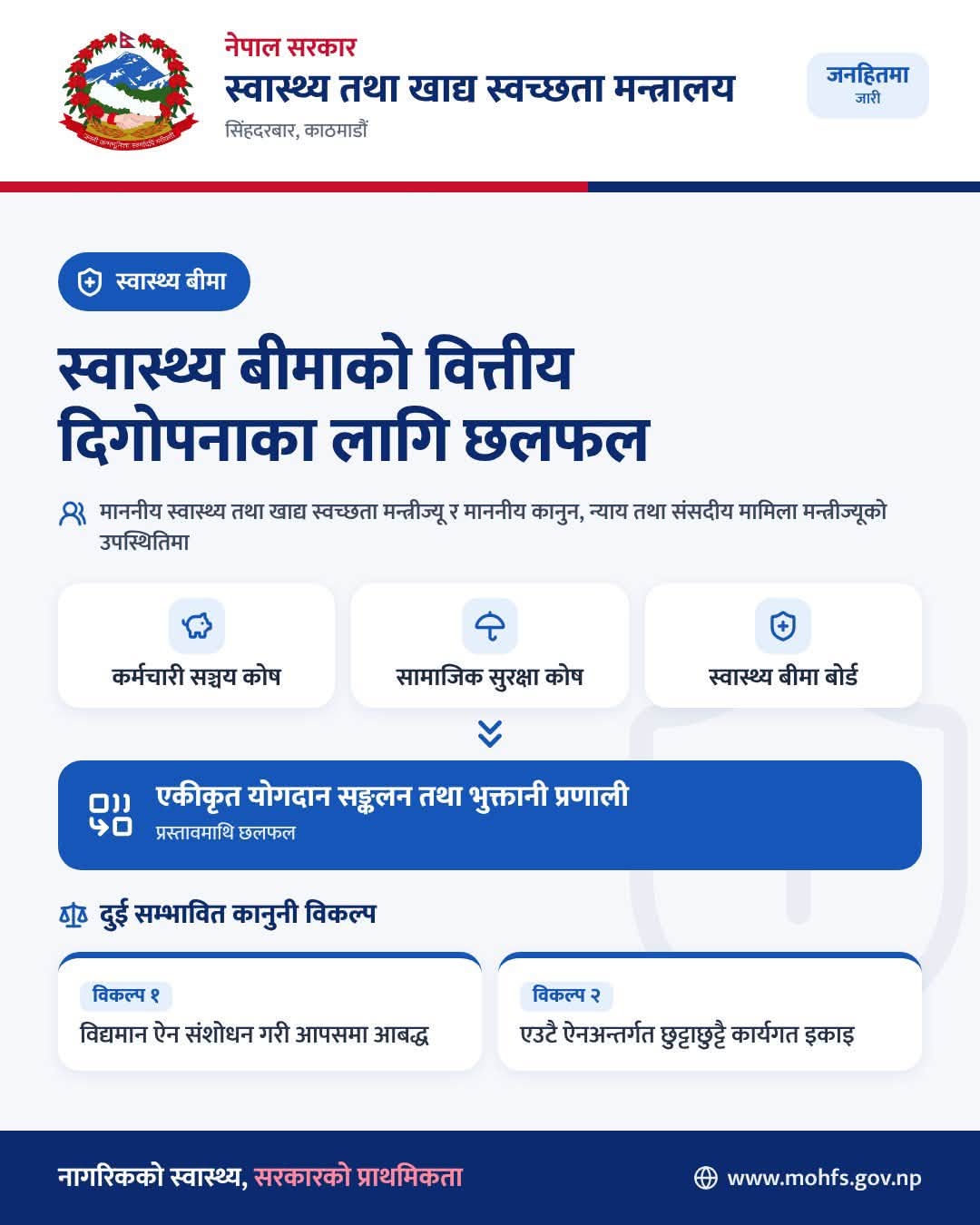
राष्ट्रिय स्वास्थ्य बीमा कार्यक्रमको वित्तीय दिगोपना तथा योगदान सङ्कलन र सेवा भुक्तानी प्रणालीलाई थप व्यवस्थित र प्रभावकारी बनाउने सम्बन्धमा छलफल
राष्ट्रिय स्वास्थ्य बीमा कार्यक्रमको वित्तीय दिगोपना सुनिश्चित गर्दै योगदान सङ्कलन तथा सेवा भुक्तानी प्रणालीलाई थप व्यवस्थित र प्रभावकारी बनाउने विषयमा छलफल भएको छ। छलफलमा माननीय…
New 3 images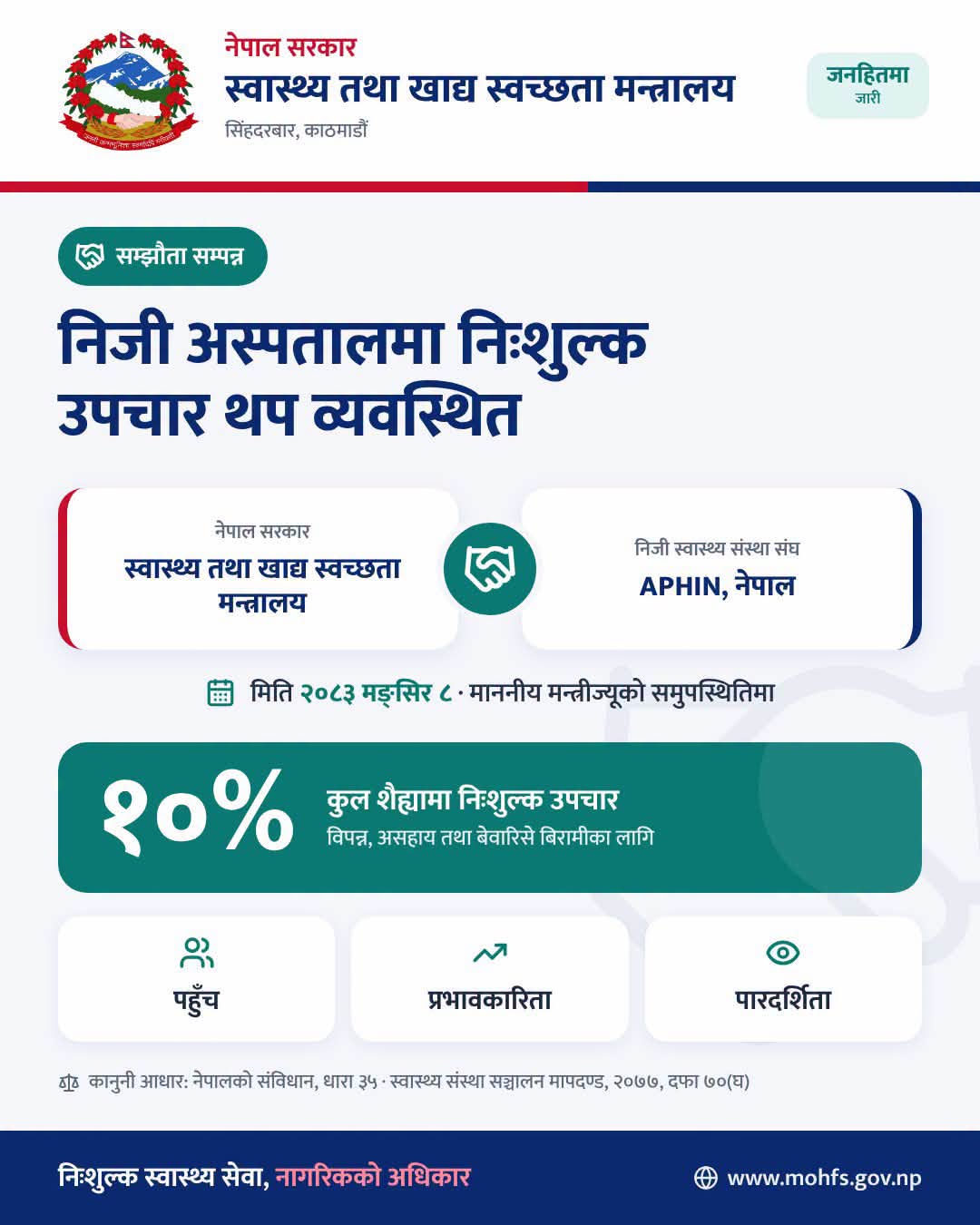
निःशुल्क स्वास्थ्य उपचार सेवा कार्यान्वयनका लागि स्वास्थ्य तथा खाद्य स्वच्छता मन्त्रालय र निजी स्वास्थ्य संस्था संघ (APHIN), नेपालबीच सम्झौता
नेपालको संविधान, २०७२ को धारा ३५ ले प्रत्येक नागरिकलाई आधारभूत स्वास्थ्य सेवा निःशुल्क प्राप्त गर्ने तथा स्वास्थ्य सेवामा समान पहुँचको हक सुनिश्चित गरेको छ। साथै, स्वास्थ्य संस्था…
New 2 images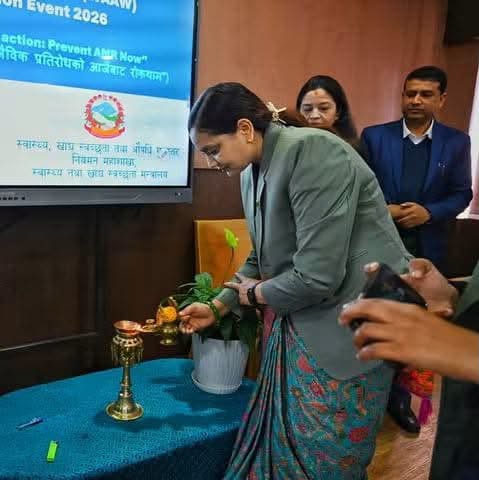
विश्व प्रतिजैविक प्रतिरोध सचेतना सप्ताह, २०२६
“एक स्वास्थ्य, एक कार्य: अहिले नै प्रतिजैविक प्रतिरोध रोकथाम गरौँ।” (One Health, One Action: Prevent AMR Now) विश्व प्रतिजैविक प्रतिरोध सचेतना सप्ताह, २०२६ को अवसरमा नेपाल सरकार,…
5 imagesविश्व प्रतिजैविक प्रतिरोध सचेतना सप्ताह, २०२६ को संयुक्त शुभकामना सन्देश ।
विश्व प्रतिजैविक प्रतिरोध सचेतना सप्ताह, २०२६ को संयुक्त शुभकामना सन्देश ।
1 imageजेन्जी घाईतेहरुको उपचारको सम्बन्धमा स्वास्थ्य तथा खाद्य स्वच्छता मन्त्रालयको अनुरोध ।
२०८२ भाद्र २३ र २४ गतेको जेन्जी आन्दोलनका क्रममा घाइते भएका व्यक्तिहरूको निःशुल्क उपचार नेपाल सरकारको निर्णय अनुरूप देशभरका अस्पतालहरूबाट उपलब्ध हुँदै आएको छ। घाइते भएका…
Comments 0
No comments yet. Start a respectful conversation.