
Basic Health Services in Nepal (Priority Setting and Essential Health Interventions) Technical Report 2026
Basic Health Services in Nepal (Priority Setting and Essential Health Interventions) Technical Report 2026
Technical Report_Basic Health Services_Priority Setting and essential health interventions_gpxujdd.pdf
Open Download
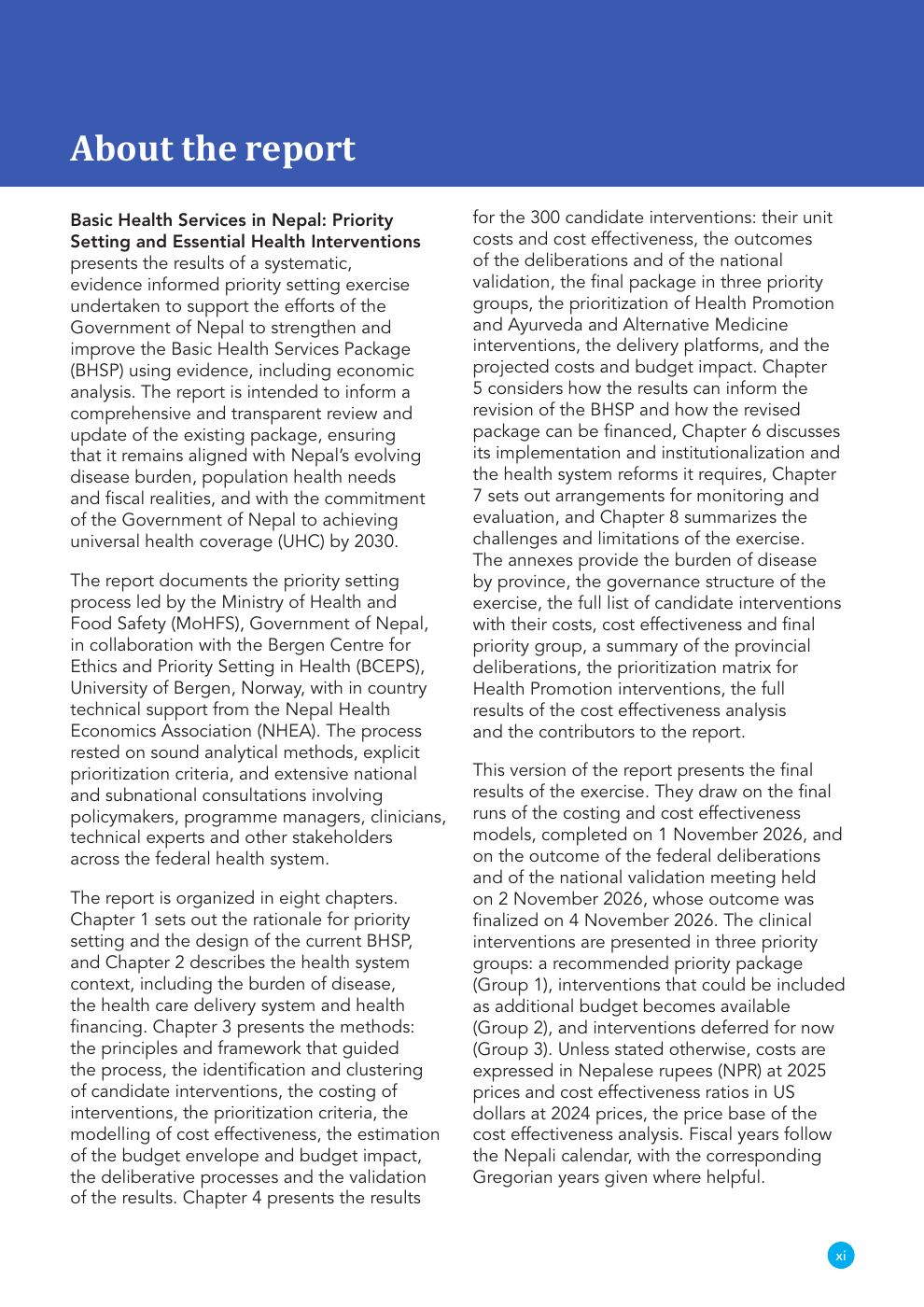
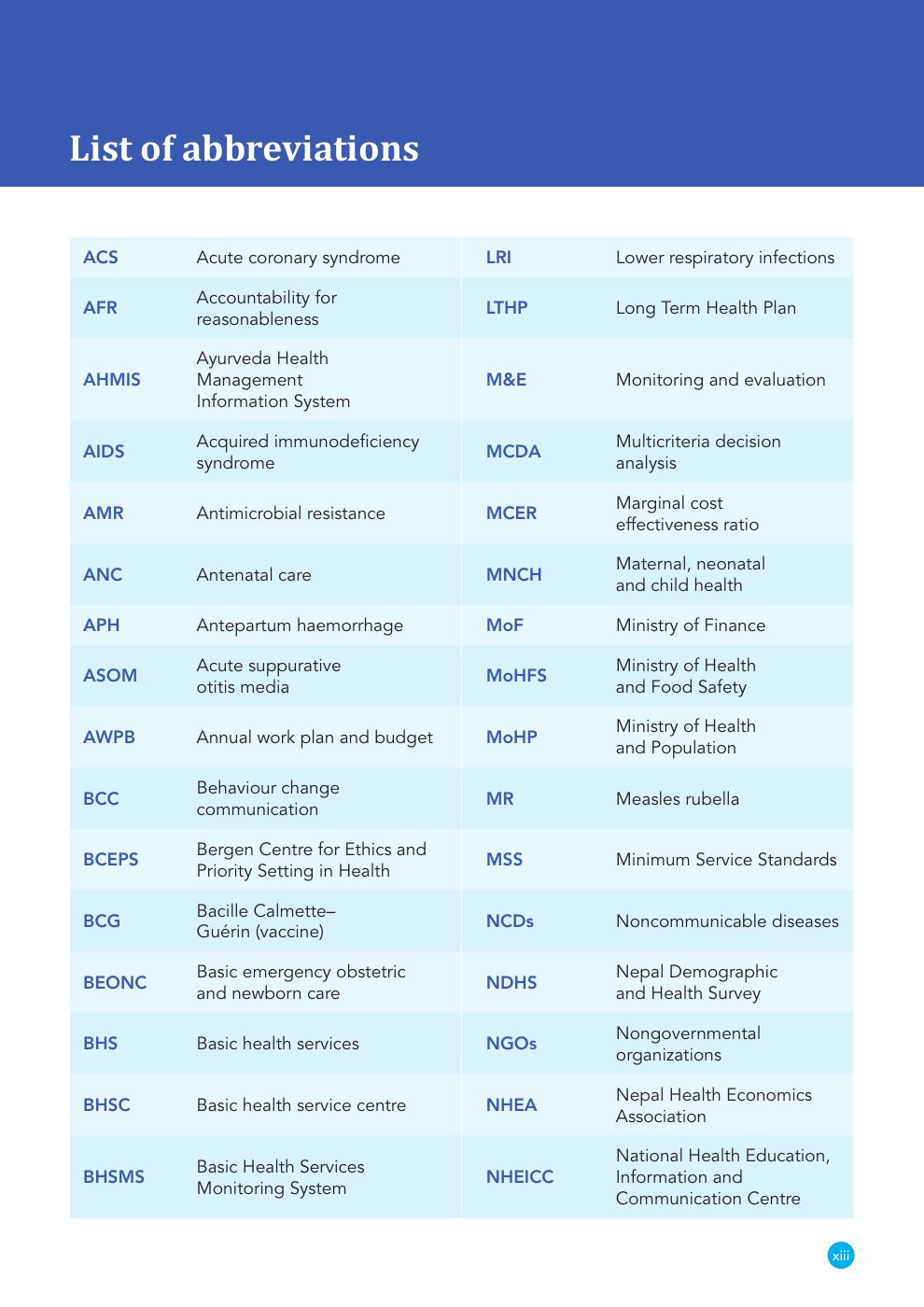
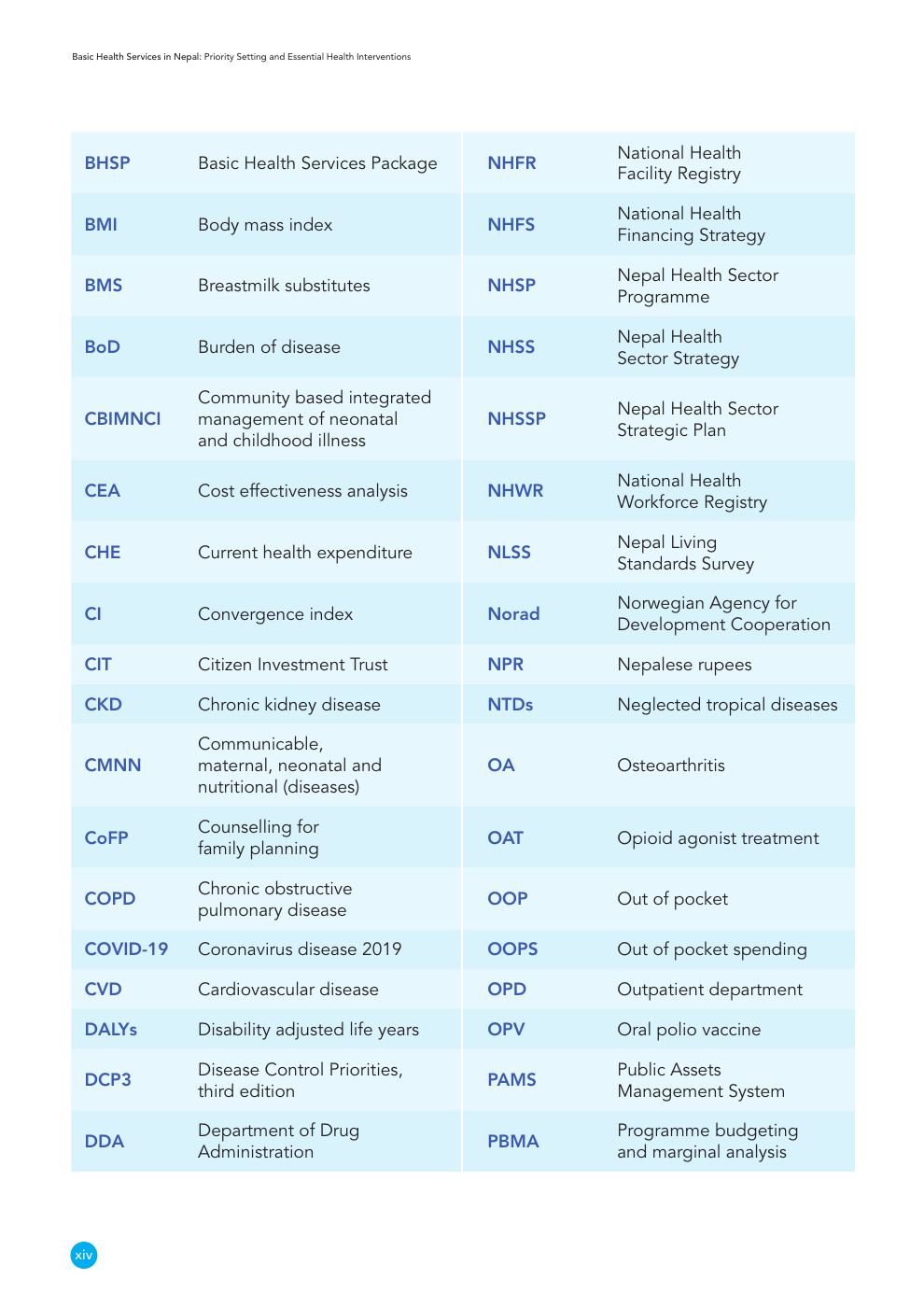
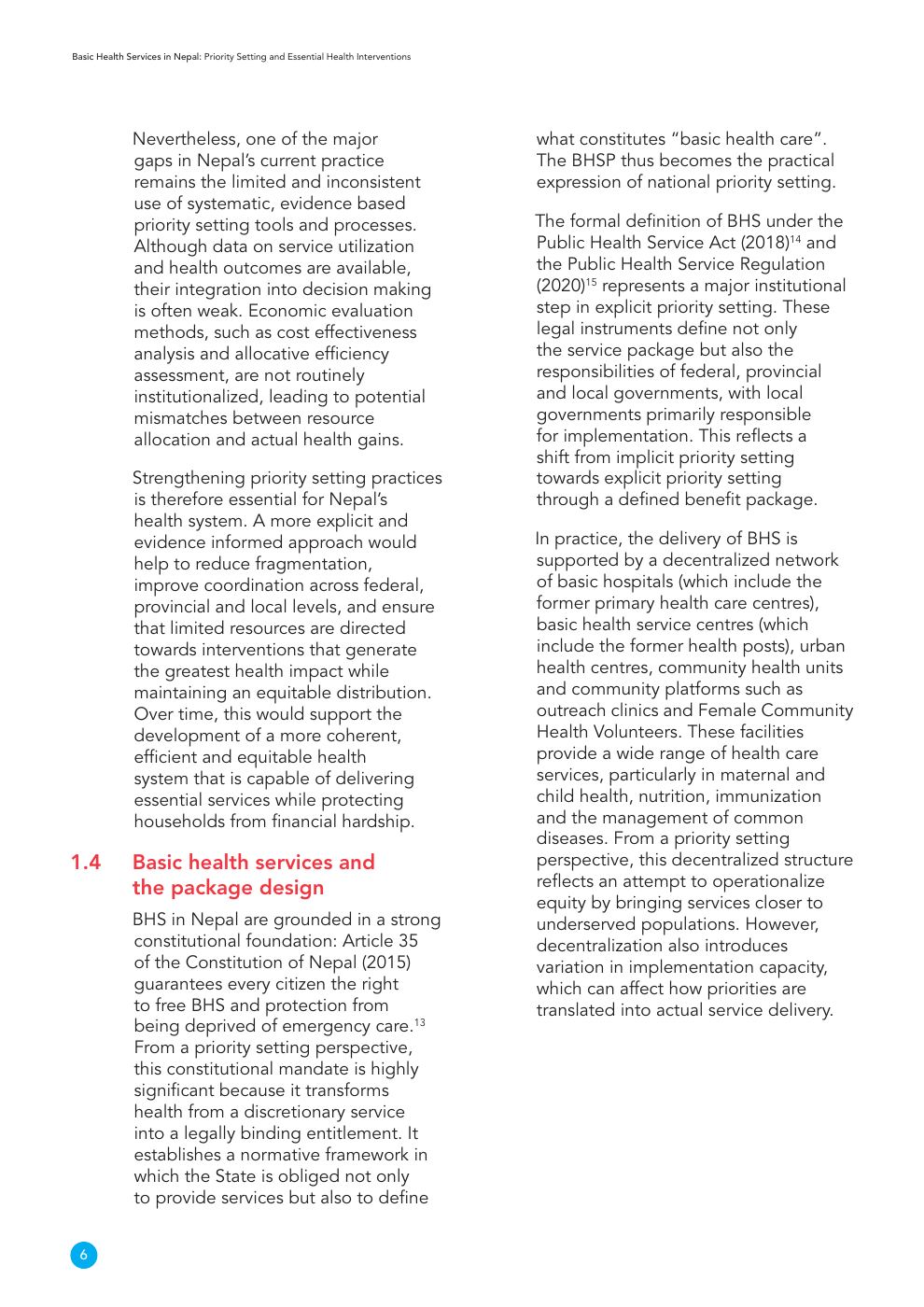
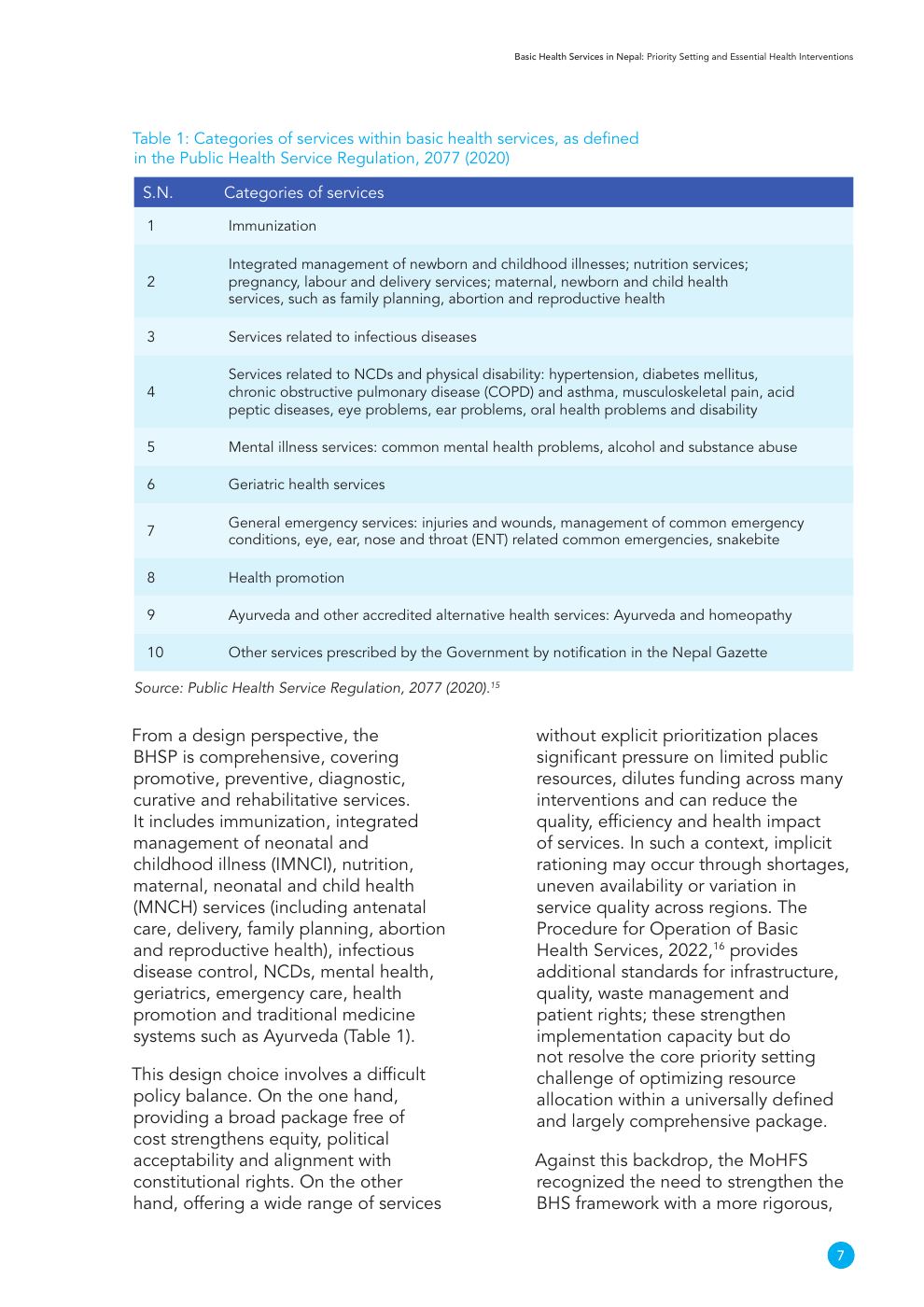
Showing the first 30 of 219 pages. Open the full PDF
Documents 1
- Technical Report_Basic Health Services_Priority Setting and essential health interventions_gpxujdd.pdfPDF · 219 pages · 8.4 MBDownload
Text extracted from the PDF: Technical Report_Basic Health Services_Priority Setting and essential health interventions_gpxujdd.pdf
Machine-extracted for search and accessibility. It may contain errors and is not the official text; the attached document is the authoritative version.
Basic Health Services in Nepal: Priority Setting and Essential Health Interventions

BASIC HEALTH SERVICES IN NEPAL
Priority Setting and Essential Health Interventions

Technical Report
November 2026

Government of Nepal

Ministry of Health and Food Safety
Singhadurbar, Kathmandu

i

Basic Health Services in Nepal: Priority Setting and Essential Health Interventions

Published by
Government of Nepal
Ministry of Health and Food Safety
Kathmandu, Nepal
In collaboration with
Bergen Centre for Ethics and Priority Setting in Health (BCEPS), University of Bergen, Norway
with technical support from the
Nepal Health Economics Association (NHEA)
Recommended Citation
Ministry of Health and Food Safety, Bergen Centre for Ethics and Priority Setting in Health, Nepal
Health Economics Association. Basic health services in Nepal: priority setting and essential health
interventions. Kathmandu (Nepal): Ministry of Health and Food Safety; 2026. [Technical report].

ii

Basic Health Services in Nepal: Priority Setting and Essential Health Interventions

Message
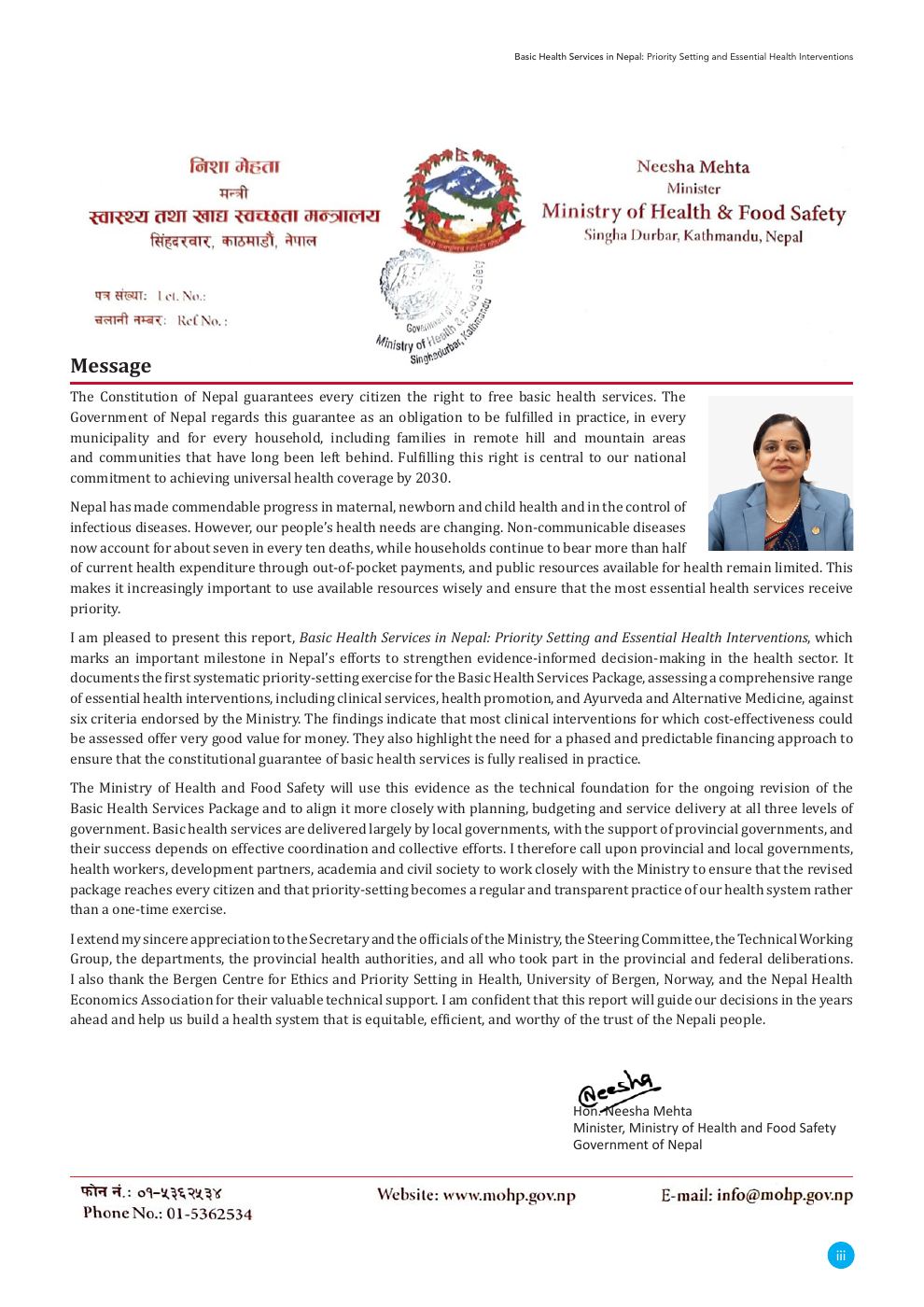
The Constitution of Nepal guarantees every citizen the right to free basic health services. The
Government of Nepal regards this guarantee as an obligation to be fulfilled in practice, in every
municipality and for every household, including families in remote hill and mountain areas
and communities that have long been left behind. Fulfilling this right is central to our national
commitment to achieving universal health coverage by 2030.

Nepal has made commendable progress in maternal, newborn and child health and in the control of
infectious diseases. However, our people’s health needs are changing. Non-communicable diseases
now account for about seven in every ten deaths, while households continue to bear more than half
of current health expenditure through out-of-pocket payments, and public resources available for health remain limited. This
makes it increasingly important to use available resources wisely and ensure that the most essential health services receive
priority.

I am pleased to present this report, Basic Health Services in Nepal: Priority Setting and Essential Health Interventions, which
marks an important milestone in Nepal’s efforts to strengthen evidence-informed decision-making in the health sector. It
documents the first systematic priority-setting exercise for the Basic Health Services Package, assessing a comprehensive range
of essential health interventions, including clinical services, health promotion, and Ayurveda and Alternative Medicine, against
six criteria endorsed by the Ministry. The findings indicate that most clinical interventions for which cost-effectiveness could
be assessed offer very good value for money. They also highlight the need for a phased and predictable financing approach to
ensure that the constitutional guarantee of basic health services is fully realised in practice.

The Ministry of Health and Food Safety will use this evidence as the technical foundation for the ongoing revision of the
Basic Health Services Package and to align it more closely with planning, budgeting and service delivery at all three levels of
government. Basic health services are delivered largely by local governments, with the support of provincial governments, and
their success depends on effective coordination and collective efforts. I therefore call upon provincial and local governments,
health workers, development partners, academia and civil society to work closely with the Ministry to ensure that the revised
package reaches every citizen and that priority-setting becomes a regular and transparent practice of our health system rather
than a one-time exercise.
I extend my sincere appreciation to the Secretary and the officials of the Ministry, the Steering Committee, the Technical Working
Group, the departments, the provincial health authorities, and all who took part in the provincial and federal deliberations.
I also thank the Bergen Centre for Ethics and Priority Setting in Health, University of Bergen, Norway, and the Nepal Health
Economics Association for their valuable technical support. I am confident that this report will guide our decisions in the years
ahead and help us build a health system that is equitable, efficient, and worthy of the trust of the Nepali people.

 Hon. Neesha Mehta

Minister, Ministry of Health and Food Safety

Government of Nepal

iii

Basic Health Services in Nepal: Priority Setting and Essential Health Interventions

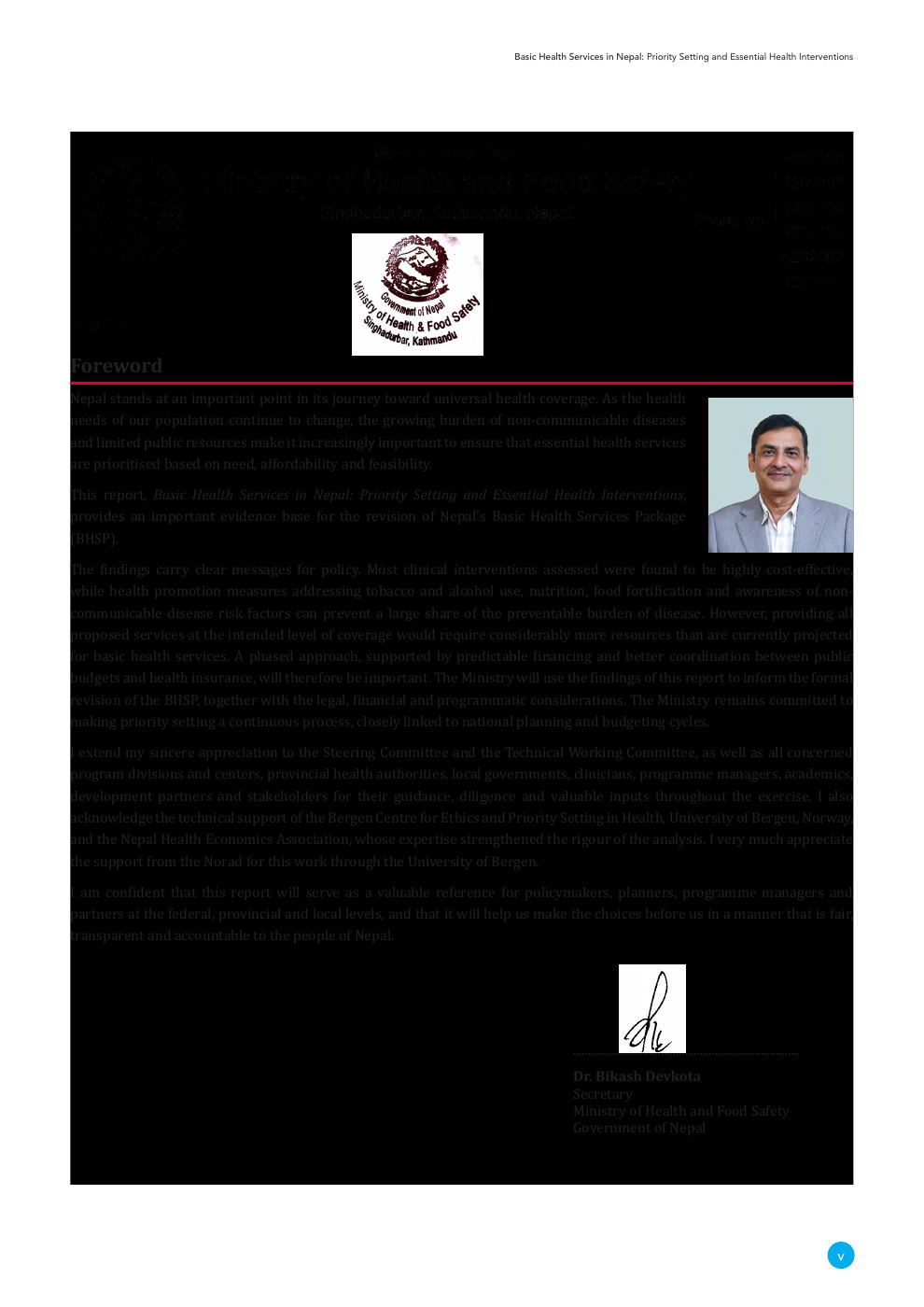
Foreword
Nepal stands at an important point in its journey toward universal health coverage. As the health
needs of our population continue to change, the growing burden of non-communicable diseases
and limited public resources make it increasingly important to ensure that essential health services
are prioritised based on need, affordability and feasibility.
This report, Basic Health Services in Nepal: Priority Setting and Essential Health Interventions,
provides an important evidence base for the revision of Nepal’s Basic Health Services Package
(BHSP).

The findings carry clear messages for policy. Most clinical interventions assessed were found to be highly cost-effective,
while health promotion measures addressing tobacco and alcohol use, nutrition, food fortification and awareness of noncommunicable disease risk factors can prevent a large share of the preventable burden of disease. However, providing all
proposed services at the intended level of coverage would require considerably more resources than are currently projected
for basic health services. A phased approach, supported by predictable financing and better coordination between public
budgets and health insurance, will therefore be important. The Ministry will use the findings of this report to inform the formal
revision of the BHSP, together with the legal, financial and programmatic considerations. The Ministry remains committed to
making priority setting a continuous process, closely linked to national planning and budgeting cycles.

I extend my sincere appreciation to the Steering Committee and the Technical Working Committee, as well as all concerned
program divisions and centers, provincial health authorities, local governments, clinicians, programme managers, academics,
development partners and stakeholders for their guidance, diligence and valuable inputs throughout the exercise. I also
acknowledge the technical support of the Bergen Centre for Ethics and Priority Setting in Health, University of Bergen, Norway,
and the Nepal Health Economics Association, whose expertise strengthened the rigour of the analysis. I very much appreciate
the support from the Norad for this work through the University of Bergen.
I am confident that this report will serve as a valuable reference for policymakers, planners, programme managers and
partners at the federal, provincial and local levels, and that it will help us make the choices before us in a manner that is fair,
transparent and accountable to the people of Nepal.

 ...........................................................................

Dr. Bikash Devkota
 Secretary

Ministry of Health and Food Safety

Government of Nepal

v

Basic Health Services in Nepal: Priority Setting and Essential Health Interventions

UNIVERSITY OF BERGEN
Department
Primary Care
U
N I VCentre
E RofSGlobal
I TEthics
Y Public
O and
F BHealth
E R Gand
EN
Bergen
for
Priority
Setting
in Health (BCEPS)

Department of Global Public Health and Primary Care
Bergen Centre for Ethics and Priority Setting in Health (BCEPS)

Message
Message

It has been a privilege for the Bergen Centre for Ethics and Priority Setting in Health (BCEPS), FairChoices
Research,
University
Bergen,
to Centre
accompany
Ministry
Health
andinFood
Safety
(MoHFS)
in
this
It has
been
privilegeofor the
Bergen
Ethics
Priority
Setting
Health
(BCEPS),
FairChoices
been a
forthe
and of
Setting
(BCEPS),
FairChoices
Research,
University
of
Bergen,
to
accompany
the
Ministry
of
Health
and
Food
Safety
(MoHFS)
in
this
priority
setting
exercise
for
the
Basic
Health
Services
Package.
The
Constitution
of
Nepal
promises
free
basic
Research, University of Bergen, to accompany the Ministry of Health and Food Safety (MoHFS) in this
priority
setting
exercise
for
the
Basic
Health
Services
Package.
The
Constitution
of
Nepal
promises
health
to every for
citizen.
Honouring
promise
withinThe
limited
resources
requires
choices.free
Thebasic
real
priorityservices
setting exercise
the Basic
Healththat
Services
Package.
Constitution
of Nepal
promises
free basic health services to every citizen. Honouring that promise within limited resources requires
question The
is
not
whether
such
choices
arethat
made,
but within
whether
theybut
are
maderequires
openly,
on
the The
basis
of
health
services
to every
citizen.
Honouring
promise
limited
resources
choices.
real
choices.
real
question
is not
whether
such
choices
are made,
whether
they are
made
openly,
evidence,
and
with
fairness
to
those
whose
needs
are
greatest.
This
report,
Basic
Health
Services
in
Nepal:
on
the
basis
of
evidence,
and
with
fairness
to
those
whose
needs
are
greatest.
This
report,
Basic
Health
question is not whether uch choices are made, but whether they are made openly, on the basis of
Services
inand
Nepal:Priority
Essential
Health
Interventions,
shows
how that
can be
done.
Priority
Setting
and fairness
EssentialSetting
Interventions,
shows
how
that
be done.
evidence,
with
toHealth
thoseand
whose
needs are
greatest.
Thiscan
report,
Basic Health
Services
in Nepal:
Priority
Setting
and Essential
Health
Interventions,
shows
thatEvery
can bestep,
done.
The Nepal
exercise
stands out
for the
leadership of
the how
MoHFS.
from the initial roadmap to

The Nepal exercise stands out for the leadership of the MoHFS. Every step, from the initial roadmap to
validation
of the
the final
finalstands
package,
decided
through
own
Committee
Technical
The
Nepalof
exercise
out was
for
leadership
ofthe
theMinistry’s
MoHFS.
step,
from
the
initialand
roadmap
to
validation
package,
wasthe
decided
through
the
Ministry’sEvery
own Steering
Steering
Committee
and
Technical
Working
Group
and
anchored
in
six
priority-setting
criteria
that
the
Ministry
had
endorsed.
A
national
Working
Group
and
anchored
in
six
priority-setting
criteria
that
the
Ministry
had
endorsed.
A
national
validation of the final package, was decided through the Ministry’s own Steering Committee and Technical
technical
team
the
FairChoices
Analytics Tool
Toolcriteria
and local
local
parameters
to
estimate
Nepal-specific
technical
team used
usedanchored
the FairChoices
Analytics
and
estimate
Nepal-specific
Working Group
and
in six priority-setting
that parameters
the Ministryto
had
endorsed.
A national
evidence for many of the 224 candidate health interventions and care pathways. As the data allowed, this
evidence
for
many
of
the
224
candidate
health
interventions
and
care
pathways.
As
the
data
allowed,
this
technical
team evidence
used the against
FairChoices
Analytics That
Tool evidence
and localcovered
parameters
estimate
Nepal-specific
team
produced
each criterion.
healthtoeffects,
cost-effectiveness,
team
produced
evidence
against
each
evidence
covered
health
effects,
cost-effectiveness,
evidence
for many
theseverity
224
candidate
health That
interventions
and
care
pathways.
As
the data
this
budget
impact
andof
the
of
thecriterion.
conditions
addressed,
and
it was
then examined
in allowed,
deliberations
budget
impact
and
the
severity
of
the
conditions
addressed,
and
it
was
then
examined
in
deliberations
at
at
provincial
and
federal
levels.
Quantitative
evidence
of
this
kind
makes
trade-offs
explicit,
which
team produced evidence against each criterion. That evidence covered health effects, cost-effectiveness,
strengthens
both
the
legitimacy
of
decisions
and
accountability
for
them.
The
results
are
encouraging.
provincial
and federal
Quantitative
evidenceaddressed,
of this kindand
makes
trade-offs
xplicit, which
strengthens
budget impact
and thelevels.
severity
of the conditions
it was
then examined
in deliberations
at
Most of the services that could be modelled offer excellent value for money, and a relatively small share of
both
the
legitimacy
of
decisions
and
accountability
for
them.
The
results
are
encouraging.
Most
of the
provincial
and
federal
levels.
Quantitative
evidence
of
this
kind
makes
trade-offs
explicit,
which
strengthens
the additional cost delivers most of the health gain.

services
could be
modelledand
offer
excellent value
for money,
and a are
relatively
small share
the
both the that
legitimacy
of decisions
accountability
for them.
The results
encouraging.
Most of
of the

The report is equally candid that the full package cannot be afforded at once and must be phased as fiscal
additionalthat
cost delivers
of the health gain.
services
be most
modelled
excellent contribution,
value for money,
andaapackage
relativelythat
small
share of the
space
grows. could
That honesty
is itselfoffer
an important
because
is affordable
and
additional
cost
delivers
most
of
the
health
gain.
predictably
financed
will
do
more
for
the
people
of
Nepal
than
one
that
promises
everything.
However,
The report is equally candid that the full package cannot be afforded at once and must be phased as fiscal
high coverage and high quality for all of the 131 health services that are assigned high priority in this revised
space
grows.
That honesty
isthat
itself
important
contribution,
because
a package
thatbeis phased
affordable
and
The report
is equally
thean
package
cannot
be afforded
once
and must
fiscal
BHS
and planned
to candid
be scaled
up
infull
a first
phase,
is essential.
The at
high-priority
services
cover as
RMNCH
predictably
financed will
do
for
people
than
one
thata
promises that
everything.
However,
(n=48),
communicable
diseases
(n=38),
NCDs
andof Nepal
disabilities
(n=23),
immunization
(n=12),
mental
health
space
grows.
That
honesty
ismore
itself
an the
important
contribution,
because
package
is
affordable
and
(n=12),
and
emergency
care
(n=3).
Universal
and
fair
health
coverage
of
these
high-priority
interventions
high
coverage
and
high
quality
for
all
of
the
131
health
services
that
are
assigned
high
priority
in
this
revised
predictably financed will do more for the people of Nepal than one that promises everything. However,
will
health
inaNepal.
BHSsubstantially
and planned improve
to be scaled
up in
first phase, is essential. The high-priority services cover RMNCH (n=48),

high coverage and high quality for all of the 131 health services that are assigned high priority in this revised

For
the work
Nepal
has
been
one is
ofessential.
mutual
learning.
The ten-step
method
for
fair (n=12),
priority
communicable
iseases
(n=38),
NCDs
and
disabilities
(n=23),
immunization
(n=12),
mentalRMNCH
health
BHS BCEPS,
and
planned
to
be incaled
up in
a first
phase,
The
high-priority
services
cover
(n=48),
setting,
first
developed
with
Zanzibar,
was
adapted
here
to
a
federal
system
in
which
local
governments
and
emergencydiseases
care (n=3).
Universal
anddisabilities
fair health(n=23),
coverage
of these high-priority
interventions
will
communicable
(n=38),
NCDs and
immunization
(n=12), mental
health (n=12),
deliver most basic health services. The lessons from Nepal will inform our work with ministries of health in
substantially
improve
health in
Nepal. and fair health coverage of these high-priority interventions will
and
emergency
care (n=3).
Universal
other
countries.

substantially improve health in Nepal.

BCEPS, the
work
has been
one ofthe
mutual
learning.
method
fair of
priority
IFor
sincerely
thank
thein Nepal
Honourable
Minister,
Secretary,
andThe
theten-step
leadership
and for
officials
the setting,
MoHFS,
as
well
as
the
members
of
the
Steering
Committee
and
the
Technical
Working
Group,
for
their
trust,
first
developed
with
Zanzibar,
was
adapted
here
to
a
federal
system
in
which
local
governments
deliver
For BCEPS, the work in Nepal has been one of mutual learning. The ten-step method for fair priority setting,
guidance
and
commitment.
My
thanks
also
go
to
the
Department
of
Health
Services
and
its
divisions
most
basic health
services.
Thewas
lessons
from here
Nepaltowill
inform system
our work
ministries
of health indeliver
other
first centres,
developed
Zanzibar,
adapted
a federal
in with
which
localhealth
governments
and
thewith
Department
of Ayurveda
and Alternative
Medicine, the
provincial
authorities, and
countries.
most
basicwho
health
services.
from Nepal
inform our
work with
ministries
of health
in other
everyone
took
part inThe
thelessons
deliberations.
I amwill
especially
grateful
to the
Nepal Health
Economics
Association,
our in
partner,
which carried
much ofand
the the
day-to-day
coordination,
collection
countries.
I sincerely thank
thecountry
Honourable
Minister,
the Secretary,
leadership
and officialsdata
of the
MoHFS,and
as
analysis, and without which this exercise would not have been possible. I am also happy to welcome the
well
as
the
members
of
the
Steering
Committee
and
the
Technical
Working
Group,
for
their
trust,
guidance
I sincerely
the School
Honourable
Minister, the
Secretary,
leadership
officials
of the MoHFS,
as
Kathmanduthank
University
of Medical
Sciences,
which and
will the
join the
Nepal and
Health
Economics
Association
and
commitment.
also
go to
the
Department
of go
Health
Services
and
its for
divisions
and
centres,
the
as
a as
partner
in
the My
next
phase of
the
project.
Further
thanks
to The
Norwegian
Agency
Development
well
the
members
ofhanks
the
Steering
Committee
and the
Technical
Working
Group,
theirfor
trust,
guidance
Cooperation
(Norad)
making
funding
tothe
BCEPS
andServices
for its
continued
engagement
in project
Department
of
Ayurveda
and
Alternative
Medicine,
health
authorities,
and
everyone
who
and commitment.
My for
thanks
also
go to theavailable
Department
ofprovincial
Health
and
its divisions
and
centres,
the
activities. I also gratefully acknowledge the Research Council of Norway for its Centres of Excellence grant
took
part
in
the
deliberations.
I
am
especially
grateful
to
the
Nepal
Health
Economics
Association,
our
inDepartment
of Ayurveda
Alternative
Medicine, Centre
the provincial
health authorities,
and everyone
who
and
continued
support toand
BCEPS
as a Norwegian
of Excellence.
BCEPS remains
committed
to
country
partner,
which
carriedI
much
the Health
day-to-day
coordination,
data
collection
analysis,
and
took
part in
theMinistry
deliberations.
am
especially
grateful
to
the Nepal
Health
Economics
Association,
insupporting
the
as it
revises
theof
Basic
Services
Package
and
makes
priorityand
setting
a our
regular,
without
this
exercise
would
notof
have
possible.
I am also happy
to welcome
theanalysis,
Kathmandu
country which
partner,
which
carried
much
thebeen
day-to-day
coordination,
data collection
and
and
without which this exercise would not have been possible. I am also happy to welcome the Kathmandu
Email: bceps@uib.no

Twitter | Facebook

Post Box 7804

Overlege Danielssens hus

www.uib.no/en/bceps
Email: bceps@uib.no

@BCEPShealth
Twitter | Facebook

N-5020
Post
BoxBergen
7804

Årstadveien
21, 5020 Bergen
Overlege Danielssens
hus

www.uib.no/en/bceps

@BCEPShealth

N-5020 Bergen

Årstadveien 21, 5020 Bergen

vii

Basic Health Services in Nepal: Priority Setting and Essential Health Interventions

UNIVERSITY OF BERGEN
Department
Primary Care
U
N I VCentre
E RofSGlobal
I TEthics
Y Public
O and
F BHealth
E R Gand
EN
Bergen
for
Priority
Setting
in Health (BCEPS)

Department of Global Public Health and Primary Care
Bergen Centre for Ethics and Priority Setting in Health (BCEPS)

Message
transparent function of the health system. I hope this report serves the Ministry well in the choices ahead and
Message
that Nepal’s experience proves useful to other countries working towards universal health coverage. I look
It has
been to
a privilege
Centre
for Ethics
andover
Priority
Setting
Health
FairChoices
forward
working for
withthe
the…Reading is open to everyone. Sign in to react, comment or save.
Related updates
All updates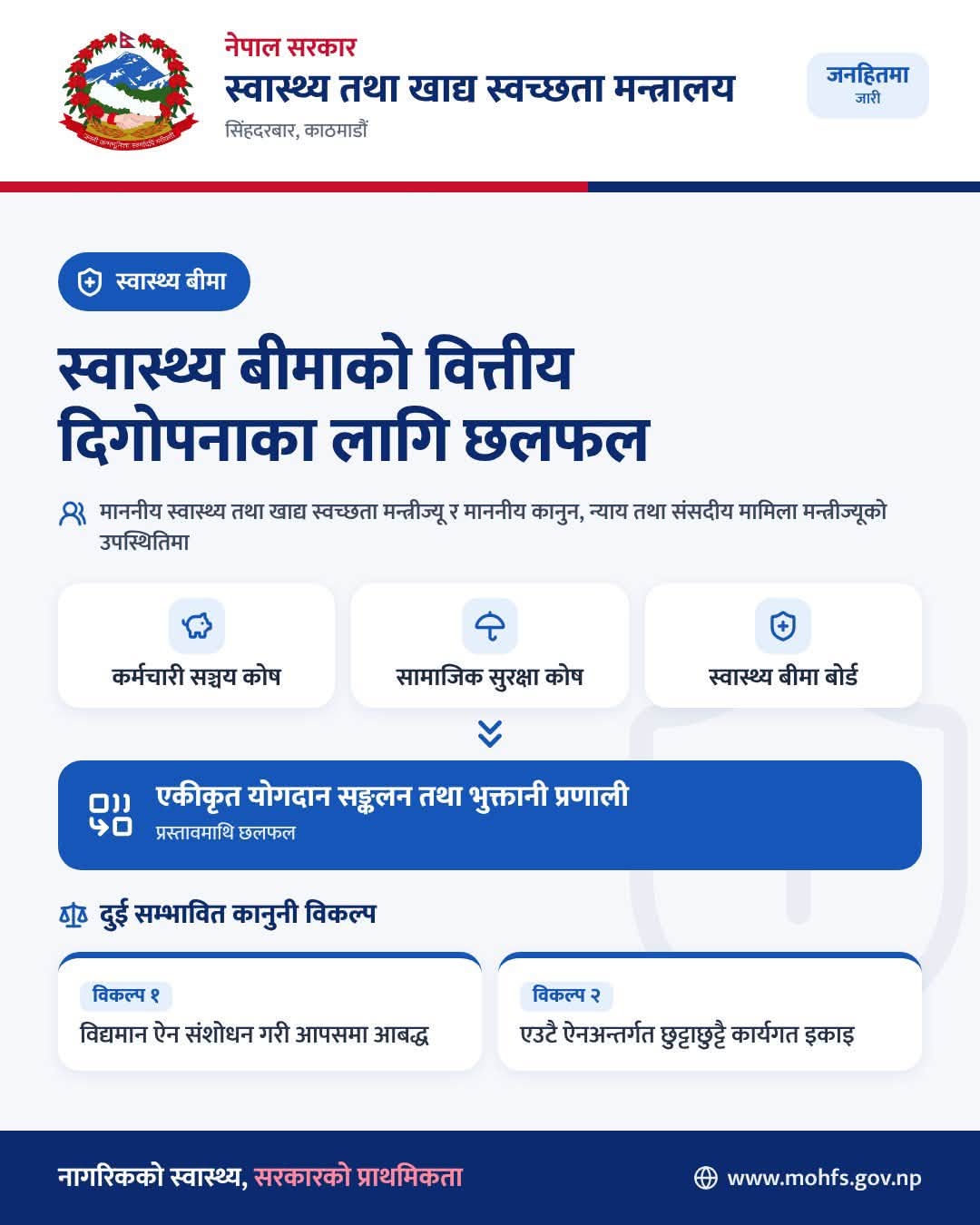
राष्ट्रिय स्वास्थ्य बीमा कार्यक्रमको वित्तीय दिगोपना तथा योगदान सङ्कलन र सेवा भुक्तानी प्रणालीलाई थप व्यवस्थित र प्रभावकारी बनाउने सम्बन्धमा छलफल
राष्ट्रिय स्वास्थ्य बीमा कार्यक्रमको वित्तीय दिगोपना सुनिश्चित गर्दै योगदान सङ्कलन तथा सेवा भुक्तानी प्रणालीलाई थप व्यवस्थित र प्रभावकारी बनाउने विषयमा छलफल भएको छ। छलफलमा माननीय…
New 3 images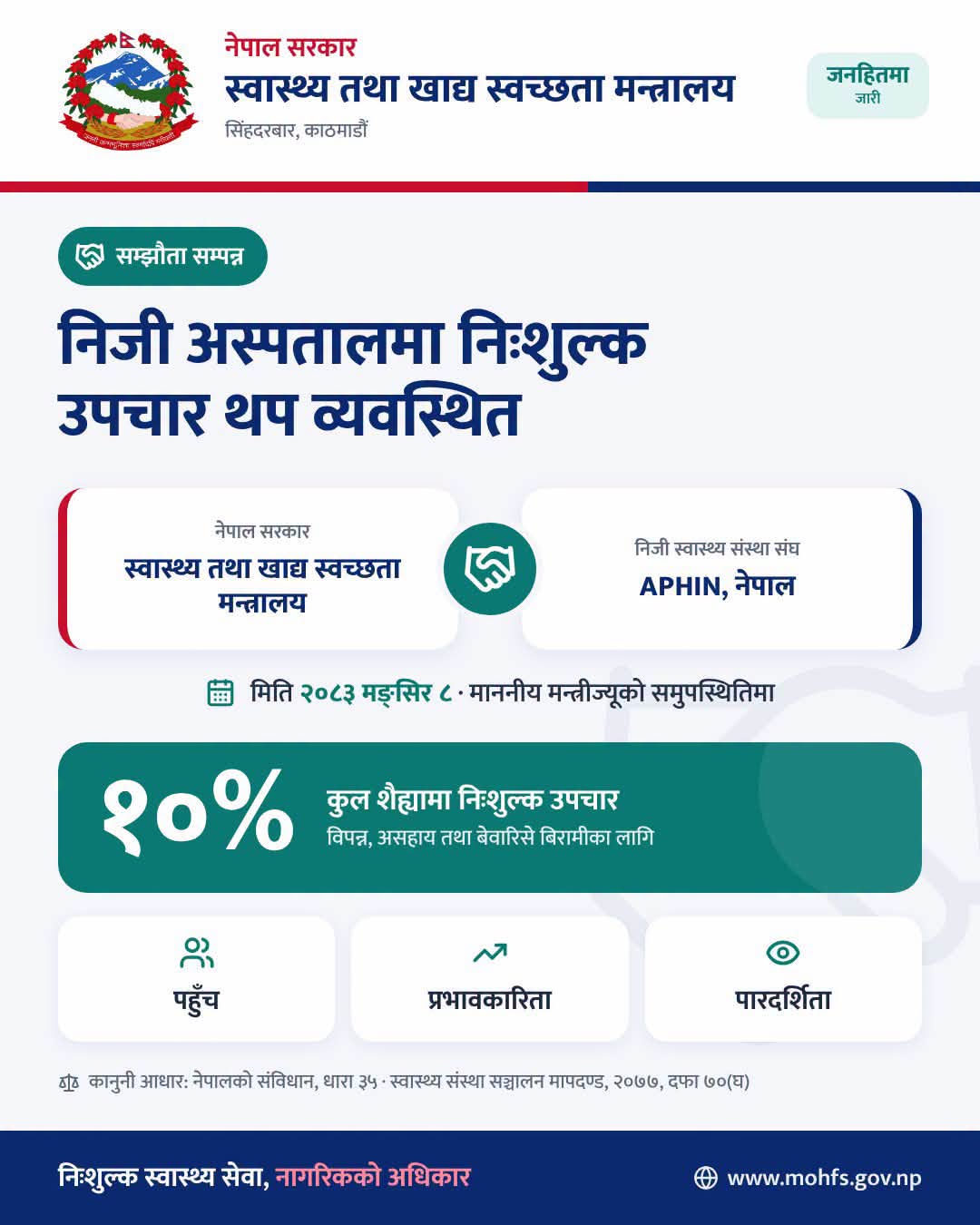
निःशुल्क स्वास्थ्य उपचार सेवा कार्यान्वयनका लागि स्वास्थ्य तथा खाद्य स्वच्छता मन्त्रालय र निजी स्वास्थ्य संस्था संघ (APHIN), नेपालबीच सम्झौता
नेपालको संविधान, २०७२ को धारा ३५ ले प्रत्येक नागरिकलाई आधारभूत स्वास्थ्य सेवा निःशुल्क प्राप्त गर्ने तथा स्वास्थ्य सेवामा समान पहुँचको हक सुनिश्चित गरेको छ। साथै, स्वास्थ्य संस्था…
New 2 images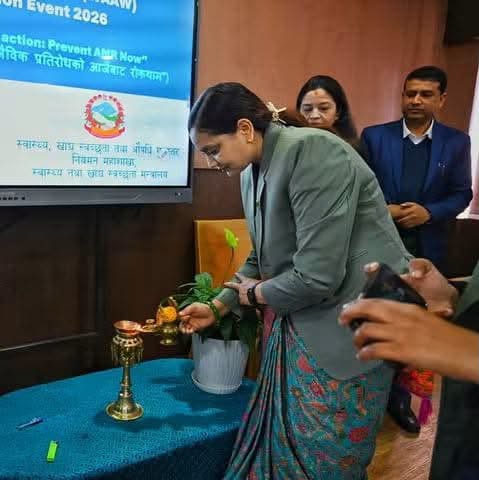
विश्व प्रतिजैविक प्रतिरोध सचेतना सप्ताह, २०२६
“एक स्वास्थ्य, एक कार्य: अहिले नै प्रतिजैविक प्रतिरोध रोकथाम गरौँ।” (One Health, One Action: Prevent AMR Now) विश्व प्रतिजैविक प्रतिरोध सचेतना सप्ताह, २०२६ को अवसरमा नेपाल सरकार,…
5 imagesविश्व प्रतिजैविक प्रतिरोध सचेतना सप्ताह, २०२६ को संयुक्त शुभकामना सन्देश ।
विश्व प्रतिजैविक प्रतिरोध सचेतना सप्ताह, २०२६ को संयुक्त शुभकामना सन्देश ।
1 imageजेन्जी घाईतेहरुको उपचारको सम्बन्धमा स्वास्थ्य तथा खाद्य स्वच्छता मन्त्रालयको अनुरोध ।
२०८२ भाद्र २३ र २४ गतेको जेन्जी आन्दोलनका क्रममा घाइते भएका व्यक्तिहरूको निःशुल्क उपचार नेपाल सरकारको निर्णय अनुरूप देशभरका अस्पतालहरूबाट उपलब्ध हुँदै आएको छ। घाइते भएका…
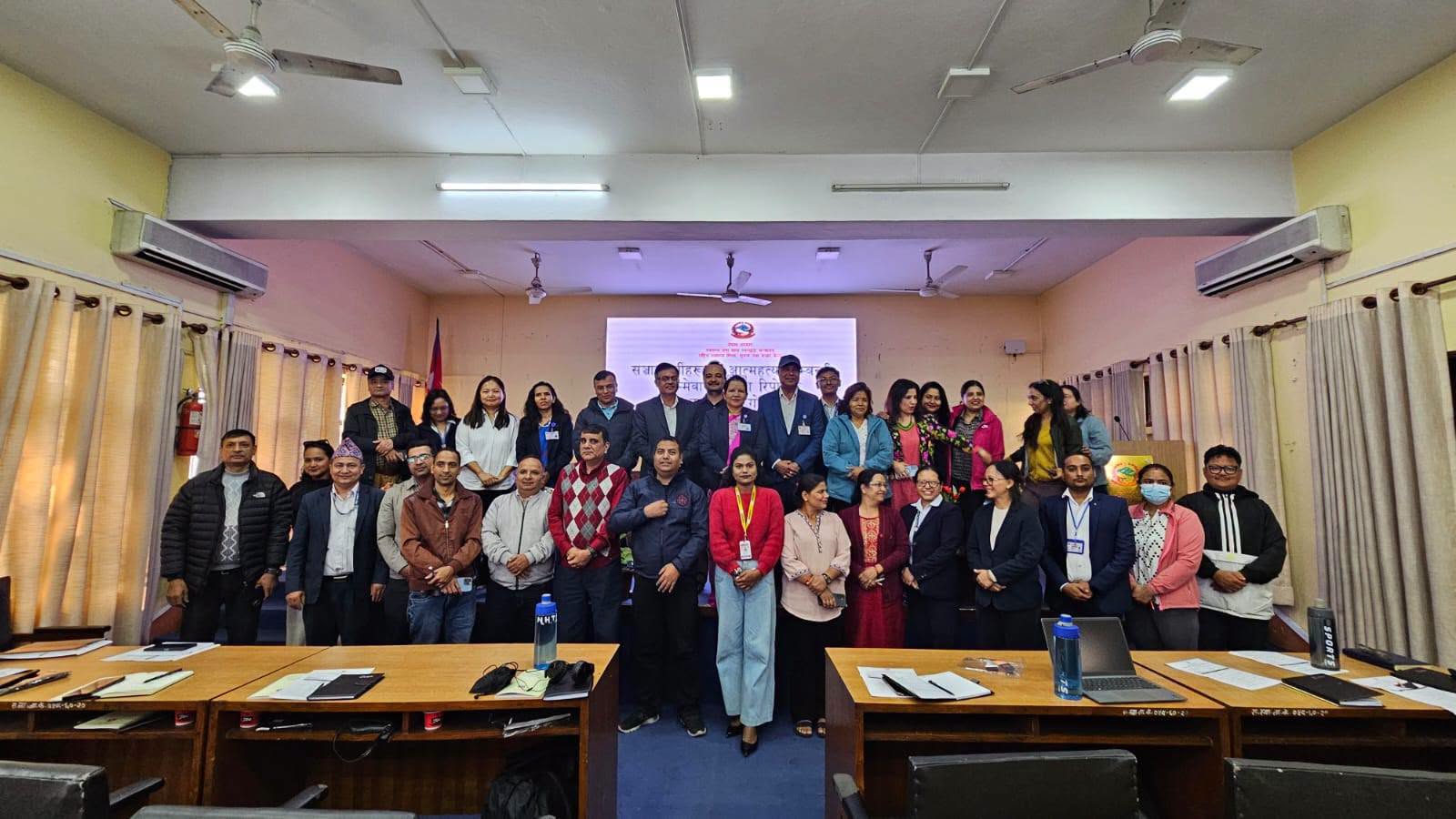
आत्महत्यासम्बन्धी जिम्मेवार रिपोर्टिङका लागि सञ्चारकर्मीलाई अभिमुखीकरण
मानसिक स्वास्थ्य र आत्महत्या रोकथामलाई प्राथमिकतामा राख्दै स्वास्थ्य तथा खाद्य स्वच्छता मन्त्रालयले सञ्चारकर्मीलाई आत्महत्यासम्बन्धी जिम्मेवार मिडिया रिपोर्टिङका लागि अभिमुखीकरण…
3 images
Comments 0
No comments yet. Start a respectful conversation.