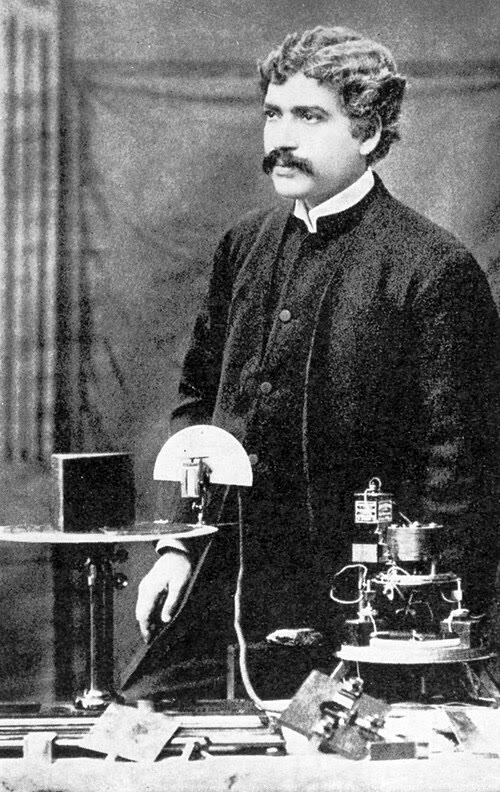
Jagadish Chandra Bose
डा. जगदीश चन्द्र बोस
Bengali polymath, physicist, and biologist (1858–1937)
नेपालीमा पढ्नुहोस् · हिंदी में पढ़ें
- नेपाली · English · हिंदीRead in your language
- CitedEvery fact sourced
- Ad-freeNo ads, no tracking
Sir Jagadish Chandra Bose (; IPA: [d͡ʒɔɡod̪iʃ t͡ʃɔn̪d̪ro boʃu]; 30 November 1858 – 23 November 1937) was a polymath with interests in biology, physics and writing science fiction. He was a pioneer in the investigation of radio microwave optics, made significant contributions to botany, and was a major force behind the expansion of experimental science on the Indian subcontinent. Bose is considered the father of Bengali science fiction. A crater on the Moon was named in his honour. He founded the Bose Institute, a premier research institute in India and also one of its oldest. Established in 1917, the institute was the first interdisciplinary research centre in Asia. He served as the Director of Bose Institute from its inception until his death.
Quick facts
- Born
- wd
- Place of birth
- Bikrampur wd
- Died
- wd
- Place of death
- Giridih wd
- Citizenship
- British Raj wd
- Occupation
- botanist, university teacher, physicist, archaeologist, writer, chemist wd
- Education
- Christ's College, University College London, St. Xavier's College, Kolkata, Hare School, University of London, St. Xavier's Collegiate School, Dhaka Collegiate School, Mymensingh Zilla School wd
- Spouse
- Abala Bose wd
Awards wd
- Fellow of the Royal Society
- Companion of the Order of the Indian Empire (1903)
- Companion of the Order of the Star of India (1912)
- honorary doctor of the University of Calcutta
- Knight Bachelor
About
Born in Mymensingh, Bengal Presidency (present-day Bangladesh), during British governance of India, Bose graduated from St. Xavier's College, Calcutta (now Kolkata, West Bengal, India). Prior to his enrollment at St. Xavier's College, Calcutta, Bose attended Pabna Zilla School and Dhaka Collegiate School, where he began his educational journey. He attended the University of London to study medicine, but had to give it up due to health problems. Instead, he conducted research with Nobel Laureate, Lord Rayleigh at the University of Cambridge. Bose returned to India to join the Presidency College of the University of Calcutta as a professor of physics. There, despite racial discrimination and a lack of funding and equipment, Bose carried on his scientific research. He made progress in his research into radio waves in the microwave spectrum and was the first to use semiconductor junctions to detect radio waves.
Bose made pioneering discoveries in plant physiology. He used his own invention, the crescograph, to measure plant response to various stimuli and proved parallelism between animal and plant tissues. Bose filed for a…
People also search for
 Srinivasa Ramanujan
 C. V. Raman
 Homi J. Bhabha
 Albert Einstein
 Marie Curie
 Isaac Newton
 Charles Darwin
 Nikola Tesla
 Galileo Galilei
 Ada Lovelace
 Alan Turing
 Rosalind Franklin
Questions
- When was Jagadish Chandra Bose born?
- Jagadish Chandra Bose was born on 30 November 1858 in Bikrampur.
- Where did Jagadish Chandra Bose study?
- Jagadish Chandra Bose was educated at Christ's College, University College London, St. Xavier's College, Kolkata, Hare School.
Sources
- Wikipedia (English): Jagadish Chandra Bose · CC BY-SA 4.0
- Wikipedia (Nepali): डा. जगदीश चन्द्र बोस · CC BY-SA 4.0
- Wikidata item Q314267 · CC0 1.0
- Image: J.C.Bose.JPG by The Birth Centenary Committee, printed by P.C. Ray (Public domain)

Last updated · facts checked 5 November 2026
Cite this page
"Jagadish Chandra Bose". DigiNepal. Last updated 31 October 2026. https://diginpl.com/people/jagadish-chandra-bose. Retrieved 5 November 2026.
Is this you, or do you work in this person's office? Claim this profile