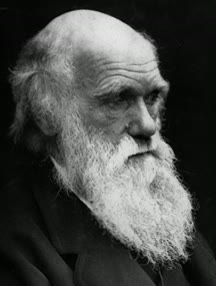
Charles Darwin
चार्ल्स डार्विन
English naturalist and biologist (1809–1882)
नेपालीमा पढ्नुहोस् · हिंदी में पढ़ें
- नेपाली · English · हिंदीRead in your language
- CitedEvery fact sourced
- Ad-freeNo ads, no tracking
Charles Robert Darwin ( DAR-win; 12 February 1809 – 19 April 1882) was an English naturalist, geologist, and biologist, widely known for his contributions to evolutionary biology. His proposition that all species have descended from a common ancestor is now accepted and considered a fundamental scientific concept. In a joint presentation with Alfred Russel Wallace, he proposed that this branching pattern of evolution resulted from a process he called natural selection, in which the struggle for existence has a similar effect to the artificial selection involved in selective breeding. Darwin has been described as one of the most influential figures in human history and was honoured by burial in Westminster Abbey.
Quick facts
- Born
- wd
- Died
- wd
- Place of death
- Down House wd
- Citizenship
- United Kingdom of Great Britain and Ireland wd
- Occupation
- geologist, explorer, travel writer, ethologist, naturalist, philosopher wd
- Education
- Christ's College, University of Edinburgh Medical School, Shrewsbury School, University of Cambridge, University of Edinburgh wd
- Spouse
- Emma Darwin wd
Awards wd
- Royal Medal (1853)
- Copley Medal (1864)
- Pour le Mérite for Sciences and Arts order (1868)
- Fellow of the Linnean Society of London
- Fellow of the Royal Geographical Society
- Fellow of the Royal Society
- Baly Medal (1879)
- Fellow of the Geological Society of London
- Bressa Prize (1875)
- Honorary doctor of Leiden University (1875)
- Wollaston Medal (1859)
- Honorary Fellow of the Royal Society Te Apārangi
About
Darwin's early interest in nature led him to neglect his medical education at the University of Edinburgh; instead, he helped Robert Edmond Grant to investigate marine invertebrates. His studies at the University of Cambridge's Christ's College from 1828 to 1831 encouraged his passion for natural science. However, it was his five-year voyage on HMS Beagle from 1831 to 1836 that established Darwin as an eminent geologist. The observations he made during his voyage supported Charles Lyell's concept of gradual geological change. The Voyage of the Beagle (1839), Darwin's travel journal, made him a popular author. His first scientific work was The Structure and Distribution of Coral Reefs (1842). Along with his work on barnacles, it won him the Royal Medal in 1853.
Puzzled by the geographical distribution of wildlife and fossils he collected on the voyage, Darwin began detailed investigations and, in 1838, devised his theory of natural selection. Although he discussed his ideas with several naturalists, he needed time for extensive research, and his geological work had priority. He was writing up his theory in 1858 when Wallace sent him an essay outlining the…
In the news All news →
People also search for
 Isaac Newton
 Ada Lovelace
 Alan Turing
 Rosalind Franklin
 Stephen Hawking
 Alexander Fleming
 Dorothy Hodgkin
 Jane Goodall
Questions
- When was Charles Darwin born?
- Charles Darwin was born on 12 February 1809.
- Where did Charles Darwin study?
- Charles Darwin was educated at Christ's College, University of Edinburgh Medical School, Shrewsbury School, University of Cambridge.
Sources
- Wikipedia (English): Charles Darwin · CC BY-SA 4.0
- Wikipedia (Nepali): चार्ल्स डार्विन · CC BY-SA 4.0
- Wikidata item Q1035 · CC0 1.0
- Image: Charles darwin.gif (CC BY-SA 3.0)

Last updated · facts checked 4 November 2026
Cite this page
"Charles Darwin". DigiNepal. Last updated 31 October 2026. https://diginpl.com/people/charles-darwin. Retrieved 5 November 2026.
Is this you, or do you work in this person's office? Claim this profile