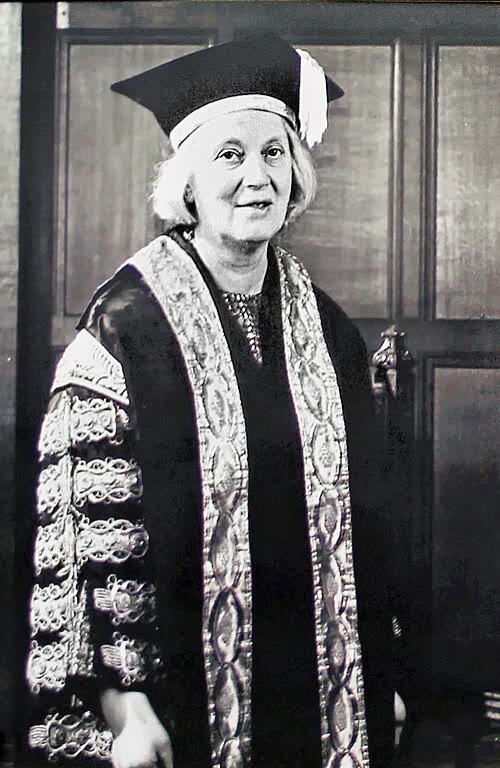
Dorothy Hodgkin
डोर्थी क्रोफट हडकिन
British chemist
नेपालीमा पढ्नुहोस् · हिंदी में पढ़ें
- नेपाली · English · हिंदीRead in your language
- CitedEvery fact sourced
- Ad-freeNo ads, no tracking
Dorothy Mary Crowfoot Hodgkin (née Crowfoot; 12 May 1910 – 29 July 1994) was an English chemist who advanced the technique of X-ray crystallography to determine the structure of biomolecules, which became essential for structural biology. She received the 1964 Nobel Prize in Chemistry, and is the only British woman scientist to have been awarded a Nobel Prize.
Quick facts
- Born
- wd
- Place of birth
- Cairo wd
- Died
- wd
- Place of death
- Ilmington wd
- Citizenship
- United Kingdom, United Kingdom of Great Britain and Ireland wd
- Occupation
- chemist, biochemist, crystallographer, biophysicist, physicist wd
- Education
- Somerville College, Newnham College, Sir John Leman High School, University of Oxford wd
- Spouse
- Thomas Lionel Hodgkin wd
Positions held wd
- Chancellor of the University of Bristol (1970–1988)
Awards wd
- Fellow of the Royal Society
- Nobel Prize in Chemistry (1964)
- Order of Merit (1965)
- Copley Medal (1976)
- Lomonosov Gold Medal (1986)
- Royal Medal (1956)
- Lenin Peace Prize
- Honorary doctor of the University of Zagreb
- Royal Society Bakerian Medal (1972)
- Fellow of the Royal Institute of Chemistry
- Banting Medal (1972)
- Fellow of the American Academy of Arts and Sciences
- Honorary Fellow of the Royal Society of Chemistry
- Austrian Decoration for Science and Art (1983)
- Baly Medal (1971)
About
Among her most influential discoveries are the confirmation of the structure of penicillin as previously surmised by Edward Abraham and Ernst Boris Chain; and mapping the structure of vitamin B12, for which in 1964 she became the third woman to win the Nobel Prize in Chemistry. Hodgkin also elucidated the structure of insulin in 1969 after 35 years of work.
Hodgkin used the name "Dorothy Crowfoot" until twelve years after marrying Thomas Lionel Hodgkin, when she began using "Dorothy Crowfoot Hodgkin". Hodgkin is referred to as "Dorothy Hodgkin" by the Royal Society (when referring to its sponsorship of the Dorothy Hodgkin fellowship), and by Somerville College. The National Archives of the United Kingdom refer to her as "Dorothy Mary Crowfoot Hodgkin". The case of her Nobel prize is inscribed 'Crowfoot Hodgkin'.
People also search for
 Paul Nurse
 Isaac Newton
 Charles Darwin
 Ada Lovelace
 Alan Turing
 Rosalind Franklin
 Stephen Hawking
 Alexander Fleming
 Jane Goodall
Questions
- When was Dorothy Hodgkin born?
- Dorothy Hodgkin was born on 12 May 1910 in Cairo.
- What positions has Dorothy Hodgkin held?
- Positions held by Dorothy Hodgkin include: Chancellor of the University of Bristol (1970–1988).
- Where did Dorothy Hodgkin study?
- Dorothy Hodgkin was educated at Somerville College, Newnham College, Sir John Leman High School, University of Oxford.
Sources
- Wikipedia (English): Dorothy Hodgkin · CC BY-SA 4.0
- Wikipedia (Nepali): डोर्थी क्रोफट हडकिन · CC BY-SA 4.0
- Wikidata item Q7487 · CC0 1.0
- Image: Professor Dorothy Hodgkin.jpg by University of Bristol (CC BY-SA 2.0)

Last updated · facts checked 5 November 2026
Cite this page
"Dorothy Hodgkin". DigiNepal. Last updated 31 October 2026. https://diginpl.com/people/dorothy-hodgkin. Retrieved 5 November 2026.
Is this you, or do you work in this person's office? Claim this profile