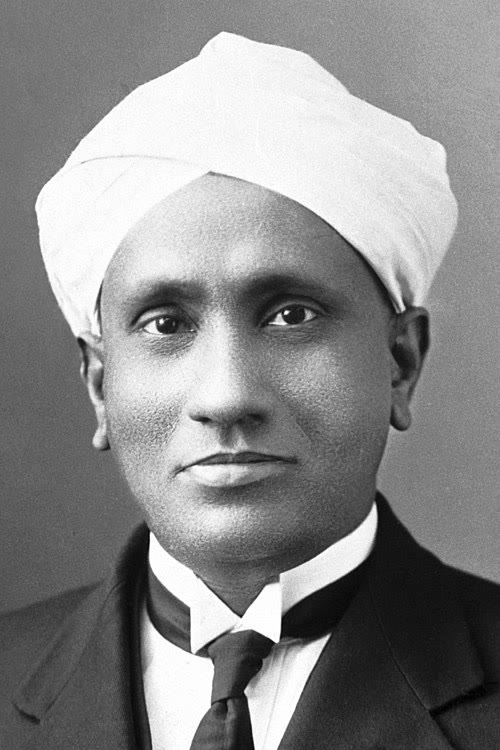
C. V. Raman
चन्द्रशेखर वेङ्कट रामन
Indian physicist (1888–1970)
नेपालीमा पढ्नुहोस् · हिंदी में पढ़ें
- नेपाली · English · हिंदीRead in your language
- CitedEvery fact sourced
- Ad-freeNo ads, no tracking
Chandrasekhara Venkata Raman ( RAH-muhn; IAST: Candraśēkhara Veṅkaṭarāmaṉ; 7 November 1888 – 21 November 1970) was an Indian physicist known for his work in the field of light scattering. Using a spectrograph that he developed, he and his student K. S. Krishnan discovered that when light traverses a transparent material, the deflected light changes its wavelength. This phenomenon, a hitherto unknown type of scattering of light they called modified scattering, was subsequently termed the Raman effect or Raman scattering. In 1930, Raman received the Nobel Prize in Physics "for his work on the scattering of light and for the discovery of the effect named after him" and became the first Asian and non-White person to receive a Nobel Prize in Physics.
Quick facts
Awards wd
- Nobel Prize in Physics (1930)
- Lenin Peace Prize (1957)
- Bharat Ratna (1954)
- Fellow of the Royal Society
- Hughes Medal (1930)
- Matteucci Medal (1928)
- Franklin Medal (1941)
- honorary doctor of the University of Calcutta
- Knight Bachelor
- Honorary Fellow of the Royal Society Te Apārangi
- honorary doctor of the University of Bordeaux (1948)
- doctor honoris causa from the University of Paris (1932)
About
Born in the Indian state of Tamil Nadu, Raman was a precocious child, completing his secondary and higher secondary education from St Aloysius' Anglo-Indian High School at the ages of 11 and 13, respectively. He topped the bachelor's degree examination of the University of Madras with honours in physics from Presidency College at age 16. His first research paper, on diffraction of light, was published in 1906, while he was a graduate student. The next year he obtained a master's degree. He joined the Indian Finance Service in Calcutta as Assistant Accountant General at age 19. There he became acquainted with the Indian Association for the Cultivation of Science (IACS), the first research institute in India, which allowed him to carry out independent research and where he made his major contributions in acoustics and optics.
In 1917, he was appointed the first Palit Professor of Physics by Ashutosh Mukherjee at the Rajabazar Science College under the University of Calcutta. On his first trip to Europe, seeing the Mediterranean Sea motivated him to identify the prevailing explanation for the blue colour of the sea at the…
People also search for
 Srinivasa Ramanujan
 Jagadish Chandra Bose
 Homi J. Bhabha
 Albert Einstein
 Marie Curie
 Isaac Newton
 Charles Darwin
 Nikola Tesla
 Galileo Galilei
 Ada Lovelace
 Alan Turing
 Rosalind Franklin
Questions
- When was C. V. Raman born?
- C. V. Raman was born on 7 November 1888 in Tiruchirappalli.
- Where did C. V. Raman study?
- C. V. Raman was educated at University of Madras, Presidency College, University of Calcutta.
Sources
- Wikipedia (English): C. V. Raman · CC BY-SA 4.0
- Wikipedia (Nepali): चन्द्रशेखर वेङ्कट रामन · CC BY-SA 4.0
- Wikidata item Q60429 · CC0 1.0
- Image: Sir CV Raman.JPG by Nobel Foundation (Public domain)

Last updated · facts checked 4 November 2026
Cite this page
"C. V. Raman". DigiNepal. Last updated 1 November 2026. https://diginpl.com/people/c-v-raman. Retrieved 5 November 2026.
Is this you, or do you work in this person's office? Claim this profile