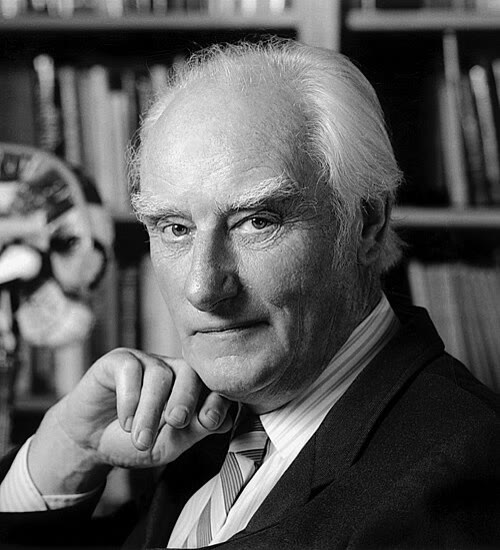
Francis Crick
British molecular biologist, biophysicist, neuroscientist; co-discoverer of the structure of DNA (1916–2004)
नेपालीमा पढ्नुहोस् · हिंदी में पढ़ें
- नेपाली · English · हिंदीRead in your language
- CitedEvery fact sourced
- Ad-freeNo ads, no tracking
Francis Harry Compton Crick (8 June 1916 – 28 July 2004) was an English molecular biologist, biophysicist, and neuroscientist. He, James Watson, Rosalind Franklin, and Maurice Wilkins played crucial roles in deciphering the helical structure of the DNA molecule.
Quick facts
- Born
- wd
- Place of birth
- Northampton wd
- Died
- wd
- Place of death
- La Jolla wd
- Citizenship
- United Kingdom wd
- Occupation
- biologist, geneticist, physicist, neuroscientist, biochemist, molecular biologist wd
- Education
- University College London, Gonville and Caius College, Mill Hill School, University of Cambridge, Northampton School for Boys wd
- Spouse
- Odile Crick wd
Awards wd
- Fellow of the Royal Society
- Albert Lasker Award for Basic Medical Research (1960)
- Nobel Prize in Physiology or Medicine (1962)
- Order of Merit
- Copley Medal (1975)
- Royal Medal (1972)
- Philadelphia Liberty Medal
- Canada Gairdner International Award (1962)
- EMBO Membership
- Grand Prix Charles-Leopold Mayer (1961)
- Sir Hans Krebs Medal (1977)
- Albert Medal (1987)
- Croonian Medal and Lecture (1966)
- Fellow of the Committee for Skeptical Inquiry
- Mendel Medal (1966)
About
Crick and Watson's paper in Nature in 1953 laid the groundwork for understanding DNA structure and functions. Together with Maurice Wilkins, they were jointly awarded the 1962 Nobel Prize in Physiology or Medicine "for their discoveries concerning the molecular structure of nucleic acids and its significance for information transfer in living material".
Crick was an important theoretical molecular biologist and played a crucial role in research related to revealing the helical structure of DNA. He is widely known for the use of the term "central dogma" to summarise the idea that once information is transferred from nucleic acids (DNA or RNA) to proteins, it cannot flow back to nucleic acids. In other words, the final step in the flow of information from nucleic acids to proteins is irreversible.
During the remainder of his career, Crick held the post of J.W. Kieckhefer Distinguished Research Professor at the Salk Institute for Biological Studies in La Jolla, California. His later research centred on theoretical neurobiology and attempts to advance the scientific study of human consciousness. Crick remained in this post until his death in 2004; "he was editing a manuscript on his death bed, a scientist until the bitter end" according to Christof Koch.
People also search for
 Robert Edwards (physiologist)
 Ronald Ross
 Alexis Carrel
 Barbara McClintock
 Carol W. Greider
 Charles Louis Alphonse Laveran
 Elizabeth Blackburn
 Emil von Behring
 Françoise Barré-Sinoussi
 Frederick Banting
 Gertrude B. Elion
 Gerty Cori
Questions
- When was Francis Crick born?
- Francis Crick was born on 8 June 1916 in Northampton.
- Where did Francis Crick study?
- Francis Crick was educated at University College London, Gonville and Caius College, Mill Hill School, University of Cambridge.
Sources
- Wikipedia (English): Francis Crick · CC BY-SA 4.0
- Wikidata item Q123280 · CC0 1.0
- Image: Francis Crick crop.jpg by Francis_Crick.png : Photo: Marc Lieberman, per ticket:2015100910022707 derivative work: Materialscientist ( talk ) (CC BY 2.5)

Last updated · facts checked 5 November 2026
Cite this page
"Francis Crick". DigiNepal. Last updated 31 October 2026. https://diginpl.com/people/francis-crick. Retrieved 5 November 2026.
Is this you, or do you work in this person's office? Claim this profile