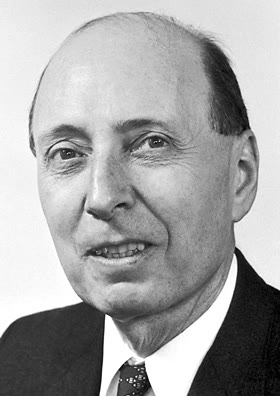
Eugene Wigner
Hungarian-American physicist and mathematician (1902–1995)
नेपालीमा पढ्नुहोस् · हिंदी में पढ़ें
- नेपाली · English · हिंदीRead in your language
- CitedEvery fact sourced
- Ad-freeNo ads, no tracking
Eugene Paul Wigner (Hungarian: Wigner Jenő Pál, pronounced [ˈviɡnɛr ˈjɛnøː ˈpaːl]; November 17, 1902 – January 1, 1995) was a Hungarian-American theoretical physicist who also contributed to mathematical physics. He received the Nobel Prize in Physics in 1963 "for his contributions to the theory of the atomic nucleus and the elementary particles, particularly through the discovery and application of fundamental symmetry principles".
Quick facts
- Born
- wd
- Place of birth
- Budapest wd
- Died
- wd
- Place of death
- Princeton wd
- Citizenship
- Hungary, United States wd
- Occupation
- mathematician, physicist, university teacher, theoretical physicist, nuclear physicist wd
- Education
- Fasori Gimnázium, Technische Universität Berlin wd
- Spouse
- Amelia Frank, Mary Annette Wheeler, Eileen Clare-Patton Hamilton wd
Awards wd
- Nobel Prize in Physics (1963)
- Max Planck Medal (1961)
- Enrico Fermi Award (1958)
- Albert Einstein Award (1972)
- National Medal of Science (1969)
- Wigner Medal (1978)
- Josiah Willard Gibbs Lectureship (1968)
- Franklin Medal (1950)
- Richtmyer Memorial Lecture Award (1955)
- Fellow of the American Physical Society
- Foreign Member of the Royal Society (1970)
- John von Neumann Prize (1966)
- Medal for Merit (1946)
- Atoms for Peace Award (1960)
About
A graduate of the Technical Hochschule Berlin (now Technische Universität Berlin), Wigner worked as an assistant to Karl Weissenberg and Richard Becker at the Kaiser Wilhelm Institute in Berlin, and David Hilbert at the University of Göttingen. Wigner and Hermann Weyl were responsible for introducing group theory into physics, particularly the theory of symmetry in physics. Along the way he performed ground-breaking work in pure mathematics, in which he authored a number of mathematical theorems. In particular, Wigner's theorem is a cornerstone in the mathematical formulation of quantum mechanics. He is also known for his research into the structure of the atomic nucleus. In 1930, Princeton University recruited Wigner, along with John von Neumann, and he moved to the United States, where he obtained citizenship in 1937.
Wigner participated in a meeting with Leo Szilard and Albert Einstein that resulted in the Einstein–Szilard letter, which prompted President Franklin D. Roosevelt to authorize the creation of the Advisory Committee on Uranium with the purpose of investigating the feasibility of nuclear weapons. Wigner was afraid that the German nuclear weapon project would develop an atomic bomb first. During the Manhattan Project, he led a team whose task was to design nuclear reactors to convert uranium into weapons grade plutonium. At the time, reactors existed only on paper, and no reactor had yet gone critical. Wigner was…
People also search for
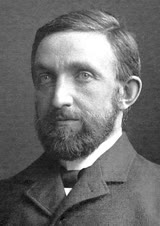 Philipp Lenard
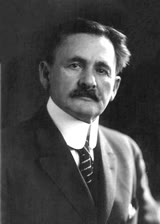 Albert A. Michelson
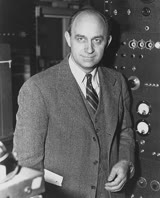 Enrico Fermi
 Erwin Schrödinger
 Hendrik Lorentz
 Henri Becquerel
 J. J. Thomson
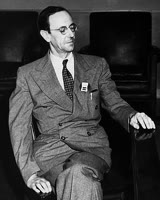 James Chadwick
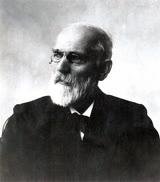 Johannes Diderik van der Waals
 K. Ferdinand Braun
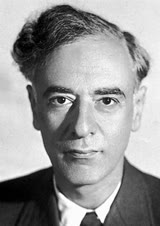 Lev Landau
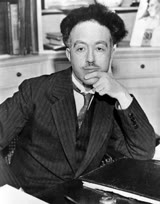 Louis de Broglie
Questions
- When was Eugene Wigner born?
- Eugene Wigner was born on 17 November 1902 in Budapest.
- Where did Eugene Wigner study?
- Eugene Wigner was educated at Fasori Gimnázium, Technische Universität Berlin.
Sources
- Wikipedia (English): Eugene Wigner · CC BY-SA 4.0
- Wikidata item Q155790 · CC0 1.0
- Image: Wigner.jpg by Nobel foundation (Public domain)

Last updated · facts checked 5 November 2026
Cite this page
"Eugene Wigner". DigiNepal. Last updated 1 November 2026. https://diginpl.com/people/eugene-wigner. Retrieved 5 November 2026.
Is this you, or do you work in this person's office? Claim this profile