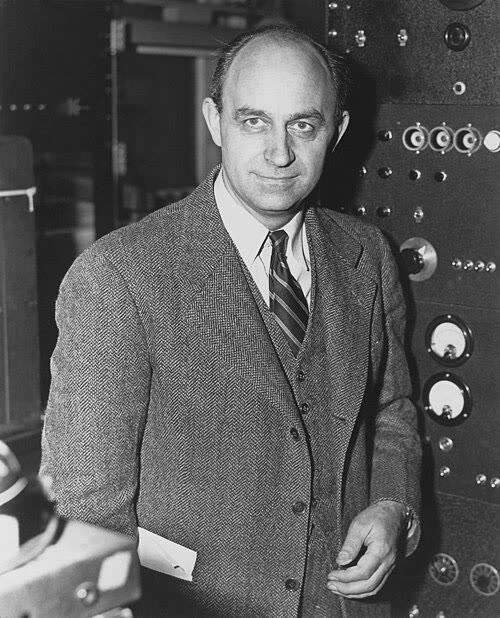
Enrico Fermi
Italian–American physicist (1901–1954)
नेपालीमा पढ्नुहोस् · हिंदी में पढ़ें
- नेपाली · English · हिंदीRead in your language
- CitedEvery fact sourced
- Ad-freeNo ads, no tracking
Enrico Fermi (Italian: [enˈriːko ˈfermi]; 29 September 1901 – 28 November 1954) was an Italian and naturalized-American physicist, renowned for being the creator of the world's first artificial nuclear reactor, Chicago Pile-1, and a member of the Manhattan Project. He won the 1938 Nobel Prize in Physics "for his demonstrations of the existence of new radioactive elements produced by neutron irradiation, and for his related discovery of nuclear reactions brought about by slow neutrons". He has been called the "architect of the nuclear age" and the "architect of the atomic bomb". He was one of very few physicists to excel in both theoretical and experimental physics. With his colleagues, Fermi filed several patents related to the use of nuclear power, all of which were taken over by the US government. He made significant contributions to the development of statistical mechanics, quantum theory, and nuclear and particle physics.
Quick facts
- Born
- wd
- Place of birth
- Rome wd
- Died
- wd
- Place of death
- Chicago wd
- Citizenship
- Kingdom of Italy, Italy wd
- Occupation
- physicist, theoretical physicist, nuclear physicist, university teacher, inventor wd
- Education
- University of Pisa, Scuola Normale Superiore. Classe di Scienze, Leiden University, University of Göttingen wd
- Spouse
- Laura Fermi wd
Awards wd
- Nobel Prize in Physics (1938)
- Max Planck Medal (1954)
- Rumford Prize (1953)
- Matteucci Medal (1926)
- Franklin Medal (1947)
- Hughes Medal (1942)
- Henry Norris Russell Lectureship (1953)
- National Inventors Hall of Fame (1976)
- Silliman Memorial Lectures (1949)
- Barnard Medal for Meritorious Service to Science (1950)
- Richtmyer Memorial Lecture Award (1952)
- Fellow of the American Physical Society (1939)
- Foreign Member of the Royal Society (1950)
About
Fermi's first major contribution involved the field of statistical mechanics. After Wolfgang Pauli formulated his exclusion principle in 1925, Fermi followed with a paper in which he applied the principle to an ideal gas, employing a statistical formulation now known as Fermi–Dirac statistics. Today, particles that obey the exclusion principle are called "fermions". Pauli later postulated the existence of an uncharged invisible particle emitted along with an electron during beta decay, to satisfy the law of conservation of energy. Fermi took up this idea, developing a model that incorporated the postulated particle, which he named the "neutrino". His theory, later referred to as Fermi's interaction and now called weak interaction, described one of the four fundamental interactions in nature. Through experiments inducing radioactivity with the recently discovered neutron, Fermi discovered that slow neutrons were more easily captured by atomic…
People also search for
 Albert A. Michelson
 Maria Goeppert Mayer
 Robert Millikan
 Steven Weinberg
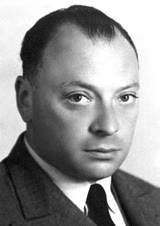 Wolfgang Pauli
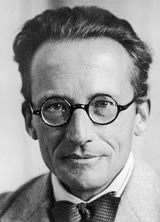 Erwin Schrödinger
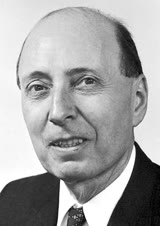 Eugene Wigner
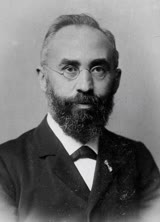 Hendrik Lorentz
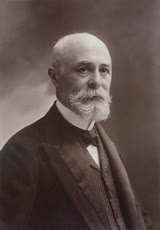 Henri Becquerel
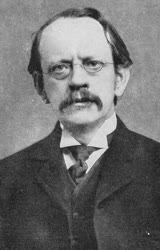 J. J. Thomson
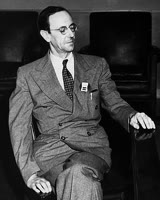 James Chadwick
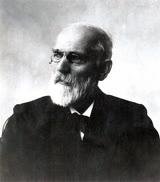 Johannes Diderik van der Waals
Questions
- When was Enrico Fermi born?
- Enrico Fermi was born on 29 September 1901 in Rome.
- Where did Enrico Fermi study?
- Enrico Fermi was educated at University of Pisa, Scuola Normale Superiore. Classe di Scienze, Leiden University, University of Göttingen.
Sources
- Wikipedia (English): Enrico Fermi · CC BY-SA 4.0
- Wikidata item Q8753 · CC0 1.0
- Image: Enrico Fermi 1943-49.jpg by Department of Energy-Office of Public Affairs, restored by Yann (Public domain)

Last updated · facts checked 5 November 2026
Cite this page
"Enrico Fermi". DigiNepal. Last updated 31 October 2026. https://diginpl.com/people/enrico-fermi. Retrieved 5 November 2026.
Is this you, or do you work in this person's office? Claim this profile