Teej
तीज
Holiday for women employeesHindu
Dates
| 2083 BS | 14 Sep 2026 (29 Bhadra 2083 BS) | Official holiday list source |
| 2084 BS | Date to be announced | Date to be announced |
Teej (Sanskrit: तीज, meaning "third") is a collective term for three Hindu festivals dedicated to the goddess Parvati and her consort Shiva. It is mainly celebrated by married women and unmarried girls, who pray for the long life of their husbands or future husbands and to welcome the arrival of the monsoon through singing, swinging, dancing, joyful celebration, pūjā, and often fasting.
Teej collectively refers to Haryālī Tīja, Kajari Tīja, and Hartālikā Tīja, which are observed in different regions of India and Nepal. Haryālī Tīja and Kajari Tīja are associated with the monsoon season, while Hartālikā Tīja commemorates the devotion of Pārvatī to Śiva. Their observances vary by region and include fasting, worship, singing, dancing, swings, and other festivities.
Hartālikā Tīja (from Harat meaning "abduction" and Ālikā meaning "female friend") falls one lunar month after Haryālī Tīja on the third day after the new moon in the month of Bhādrapada. It commemorates the occasion when Pārvatī encouraged her friends to abduct her to avoid marriage with Viṣṇu, which her father Himālaya had arranged. Married women observe nirjala vrata (a fast without water) on this day for the well-being of their husbands.
नेपालीमा
तीज हिन्दू नारीहरूले मनाउने एउटा महत्त्वपूर्ण चाड हो। यो चाड भाद्र शुक्ल द्वितीयादेखि पञ्चमीसम्म ४ दिन मनाइन्छ। तीजमा भगवान शिवको आराधना गरिनुका साथै नाचगान मनोरञ्जन समेत गर्ने गरिन्छ। नेपाली हिन्दू महिलाहरूद्वारा स्वतन्त्र र आनन्दमय रूपमा मनाइने तीज अन्य धर्म र जातजातिका नेपाली महिलाहरूले पनि हर्षोल्लासका साथ मनाउन थालेका छन्। यो पर्व मुख्यरूपले नेपालभर मनाइन्छ भने भारतका कुनै कुनै क्षेत्रमा पनि मनाइन्छ। आद्य शक्ति भगवान शिवकी अर्धाङ्गीनी हिमालय पुत्री पार्वतीले भगवान शिवको स्वास्थ्य तथा शरीरमा कुनै वाधा उत्पन्न नहोस् भनेर पहिलो बर्त राखेकी थिइन् त्यो दिन यही हरितालिका तीजको दिन थियो। त्यसै दिनदेखि आजसम्म हिन्दू नारीहरूले यो पर्व मनाउदै आएका छन् भन्ने विश्वास गरिन्छ।
Observance of Haryali Teej
Haryali Teej is celebrated in Punjab, Haryana, Western UP and Rajasthan. The festival is also celebrated in Chandigarh.
Haritalika Teej observance in Nepal
Dedicated to Parvati, commemorating her union with Shiva, the festival is celebrated for well-being of spouse and children and purification of one's body and soul. The festival is a three-day-long celebration that combines sumptuous feasts as well as rigid fasting. Teej (also romanised Tij) is celebrated by women, for the long life of her husband and long and firm relationship between them in this life and all the lives to come. It is particularly celebrated by women from various ethnicities and castes of Nepalese society, particularly the Bhojpuriyas, Maithils (Native Madheshis), Bahun, Chettri, Newairs and Kiratis, on the third day after the new moon of the month of Bhadra (mid-August to mid-September).
First day
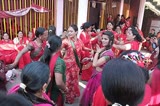
The first day of Teej is called Dar Khane Din. On this day, the women assemble at one place in their finest attire and start dancing and singing devotional songs. Amidst all this, the grand feast takes place. The feast is usually hosted by men. Women, who work hard throughout the year, do not have to do anything that day. That is the day for them to embellish themselves in sorha singaar — dressing up and using makeup to the full extent, indulge in good food, and dance. Oftentimes, because women are invited by multiple brothers for the feast, they try to dance off some food before they are ready to eat more. The food served is supposed to be rich and abundant. This is probably the only day in a year that allows women full freedom of expression. Consequently, women have traditionally used this occasion to express their pains and pang in the songs they sing while dancing. With the advancement of communication and awareness, women these days use this occasion to voice their concerns about social issues and discrimination against women. The jollity often goes on until midnight, after which the 24-hour fast starts.
Second day
The second day is the day of fasting. Some women don't eat or drink food and water while others drink liquids and eat fruit. The fasting is observed by married and unmarried women. Married women abstain strictly from food and drinks with a belief that their devotion to the gods will be blessed with longevity, peace and prosperity of their husband and family. Unmarried women observe the fast with a hope of being blessed with a good husband. They dress gaily and visit a nearby Shiva temple singing and dancing on the way. The Pashupatinath Temple gets the highest number of devotees. At the temple, women circumambulate the shiva lingam, which symbolizes Shiva. The main pooja (religious ceremony) takes place with offerings of flowers, fruits, etc., made to Shiva and his wife Parvati, beseeching them to grant their blessing upon the husband and family. The important part of the puja is the oil lamp which should be alight throughout the night. It is believed that by the light of an oil lamp all night will bring peace and prosperity to the husband and family.
Third day
The third day of the festival is Rishi Panchami. After the completion of the previous day's puja, women pay homage to seven saints or sages, offer prayers to deities, and bathe with red mud found on the roots of the sacred datiwan bush, along with its leaves. The Rishi Panchami revolves around the purity of women. During this festival, which occurs two days after the Teej, the women participate in ritual baths and puja (worship). One of the defining characteristics of the Teej Festival is the songs the women sing. Ethnographic research in Nepal found that the songs are not fixed texts: singers may modify existing verses, add new ones, and adapt them to changing circumstances. The songs address subjects including hardship, family relationships, gender relations, social conditions and political issues. Traditionally, these songs emphasized the subservient role of women in Nepalese society in addition to reinforcing traditional Hindu ideology of gender relations. Within the past few decades, as Nepal and the surrounding area experiences rapid development and modernization, the Teej songs have become more of a critical commentary on gender relations from women's perspectives. These songs "extend the women's thoughts and experiences of hardships from an intimate conversation to a public setting". The Teej songs allow women to effect change in their respective societies by giving them a public voice.
