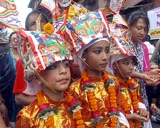
Gai Jatra
गाईजात्रा
Holiday for the communityHinduNewar
Dates
| 2083 BS | 29 Aug 2026 (13 Bhadra 2083 BS) | Official holiday list source |
| 2084 BS | Day following the full moon (waning fortnight) of the month of Gunla in the Nepal Sambat calendar — date to be announced | Date to be announced |
When: Day following the full moon (waning fortnight) of the month of Gunla in the Nepal Sambat calendar (Wikipedia)
Gai Jatra (Newar: गाईजात्रा), also known by its endonym of Sa Paru (Nepal Bhasa: 𑐳𑐵𑐥𑐵𑐬𑐸, sāpāru) or Saya (Nepal Bhasa: 𑐳𑐵𑐫𑐵𑑅, sāyāḥ), is a Nepalese festival celebrated mainly in the Kathmandu Valley by the Newar people. The festival is celebrated in honour of their immediate relatives who have died during the previous year. Various groups of children dressed up as cows and in other religious drags are organized throughout various cities.
The festival takes place in waning fortnight of the month of Gunla in the Nepal Sambat calendar, falling between September and August.
नेपालीमा
गाई जात्रा (नेवारीः सापारु) काठमाडौँ उपत्यका सहित देशका विभिन्न स्थानमा धुमधामका साथ मनाइने पर्व हो । यो नेपाली समाजको एक महत्त्वपूर्ण सांस्कृतिक पर्व हो । यो नेवार संस्कृतिबाट सुरू भएको जात्रा हो । नेपाली समाजमा गाइजात्रा व्यङ्ग्य गर्ने अवसरको रूपमा समेत परिचित छ । यस पर्वमा नेवार समुदायमा पितृगणको सम्झनामा गाईको रूप धारण गरी टोलटोल घुम्ने गर्दछन । यस दिन भजन कीर्तन पनि गरिन्छ । यो जात्रा नेपाल सम्बत अनुसार गुंलागाः पारु अथवा भाद्र शुक्ल प्रतिपदा अर्थात जनैपूर्णिमाको भोलिपल्ट पर्दछ । वर्ष दिनभित्र मरेका मान्छेको दिवंगत आफन्तको सम्झनामा मनाइने धार्मिक सांस्कृतिक तथा ऐतिहासिक महत्त्व बोकेको यो पर्व नेवार समुदाय रहेका विभिन्न ठाउँमा मनाइने गरिन्छ ।
Observed by: Newar people
Origin
Gai Jatra was started by King Pratap Malla during his reign from 1641 to 1671 AD. His teenage son Chakravartendra Malla died an untimely death and the queen grieved the loss of her son. King Pratap Malla started this tradition to help ascend his son to the next life and cheer the grieving queen and families of those whose loved ones had died. However, the association of the festival's origin exclusively with Pratap Malla has been questioned by historians. According to historian Prof. Dr. Purushottam Lochan Shrestha and historical evidence discussed in relation to the festival, Gai Jatra may have existed in the Kathmandu Valley more than three centuries before Pratap Malla's reign. The tradition may have been associated with Jayasthiti Malla, the ruler of Bhaktapur in the 14th century. The Gopal Raj Vamshavali, an important historical chronicle of Nepal, is cited as containing references to Sa: Paru or related observances from this earlier period. This interpretation suggests that the festival may have originated in Bhaktapur and subsequently developed in other parts of the Kathmandu Valley. Pratap Malla may therefore have continued an existing tradition in Kantipur, while introducing or expanding particular customs, performances and forms of satire associated with the festival. The historical origin of Gai Jatra is therefore not conclusively established.
Celebrations
In the Hindu religion, Gai (Cow) is sacred like a Lakshmi and viewed as a mother. The children of those whose families had died would come out to Hanuman Dhoka Palace and the Newar priest performs the prayers for those passed. The children usually wear long skirts and must have a tulle belt around their waist with the ends hanging on both their right and left sides that drag on the ground while walking. It is necessary that it drag because it touches the ground (Earth) for the loved ones who died to ascend from Earth to heaven. This is a festival of dragging clothes while walking. The children also wear headdresses that have a cow drawn on them which is important, and they wear a moustache drawn on their faces. The Jatra is supposed to be religious for the Newar community to help loved ones pass from Earth to heaven and cheer those left behind. The parade of drag is done in the morning by children and in the evening with caricature and stand-up comedy by Hanuman Dhoka Dabali for the grieving Queen and others. Since the 1600s, the caricatures and jokes have improved and also include political satires to make it more interesting on TV shows, usually the male standup comedians wear female clothes and perform both male and female parts of the play, this is a fun event for the Newar community as well as for all other Nepalese communities.
