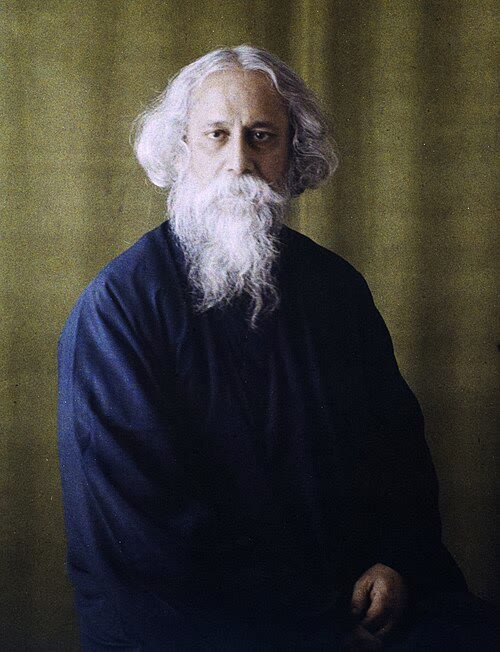
Rabindranath Tagore
रवीन्द्रनाथ टेगोर
Bengali poet, philosopher and polymath (1861–1941)
नेपालीमा पढ्नुहोस् · हिंदी में पढ़ें
- नेपाली · English · हिंदीRead in your language
- CitedEvery fact sourced
- Ad-freeNo ads, no tracking
Rabindranath Tagore (Bengali: [ˈrobind̪ɾonat̪ʰ ˈʈʰakuɾ] ; 7 May 1861 – 7 August 1941) was a Bengali poet, author, playwright, musician, composer, philosopher, social reformer, painter, and one of the foremost figures of the Bengal Renaissance. In 1913, Tagore became the first Indian and non-European to win a Nobel Prize in any category, and also the first lyricist to win the Nobel Prize in Literature. A significant moulder of culture within Bengal and the Indian subcontinent, he wrote and composed the national anthems of India and Bangladesh.
Quick facts
- Born
- wd
- Place of birth
- Kolkata wd
- Died
- wd
- Place of death
- Kolkata wd
- Citizenship
- British Raj wd
- Occupation
- painter, poet, composer, playwright, essayist, philosopher wd
- Education
- University College London, St. Xavier's Collegiate School wd
- Spouse
- Mrinalini Devi wd
- Official website
- de.wikipedia.org/w/index.php?oldid=237189982 wd
Awards wd
- Nobel Prize in Literature (1913)
- honorary doctor of the University of Calcutta
- Knight Bachelor
About
He reshaped Bengali literature and music as well as Indian art with Contextual Modernism in the late 19th and early 20th centuries. He was the author of the "profoundly sensitive, fresh and beautiful" poetry of Gitanjali. Tagore's poetic songs were viewed as spiritual and mercurial; his elegant prose and magical poetry were widely popular in the Indian subcontinent. He was a fellow of the Royal Asiatic Society. Referred to as "the Bard of Bengal", Tagore was known by the sobriquets Gurudeb, Kobiguru, and Bishwokobi.
A Bengali Brahmin from Calcutta with ancestral gentry roots in Jessore and Bardhaman districts, Tagore wrote poetry as an eight-year-old. At the age of sixteen, he released his first substantial poems under the pseudonym Bhānusiṃha ("Sun Lion"), which were seized upon by literary authorities as long-lost classics. By 1877 he graduated to his first short stories and dramas, published under his real name. As a humanist, universalist, internationalist, and ardent critic of nationalism, he denounced the British Raj and advocated independence from Britain. As an exponent of the Bengal Renaissance, he advanced a vast canon that comprised paintings, sketches and doodles, hundreds of texts, and some two thousand songs; his legacy also endures in his founding of Visva-Bharati University.
Tagore modernised Bengali art by…
People also search for
 Satyajit Ray
 A. R. Rahman
 Lata Mangeshkar
 Leonardo da Vinci
 Michelangelo
 Vincent van Gogh
 Frida Kahlo
 William Shakespeare
 Leo Tolstoy
 Maya Angelou
 Ludwig van Beethoven
 Wolfgang Amadeus Mozart
Questions
- When was Rabindranath Tagore born?
- Rabindranath Tagore was born on 7 May 1861 in Kolkata.
- Where did Rabindranath Tagore study?
- Rabindranath Tagore was educated at University College London, St. Xavier's Collegiate School.
Sources
- Wikipedia (English): Rabindranath Tagore · CC BY-SA 4.0
- Wikipedia (Nepali): रवीन्द्रनाथ टेगोर · CC BY-SA 4.0
- Wikidata item Q7241 · CC0 1.0
- Image: 1926 Rabindrath Tagore.jpg by Georges Chevalier (CC BY 4.0)

Last updated · facts checked 4 November 2026
Cite this page
"Rabindranath Tagore". DigiNepal. Last updated 31 October 2026. https://diginpl.com/people/rabindranath-tagore. Retrieved 4 November 2026.
Is this you, or do you work in this person's office? Claim this profile