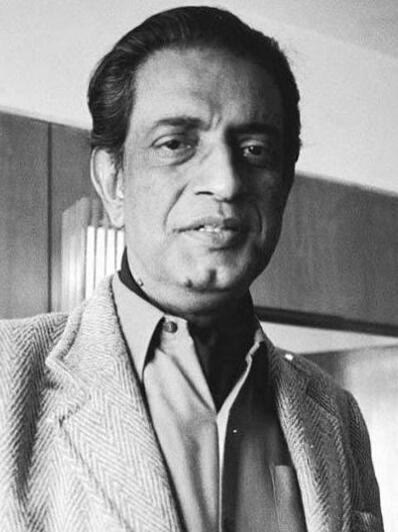
Satyajit Ray
सत्यजित राय
Indian filmmaker and writer (1921–1992)
नेपालीमा पढ्नुहोस् · हिंदी में पढ़ें
- नेपाली · English · हिंदीRead in your language
- CitedEvery fact sourced
- Ad-freeNo ads, no tracking
Satyajit Ray (Bengali: [ʃot̪ːod͡ʒit̪ rae̯] ; 2 May 1921 – 23 April 1992) was an Indian film director, screenwriter, author, lyricist, magazine editor, illustrator, calligrapher, and composer. He is widely considered to be one of the greatest and most influential film directors in the history of cinema. He is celebrated for works including The Apu Trilogy (1955–1959), The Music Room (1958), The Big City (1963), Charulata (1964), and the Goopy–Bagha trilogy (1969–1992).
Quick facts
- Born
- wd
- Place of birth
- Kolkata wd
- Died
- wd
- Place of death
- Kolkata wd
- Citizenship
- India wd
- Occupation
- film director, writer, composer, film producer, screenwriter, film editor wd
- Education
- University of Calcutta, Visva-Bharati University, Ballygunge Government High School, Presidency University wd
- Spouse
- Bijoya Ray wd
- Official website
- satyajitray.org wd
Awards wd
- Sangeet Natak Akademi Award (1959)
- Commander of the Legion of Honour (1987)
- Ramon Magsaysay Award (1967)
- National Film Award for Best Bengali Feature Film (1955)
- National Film Award for Best Feature Film (1955)
- Golden Lion (1957)
- National Film Award for Second Best Feature Film (1958)
- National Board of Review Award for Best Foreign Language Film (1958)
- BAFTA Award for Best Film (1958)
- Sutherland Trophy (1959)
- National Film Award for Best Non-Feature Film (1961)
- Silver Bear for Best Director (1964)
- Padma Bhushan (1965)
- National Film Award for Best Screenplay (1966)
- Bodil Award for Best American Film (1967)
About
Ray was born in Calcutta to author Sukumar Ray and Suprabha Ray. Starting his career as a commercial artist, Ray was drawn into independent film-making after meeting French filmmaker Jean Renoir (who was in India to make his film The River) and viewing Vittorio De Sica's Italian neorealist film Bicycle Thieves (1948) during a visit to London. He started work on his first film after he returned from London.
Ray directed 36 films, including feature films, documentaries, and shorts. Ray's first film, Pather Panchali (1955), won eleven international prizes, including the inaugural Best Human Document award at the 1956 Cannes Film Festival. This film, along with Aparajito (1956) and Apur Sansar (The World of Apu) (1959), form The Apu Trilogy. Ray did the scripting, casting, scoring, and editing for the movie and designed his own credit titles and publicity material. He also authored several short stories and novels, primarily for young children and teenagers. Popular characters created by Ray include Feluda the sleuth, Professor Shonku the scientist, Tarini Khuro the storyteller, and Lalmohan Ganguly the novelist.
Ray received many major awards in his career, including a record thirty-seven Indian National Film Awards which includes Dadasaheb Phalke Award, a Golden Lion, a Golden Bear, two Silver Bears, many additional awards at international film festivals and ceremonies; till date remaining the only…
People also search for
 Rabindranath Tagore
 A. R. Rahman
 Lata Mangeshkar
 Leonardo da Vinci
 Michelangelo
 Vincent van Gogh
 Frida Kahlo
 William Shakespeare
 Leo Tolstoy
 Maya Angelou
 Ludwig van Beethoven
 Wolfgang Amadeus Mozart
Questions
- When was Satyajit Ray born?
- Satyajit Ray was born on 2 May 1921 in Kolkata.
- Where did Satyajit Ray study?
- Satyajit Ray was educated at University of Calcutta, Visva-Bharati University, Ballygunge Government High School, Presidency University.
Sources
- Wikipedia (English): Satyajit Ray · CC BY-SA 4.0
- Wikipedia (Nepali): सत्यजित राय · CC BY-SA 4.0
- Wikidata item Q8873 · CC0 1.0
- Image: Satyajit Ray in New York (cropped).jpg by Dinu Alam Newyork (CC BY-SA 4.0)

Last updated · facts checked 4 November 2026
Cite this page
"Satyajit Ray". DigiNepal. Last updated 4 November 2026. https://diginpl.com/people/satyajit-ray. Retrieved 4 November 2026.
Is this you, or do you work in this person's office? Claim this profile