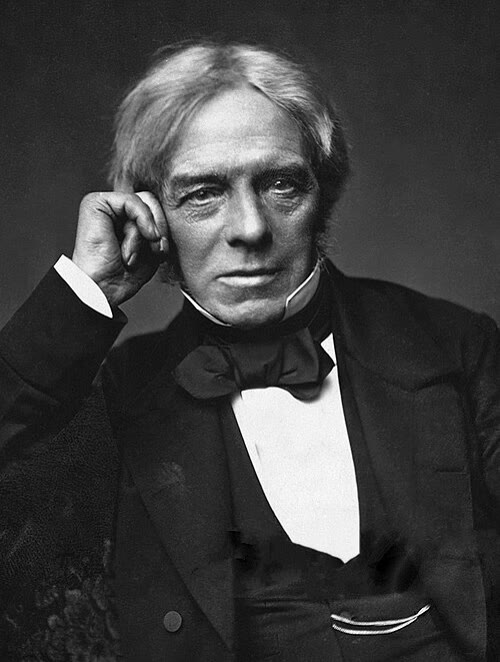
Michael Faraday
माइकल फराडे
British scientist (1791–1867)
नेपालीमा पढ्नुहोस् · हिंदी में पढ़ें
- नेपाली · English · हिंदीRead in your language
- CitedEvery fact sourced
- Ad-freeNo ads, no tracking
Michael Faraday (22 September 1791 – 25 August 1867) was an English chemist and physicist who contributed vastly to the study of electrochemistry and electromagnetism. His main discoveries include the principles underlying electromagnetic induction, diamagnetism, and electrolysis. Despite receiving little formal education, as an autodidact Faraday became one of the most influential scientists in history. It was by his research on the magnetic field around a conductor carrying a direct current that Faraday established the concept of the electromagnetic field in physics. Faraday also established that magnetism could affect rays of light and that there was an underlying relationship between the two phenomena. He similarly discovered the principles of electromagnetic induction, diamagnetism, and the laws of electrolysis. His inventions of electromagnetic rotary devices formed the foundation of electric motor technology, and it was largely due to his efforts that electricity became practical for use in technology. The SI unit of capacitance, the farad, is named after him.
Quick facts
Awards wd
- Pour le Mérite for Sciences and Arts order
- Fellow of the Royal Society (1824)
- Copley Medal (1832)
- Royal Medal (1835)
- Rumford Medal (1846)
- Albert Medal (1866)
- Royal Society Bakerian Medal (1857)
- Fellow of the American Academy of Arts and Sciences (1832)
- honorary member of the Physics Association (Frankfurt am Main, Germany) (1839)
About
As a chemist, Faraday discovered benzene and tetrachloroethylene, investigated the clathrate hydrate of chlorine, invented an early form of the Bunsen burner and the system of oxidation numbers, and popularised terminology such as "anode", "cathode", "electrode" and "ion". Faraday ultimately became the first and foremost Fullerian Professor of Chemistry at the Royal Institution, a lifetime position.
Faraday was an experimentalist who conveyed his ideas in clear and simple language, and thought and sensed the physical world in a visual manner, rather than in words or symbols. His mathematical abilities did not extend as far as trigonometry and were limited to the simplest algebra. Physicist and mathematician James Clerk Maxwell took the work of Faraday and others and summarised it in a set of equations…
People also search for
 Alfred Nobel
 André-Marie Ampère
 Antoine de Saint-Exupéry
 Archimedes
 Christiaan Huygens
 James Clerk Maxwell
 James Watt
 Johannes Kepler
 L. L. Zamenhof
 Leonhard Euler
 Richard Stallman
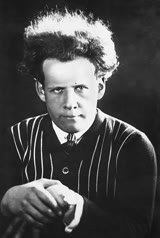 Sergei Eisenstein
Questions
- When was Michael Faraday born?
- Michael Faraday was born on 22 September 1791 in Newington Butts.
Sources
- Wikipedia (English): Michael Faraday · CC BY-SA 4.0
- Wikipedia (Nepali): माइकल फराडे · CC BY-SA 4.0
- Wikidata item Q8750 · CC0 1.0
- Image: Michael Faraday sitting crop.jpg by Unknown author Unknown author (Public domain)

Last updated · facts checked 5 November 2026
Cite this page
"Michael Faraday". DigiNepal. Last updated 31 October 2026. https://diginpl.com/people/michael-faraday. Retrieved 5 November 2026.
Is this you, or do you work in this person's office? Claim this profile