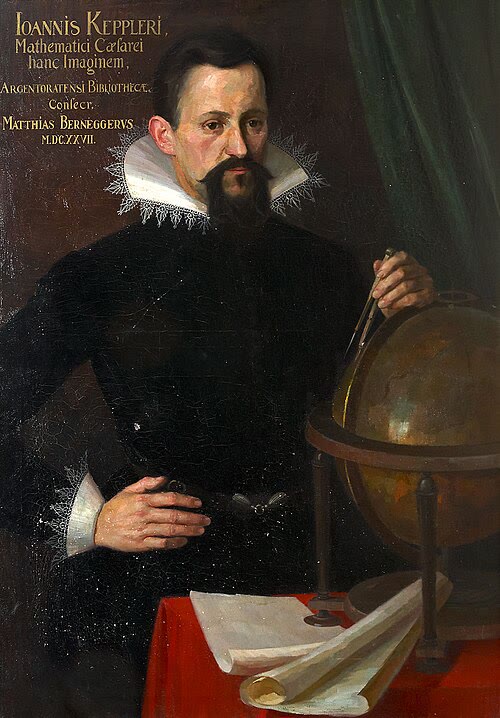
Johannes Kepler
German mathematician and astronomer (1571–1630)
नेपालीमा पढ्नुहोस् · हिंदी में पढ़ें
- नेपाली · English · हिंदीRead in your language
- CitedEvery fact sourced
- Ad-freeNo ads, no tracking
Johannes Kepler (27 December 1571 – 15 November 1630) was a German polymath who was an astronomer, mathematician, astrologer, natural philosopher and music theorist. He is a key figure in the 17th-century Scientific Revolution, best known for his laws of planetary motion, and his books Astronomia nova, Harmonice Mundi, and Epitome Astronomiae Copernicanae. The variety and impact of his work made Kepler one of the founders and fathers of modern astronomy, the scientific method, natural science, and modern science. He has been described as the "father of science fiction" for his novel Somnium.
Quick facts
- Born
- wd
- Place of birth
- Weil der Stadt wd
- Died
- wd
- Place of death
- Regensburg wd
- Citizenship
- Duchy of Württemberg, Holy Roman Empire wd
- Occupation
- naturalist, astrologer, Protestant theologian, mathematician, astronomer, musicologist wd
- Education
- University of Tübingen, Evangelical Seminaries of Maulbronn and Blaubeuren, Tübinger Stift wd
- Spouse
- Barbara Müller, Susanne Reuttinger wd
Awards wd
- International Space Hall of Fame (1996)
About
Kepler was a mathematics teacher at a seminary school in Graz, where he became an associate of Prince Hans Ulrich von Eggenberg. Later he became an assistant to the astronomer Tycho Brahe in Prague, and eventually the imperial mathematician to Emperor Rudolf II and his two successors Matthias and Ferdinand II. He also taught mathematics in Linz, and was an adviser to General Wallenstein.
Kepler lived in an era when there was no clear distinction between astronomy and astrology, but there was a strong division between astronomy (a branch of mathematics within the liberal arts) and physics (a branch of natural philosophy). Kepler also incorporated religious arguments and reasoning into his work, motivated by the religious conviction and belief that God had created the world according to an intelligible plan that is accessible through the natural light of reason. Kepler described his new astronomy as "celestial physics", as "an excursion into Aristotle's Metaphysics", and as "a supplement to Aristotle's On the Heavens", transforming the ancient tradition of physical cosmology by treating astronomy as part of a universal mathematical physics. Additionally, he did fundamental work in the field of optics, being named the father of modern optics, in particular for his Astronomiae pars…
People also search for
 Alfred Nobel
 André-Marie Ampère
 Antoine de Saint-Exupéry
 Archimedes
 Christiaan Huygens
 James Clerk Maxwell
 James Watt
 L. L. Zamenhof
 Leonhard Euler
 Michael Faraday
 Richard Stallman
 Sergei Eisenstein
Questions
- When was Johannes Kepler born?
- Johannes Kepler was born on 27 December 1571 in Weil der Stadt.
- Where did Johannes Kepler study?
- Johannes Kepler was educated at University of Tübingen, Evangelical Seminaries of Maulbronn and Blaubeuren, Tübinger Stift.
Sources
- Wikipedia (English): Johannes Kepler · CC BY-SA 4.0
- Wikidata item Q8963 · CC0 1.0
- Image: JKepler.jpg by August Köhler [1] (Public domain)

Last updated · facts checked 6 November 2026
Cite this page
"Johannes Kepler". DigiNepal. Last updated 31 October 2026. https://diginpl.com/people/johannes-kepler. Retrieved 6 November 2026.
Is this you, or do you work in this person's office? Claim this profile