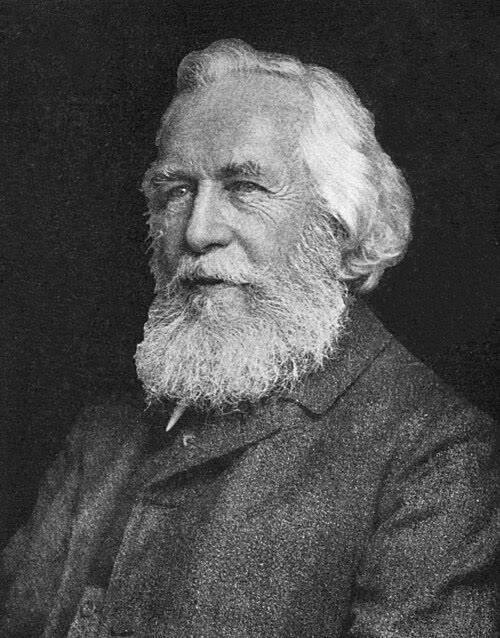
Ernst Haeckel
अर्नस्ट हेकेल
German zoologist (1834-1919)
नेपालीमा पढ्नुहोस् · हिंदी में पढ़ें
- नेपाली · English · हिंदीRead in your language
- CitedEvery fact sourced
- Ad-freeNo ads, no tracking
Ernst Heinrich Philipp August Haeckel (; German: [ɛʁnst ˈhɛkl̩]; 16 February 1834 – 9 August 1919) was a German zoologist, naturalist, eugenicist, philosopher, physician, professor, marine biologist and artist. He discovered, described and named thousands of new species, mapped a genealogical tree relating all life forms and coined many terms in biology, including ecology, phylum, phylogeny, ontogeny, and Protista. Haeckel promoted and popularised Charles Darwin's work in Germany and developed the disproven but influential recapitulation theory (summed up by the dictum "ontogeny recapitulates phylogeny"), later generalizing it into the so called "Biogenetic Law". He wrongly claimed that an individual organism's biological development, or ontogeny, parallels and summarizes its species' evolutionary development, or phylogeny, using incorrectly drawn images of human embryonic development to derive the law. Whether they were intentionally falsified, or drawn poorly by accident is a matter of debate.
Quick facts
Positions held wd
- rector of the University of Jena (1884–1885)
- rector of the University of Jena (1876–1876)
Awards wd
- Darwin Medal (1900)
- Cothenius Medal (1864)
- Darwin–Wallace Medal (1908)
- Linnean Medal (1894)
- Bressa Prize (1895)
- Swammerdam Medal (1890)
About
The published artwork of Haeckel includes over 100 detailed, multi-colour illustrations of animals and sea creatures, collected in his Kunstformen der Natur ("Art Forms in Nature"), a book which would go on to influence the Art Nouveau artistic movement. As a philosopher, Ernst Haeckel wrote Die Welträthsel (1895–1899; in English: The Riddles of the Universe, 1900), the genesis for the term "world riddle" (Welträtsel); and Freedom in Science and Teaching to support teaching evolution. He also coined the "Biogenetic Law".
Haeckel promoted scientific racism and embraced the idea of Social Darwinism. He was the first person to characterize the Great War as the "first" World War, which he did as early as 1914.
People also search for
 Abel Tasman
 Alexander von Humboldt
 Alexei Leonov
 Alfred Russel Wallace
 Alfred Wegener
 Amerigo Vespucci
 Arthur C. Clarke
 Christopher Columbus
 David Livingstone
 Ferdinand Magellan
 Francis Xavier
 Hernán Cortés
Questions
- When was Ernst Haeckel born?
- Ernst Haeckel was born on 16 February 1834 in Potsdam.
- What positions has Ernst Haeckel held?
- Positions held by Ernst Haeckel include: rector of the University of Jena (1884–1885); rector of the University of Jena (1876–1876).
- Where did Ernst Haeckel study?
- Ernst Haeckel was educated at Frederick William University Berlin, Humboldt-Universität zu Berlin.
Sources
- Wikipedia (English): Ernst Haeckel · CC BY-SA 4.0
- Wikidata item Q48246 · CC0 1.0
- Image: Ernst Haeckel 5.jpg by Unknown author Unknown author (Public domain)

Last updated · facts checked 4 November 2026
Cite this page
"Ernst Haeckel". DigiNepal. Last updated 31 October 2026. https://diginpl.com/people/ernst-haeckel. Retrieved 5 November 2026.
Is this you, or do you work in this person's office? Claim this profile