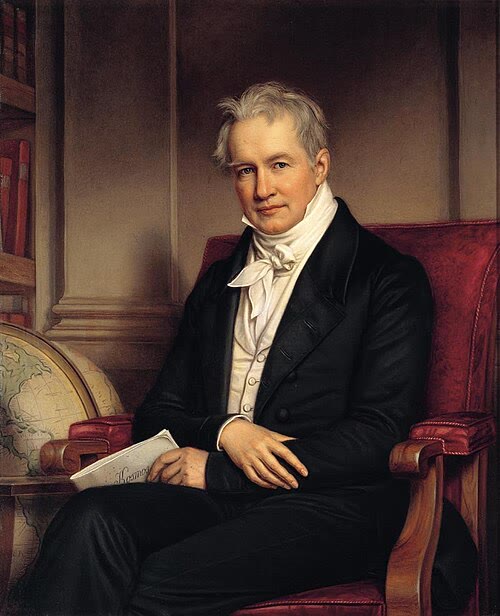
Alexander von Humboldt
Prussian geographer, naturalist and explorer (1769–1859)
नेपालीमा पढ्नुहोस् · हिंदी में पढ़ें
- नेपाली · English · हिंदीRead in your language
- CitedEvery fact sourced
- Ad-freeNo ads, no tracking
Friedrich Wilhelm Heinrich Alexander von Humboldt (14 September 1769 – 6 May 1859) was a German polymath, geographer, naturalist, explorer, and proponent of Romantic philosophy and science. He was the younger brother of the Prussian minister, philosopher, and linguist Wilhelm von Humboldt (1767–1835). Humboldt's quantitative work on botanical geography laid the foundation for the field of biogeography, while his advocacy of long-term systematic geophysical measurement pioneered modern geomagnetic and meteorological monitoring. Humboldt and Carl Ritter are both regarded as the founders of modern geography as they established it as an independent scientific discipline.
Quick facts
- Born
- wd
- Place of birth
- Berlin wd
- Died
- wd
- Place of death
- Berlin wd
- Citizenship
- Kingdom of Prussia wd
- Occupation
- geologist, explorer, botanist, geographer, oceanographer, volcanologist wd
- Education
- University of Frankfurt an der Oder, Freiberg University of Mining and Technology, University of Göttingen, University of Jena wd
Positions held wd
- Geheimrat
Awards wd
- Merit Order of the Bavarian Crown
- Imperial Order of the Rose
- Grand Cross of the Order of the Dannebrog
- Grand Cross of the Legion of Honour
- Mexican Imperial Orders
- Grand Cross of the Order of Christ
- Order of St. Vladimir, 1st class
- Order of the White Falcon
- Knight Grand Cross of the Order of Saints Maurice and Lazarus
- Grand Cross of the Order of Charles III
- Bavarian Maximilian Order for Science and Art (1853)
- Copley Medal (1852)
- Pour le Mérite for Sciences and Arts order
- Knight of the Order of St. Alexander Nevsky
- honorary citizen of Berlin
About
Between 1799 and 1804, Humboldt travelled extensively in the Americas, exploring and describing them for the first time from a non-Spanish European scientific point of view. On these travels, along with French explorer Aimé Bonpland, he traversed thousands of miles through some of the most difficult and little-known places on Earth, to include identifying the source of the Orinoco River and in 1802 climbing the highest mountain in Ecuador to a height of 19,286 feet, at the time a world record altitude for a Westerner. His description of the journey was written up and published in several volumes over 21 years.
Humboldt resurrected the use of the word cosmos from the ancient Greek and assigned it to his multivolume treatise, Kosmos, in which he sought to unify diverse branches of scientific knowledge and culture. This important work also motivated a holistic perception of the universe as one interacting entity, which introduced concepts of ecology leading to ideas of environmentalism. In 1800, and again in 1831, he described scientifically, on the basis of observations generated during his travels, local impacts of development causing human-induced climate change.
Humboldt is seen as "the father of…
People also search for
 Carl Bosch
 Otto Grote zu Schauen
 Arnold Sommerfeld
 Heinrich von Schlick
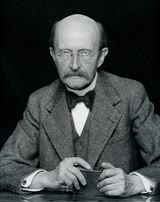 Max Planck
Questions
- When was Alexander von Humboldt born?
- Alexander von Humboldt was born on 14 September 1769 in Berlin.
- What positions has Alexander von Humboldt held?
- Positions held by Alexander von Humboldt include: Geheimrat.
- Where did Alexander von Humboldt study?
- Alexander von Humboldt was educated at University of Frankfurt an der Oder, Freiberg University of Mining and Technology, University of Göttingen, University of Jena.
Sources
- Wikipedia (English): Alexander von Humboldt · CC BY-SA 4.0
- Wikidata item Q6694 · CC0 1.0
- Image: Stieler, Joseph Karl - Alexander von Humboldt - 1843.jpg by Joseph Karl Stieler (Public domain)

Last updated · facts checked 4 November 2026
Cite this page
"Alexander von Humboldt". DigiNepal. Last updated 31 October 2026. https://diginpl.com/people/alexander-von-humboldt. Retrieved 4 November 2026.
Is this you, or do you work in this person's office? Claim this profile