Rato Machindranath Jatra
रातो मच्छिन्द्रनाथको रथजात्रा
Holiday in Kathmandu ValleyBuddhistNewar
Dates
| 2083 BS | Public holiday on the day it falls; date to be announced. | Date to be announced source |
| 2083 BS | Date to be announced | Date to be announced |
| 2084 BS | Date to be announced | Date to be announced |
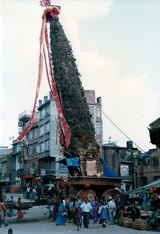
Rato Machindranath Jatra (Nepali: रातो मच्छिन्द्रनाथको रथयात्रा), also known as Buṅga Dyaḥ Jātrā (Newar: बुंग द्यः जात्रा) is a Nepalese chariot festival which is held in Lalitpur, Nepal. It is one of the greatest religious events in the city and the longest chariot festival celebrated in the country.
The festival is dedicated to Buṅga Dyaḥ, who is also venerated as Karunamaya (Newar: करुणामय, "the compassionate one"), an aspect of the Bodhisattva Avalokiteśvara and is popularly believed to bring the monsoon rains.
He is also identified as an aspect of the Hindu saintes Machhindranātha. More specifically, he is referred as Rato Machhindranath in Nepali, where Rato, meaning "red", is a reference to the colour of the deity's image. The chariot festival is held according to the lunar calendar, so the date is changeable. It begins on the 4th day of the bright fortnight of Bachhalā, the seventh month in the lunar Nepal Sambat calendar.
Observed by: Nepalese
Chariot procession
The chariot procession was instituted to celebrate the arrival of Bunga Dyah in Nepal and the end of a devastating drought. It was started when Narendra Deva was the king (640-683 AD). Preparations for the festival begin with the construction of a 60-foot tall chariot at Pulchok at the western end of Lalitpur. When the chariot is complete, the image of Bunga Dyah from his temple is installed in it. Revellers then drag the chariot through the streets of Lalitpur on a tour that lasts a month. The chariot of Bunga Dyah is accompanied on the journey by a similar but smaller chariot of Chākuwā Dyah (चाकुवा द्यः). The route of the chariot procession starts at Pulchok and passes through Gabahal, Mangal Bazar, Hakha, Sundhara, Chakrabahil, Lagankhel and ends at Jawalakhel. As per time-honored tradition, the chariot is pulled exclusively by men on the stretch between the localities of Iti and Thati. This part of the chariot procession is known as Yākah Misāyā Bhujyā (याकः मिसाया भुज्या). The parade finishes at the open ground of Jawalakhel which is situated at the western side of Lalitpur. There, the festivities conclude with the ceremony of Bhoto Jatra, the display of the bhoto, a traditional Nepalese vest. During the "Barha Barsa Jatra", that happens once in every 12 years, the chariot of the Machhindranath is constructed at Bungamati. The chariot is pulled all the way from Bungamati through Bhaisepati, Nakkhu, Bhanimandal, Jhamsikhel and to Pulchowk. The chariot is pulled from Jhamsikhel (near Ideal Model School) to Pulchowk at night.
History
In the past, for 12 years, there was no rainfall, and all the river dried off. To find out the solution to this problem, the King of Bhaktapur kingdom at that time went to Swayambhu to meet Tantrik. Then, the Tantrik said that Guru Gorakhnath was angry, so he was meditating on the cushion of 9 mighty serpents whose duty was to make of rainfall in the valley. Until and unless the serpents would be free, rainfall wouldn't happen in the valley. It was possible only when his teacher Rato Machhindranath met him. So the king started searching for his teacher. After some time, they found out that Machhindranath was reborn as the 108th son of King Sashi in Assam. Then the king of Bhaktapur, Tantrik from Kathmandu, and a Newar from Lalitpur went to Assam to bring Machhindranath back. They knew that it wouldn’t be easy to get him back because he was the son of Daitya. They tried a lot of techniques but they were not successful in bringing him back. Then the Tantrik called 4 Bhairabs and asked them to bring him back. Bhairabs brought him back to Guru Gorakhnath, whose anger settled down and he became calm after seeing his teacher. Finally, the serpents were free and the rain started raining on the valley. Now, the king, Tantrik, and Newar couldn't decide where Rato Machhindranath should be kept, so they went to Lalitpur King to find the solution. Lalitpur King was very clever as he chose to keep Rato Machhindranath in Lalitpur. From that day, every year, people celebrate this festival in Lalitpur and pray for good rainfall.
