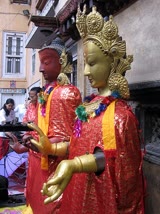
Gunla
BuddhistNewar
Dates
| 2083 BS | Date to be announced | Date to be announced |
| 2084 BS | Date to be announced | Date to be announced |
Gunlā (Nepal Bhasa: गुँला) (also spelt Gumlā) is the tenth month in the Nepal Sambat lunar calendar, the national lunar calendar of Nepal. It corresponds to August in the Gregorian calendar.
Gunla is a holy month for Newar Buddhists when they recite the scriptures, observe fasts and visit places of worship playing devotional music. It is one of the most important events in Newar Buddhism. The practice of observing the sacred month is descended from the rains retreat dating from the Buddha's time when monks would stay in one place and teach the Dhamma to the locals during this period.
According to traditional beliefs, during primitive times, too much rain would fall. Due to this rain, the mud houses during the time would get devastated, moreover floods and landslides would add melancholy in people's lives. So, in order to downturn the melancholy, and be safe from floods and landslides, people would go to Swayambhu playing the devotional music as it was in an elevation.
Observed by: Nepalese Buddhists
Observances
Devotees mark the holy month by making daily early morning pilgrimages to Swayambhu in Kathmandu and other Buddhist temples playing Gunla Bajan music. The musical bands represent various localities of the city. The devout recite the scriptures at home and sacred courtyards. Some undergo fasting. Another devotional activity during Gunla is Dyah Thāyegu (द्यः थायेगु) when devotees make little stupas out of black clay using a mold.
Other celebrations
The 5th day of the bright fortnight is Nag Panchami, a day dedicated to serpents. The 1st day of the dark fortnight is Sāpāru or Gai Jātrā when processions are held in memory of family members deceased in the past year. The participants wear cow costumes and make a tour of the city. The 8th day of the dark fortnight is the festival of Krishna Janmashtami which celebrates the birth of the Hindu deity Krishna. Gokarna Aunsi falls on the 15th day of the dark fortnight or Āmāi. This is Father's Day and is also known as Bauyā Khwā Swayegu ("Looking upon Father's Face").
