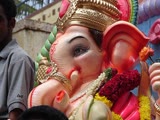
Ganesh Chaturthi
गणेश चतुर्थी
Hindu
Dates
| 2083 BS | Varies depending on lunar cycle as per Hindu calendar or Panchang — date to be announced | Date to be announced |
| 2084 BS | Varies depending on lunar cycle as per Hindu calendar or Panchang — date to be announced | Date to be announced |
When: Varies depending on lunar cycle as per Hindu calendar or Panchang (Wikipedia)
Ganesh Chaturthi (ISO: Gaṇeśa Caturthī) (transl. Festival of Ganesha on the Fourth Day), also known as Vinayaka Chavithi (Vināyaka Cavithī), or Vinayagar Chaturthi (Vināyagar Caturthī), is a Hindu festival celebrating the arrival of the Hindu deity Ganesha to the south of India to meet his brother Karthikeya. The festival is marked with the installation of Ganesha's murtis (devotional representations of a deity), privately in homes and publicly on elaborate pandals (temporary stages). Observances include chanting of Vedic hymns and Hindu texts, such as prayers and vrata (fasting). Offerings and prasada from the daily prayers, which are distributed from the pandal to the community, include sweets such as modak, as it is believed to be a favourite of Ganesha. The festival ends on the tenth day after its start, when the murti is carried in a public procession with music and group chanting, and then immersed in a nearby body of water such as a river or sea, called visarjana on the day of Ananta Chaturdashi. In Mumbai alone, around 150,000 murtis are immersed annually. It is a state festival of Indian state Maharashtra.
The festival celebrates Ganesha as the god of new beginnings, the remover of obstacles, and the god of wisdom, fortune, prosperity and intelligence. It is observed throughout the Indian subcontinent by Hindus, especially in the states such as Maharashtra, Madhya Pradesh, Gujarat, Uttar Pradesh, Karnataka, Odisha, Telangana, Andhra Pradesh, Tamil Nadu, Kerala, and Goa, as well as Sri Lanka. Ganesh Chaturthi is also observed by the Hindu diaspora elsewhere such as in Australia, New Zealand, Canada, Singapore, Malaysia, Sri Lanka, Trinidad and Tobago, Guyana, Suriname, other parts of the Caribbean, Fiji, Mauritius, South Africa, the United States, and Europe. In the Gregorian calendar, Ganesh Chaturthi falls between 22 August and 20 September every year. Reading of texts, feasting, athletic and martial arts competitions are held at public venues.
Although the exact origin of Ganesh Chaturthi is unknown, public celebrations were popularized by Chatrapati Shivaji Maharaj in the 1600s, who used the celebration as a means to promote harmony and unity across castes. Celebrations were re-popularized by Bal Gangadhar Tilak in the 1880s as a means to rebel against the British, who had banned public assemblies in India. The celebration served as an opportunity to unify Indians across castes and protest against British rule in India.
नेपालीमा
गणेश चतुर्थी हिन्दुहरूको एक प्रमुख उत्सव हो । यो उत्सव भारतको महाराष्ट्र लगायत अन्य स्थानमा निकै धूमधामले मनाइन्छ । गणेश चतुर्थी देखि अनन्त चतुर्दशी (अनन्त चौदस) सम्म दस दिन गणेशोत्सव मनाइन्छ ।
Observed by: Hindus around the world
Celebration in India
In India, Ganesh Chaturthi is primarily celebrated at home and in public by local community groups in the central and western states of Maharashtra, Madhya Pradesh, Gujarat, Uttar Pradesh, Rajasthan and Goa and the southern states of Karnataka, Andhra Pradesh, Telangana, Tamil Nadu, and Kerala and eastern states of West Bengal and Odisha and in North eastern state of Assam. On the same day, Chaurchan festival is celebrated in Mithila region of Bihar which is related to Ganesha and Chandra, the Hindu moon god. The date for the festival is usually decided by the presence of Chaturthi Thithi. The festival is held during "Bhadrapada Madyahanaa Purvabaddha". If the Chaturthi Thiti begins at night on the previous day and gets over by morning on next day, then the next day is observed as Vinayaka Chaturthi. In the consecration ceremony, a priest performs a Prana Pratishtha to invite Ganesh like a guest. This is followed by the 16-step Shodashopachara ritual, (Sanskrit: Shodash, 16; Upachara, process) during which coconut, jaggery, modaks, durva grass and red hibiscus (Jaswand) flowers are offered to the idol. Depending on the region and time zone, the ceremony commences with hymns from the Rigveda, the Ganapati Atharvashirsa, the Upanishads and the Ganesh stotra (prayer) from the Narada Purana are chanted. In Maharashtra as well as Goa, aarti is performed with friends and family, typically in the morning and evening. In preparation for the festival, artisans create clay models of Ganesha for sale.
Domestic celebration
In Maharashtra, Ganesh Chaturthi is known as Ganeshotsav. Families install small clay Murtis for worship during the festival. At home, the festival preparation includes purchases such as puja items or accessories a few days in advance and booking the Ganesh murti as early as a month beforehand (from local artisans). The murti is brought home either a day before or on the day of the Ganesh Chaturthi itself. Families decorate a small, clean portion of the house with flowers and other colourful items before installing the idol. When the Murti is installed, it and its shrine are decorated with flowers and other materials. On the day of the festival, The ceremonial installation of the clay murti (idol) is done along with chants of holy Ganesh mantras, and puja including bhajans during a certain auspicious period of the day. The Murti is worshipped in the morning and evening with offerings of flowers, durva (strands of young grass), karanji and modaks (jaggery and coconut flakes wrapped in rice flour dumplings). The worship ends with the singing of an aarti in honour of Ganesh, other Gods and Saints. In Maharashtra the Marathi aarti "Sukhakarta Dukhaharta", composed by the 17th-century saint, Samarth Ramdas is sung. Family traditions differ about when to end the celebration. Domestic celebrations end after 1+1⁄2, 3, 5, 7 or 11 days. At that time the Murti is ceremoniously brought to a body of water (such as a lake, river or the sea) for immersion.
Public celebration
Public celebrations of the festival are popular and are organised by local youth groups, neighbourhood associations, or groups of tradespeople. Funds for the public festival are collected from members of the association arranging the celebration, local residents and businesses. The Ganesh idols and accompanying Murti are installed in temporary shelters, known as mandaps or pandals. Public preparations begin months in advance. The making of the Murti in Maharashtra usually begins with "Padya pooja" or worshipping the feet of Ganesh. The Murtis are brought to "pandals" on the day or a day before the festival begins. The pandals have elaborate decoration and lighting. The festival features cultural activities such as singing, theatre and orchestral performances and community activities such as free medical checkups, blood-donation sites and donations to the poor. Ganesh Chaturthi, in addition to its religious aspects, is an important economic activity in Mumbai, Pune, Nagpur, Nashik, Kolhapur, Khamgaon, Aurangabad, Indore, Agra, Surat, Hyderabad, Visakhapatnam, Bangalore, Chennai, Thiruvananthapuram and Kurnool. Many artists, industries, and businesses earn a significant amount of their living from the festival, which is a stage for budding artists. Members of other religions also participate in the celebration. In Tamil Nadu, the festival, also known as Vinayaka Chaturthi or Pillayar Chaturthi, falls on the fourth day after the new moon in the month of Āvaṇi in the Tamil calendar.
Ganesh Chaturthi celebrations in Hyderabad
Hyderabad is known for its large public Ganesh Chaturthi celebrations, particularly the Khairatabad Ganesh. In 2026, the Khairatabad idol stood 69 feet tall and depicted Panchamukha Sankatahara Maha Ganapati, a five-faced form of Ganesha. It was constructed using natural clay, sand, straw and other materials. During the same year, the Tiranga Youth Association installed a 72-foot Shri Ashta Siddhi Mahaganpati idol in Nagole, surpassing the Khairatabad idol in height. The Nagole idol was constructed by artisans from Telangana and West Bengal using clay, bamboo, grass and other natural materials. Both installations reflected efforts by festival organizers to reduce the environmental impact of celebrations by using alternatives to conventional plaster-of-Paris idols.
Celebration outside India
In Pakistan, Ganesh Chaturthi celebrations are conducted by the Shri Maharashtra Panchayat, an organisation for Maharashtrians in Karachi. Ganesh Chaturthi is celebrated in the UK by the British Hindu population living there. The Hindu Culture and Heritage Society, a Southall-based organisation, celebrated Ganesh Chaturthi for the first time in London in 2005 at the Vishwa Hindu Temple; and the idol was immersed in the River Thames at Putney Pier. Another celebration, organised by a Gujarati group, has been celebrated in Southend-on-Sea, and attracted an estimated 18,000 devotees. Annual celebrations are also held on the River Mersey in Liverpool, in the North Sea at Clacton-on-Sea, and Caldecotte Lake in Milton Keynes. The Philadelphia Ganesh Festival is one of the most popular celebrations of Ganesh Chaturthi in North America, and it is also celebrated in Canada (particularly in the Toronto area), Detroit Metropolitan area-Wayne State university, Mauritius, Malaysia and Singapore. The Mauritius festival dates back to 1896, and the Mauritian government has made it a public holiday. In Malaysia and Singapore, the festival is more commonly known as Vinayagar Chaturthi because of the large Tamil-speaking Hindu minority. In Ghana, ethnic African Hindus celebrate Ganesh Chaturthi. In Tenerife (Spain), is one of the few places in Europe where Ganesh Chaturthi is celebrated publicly. In Fiji Islands, Thakur Lal Waghela started Ganesh Chaturthi in 1985.
