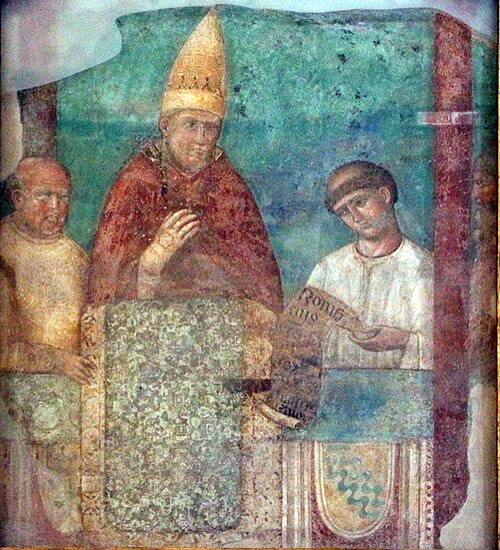
Pope Boniface VIII
Pope of the Catholic Church from 1294 to 1303
नेपालीमा पढ्नुहोस् · हिंदी में पढ़ें
- नेपाली · English · हिंदीRead in your language
- CitedEvery fact sourced
- Ad-freeNo ads, no tracking
Pope Boniface VIII (Latin: Bonifacius PP. VIII, Italian: Bonifacio VIII; born Benedetto Caetani; c. 1230 – 11 October 1303) was head of the Catholic Church and leader of the Papal States from 24 December 1294 until his death in 1303. The Caetani family was of baronial origin with connections to the papacy. He succeeded Pope Celestine V, who had abdicated from the papal throne. Boniface spent his early pontificate abroad in diplomatic roles.
Quick facts
Positions held wd
- Pope (31 December 1294 – 11 October 1303)
- cardinal (since 12 April 1281)
- cardinal-deacon
About
Boniface VIII put forward some of the strongest claims of any pope to temporal as well as spiritual power. He involved himself often with foreign affairs, including in France, Sicily, Italy, and the First War of Scottish Independence. These views, and his chronic intervention in temporal affairs, led to many bitter quarrels with Albert I of Germany, Philip IV of France, and later Dante Alighieri, who expected the pope to soon arrive at the eighth circle of Hell in his Divine Comedy, among the simoniacs.
Boniface systematized canon law by collecting it in a new volume, the Liber Sextus (1298), which continues to be important source material for canon lawyers. He established the first Catholic jubilee year to take place in Rome. Boniface had first entered into conflict with King Philip IV in 1296 when the latter sought to reinforce the nascent nation state by imposing taxes on the clergy and barring them from administration of the law. Boniface excommunicated Philip and all others who prevented French clergy from traveling to the Holy See, after which the king sent his troops to attack the pope's residence in Anagni on 7 September 1303 and capture him. Boniface was held for three days. He died a month afterwards.
King Philip IV pressured Pope Clement V of the Avignon Papacy into staging a posthumous trial of Boniface. He was accused of heresy, but no verdict against him was delivered.
People also search for
 Pope Telesphorus
 Pope Gregory XIII
 Pope Clement VII
 Pope Pius I
 Pope Boniface I
 Pope Agapetus I
 Pope Hormisdas
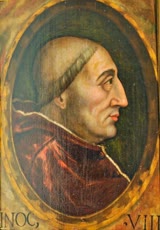 Pope Innocent VIII
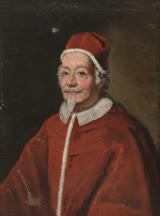 Pope Alexander VIII
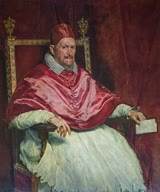 Pope Innocent X
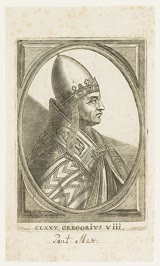 Pope Gregory VIII
 Pope Paul II
Questions
- When was Pope Boniface VIII born?
- Pope Boniface VIII was born on 23 January 1235 in Anagni.
- What positions has Pope Boniface VIII held?
- Positions held by Pope Boniface VIII include: Pope (1294–1303); cardinal (since 12 April 1281); cardinal-deacon.
- Where did Pope Boniface VIII study?
- Pope Boniface VIII was educated at University of Bologna.
Sources
- Wikipedia (English): Pope Boniface VIII · CC BY-SA 4.0
- Wikidata item Q134646 · CC0 1.0
- Image: Giotto, bonifacio VIII proclama il giubileo del 1300, frammento 02.jpg by Giotto (Public domain)

Last updated · facts checked 4 November 2026
Cite this page
"Pope Boniface VIII". DigiNepal. Last updated 3 November 2026. https://diginpl.com/people/pope-boniface-viii. Retrieved 5 November 2026.
Is this you, or do you work in this person's office? Claim this profile