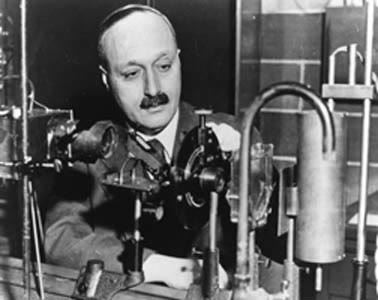
James Franck
German-American physicist (1882–1964)
नेपालीमा पढ्नुहोस् · हिंदी में पढ़ें
- नेपाली · English · हिंदीRead in your language
- CitedEvery fact sourced
- Ad-freeNo ads, no tracking
James Franck (German: [ˈdʒɛɪ̯ms ˈfʁaŋk] ; 26 August 1882 – 21 May 1964) was a German–American physicist who shared the 1925 Nobel Prize in Physics with Gustav Hertz "for their discovery of the laws governing the impact of an electron upon an atom."
Quick facts
Awards wd
- Nobel Prize in Physics (1925)
- Max Planck Medal (1951)
- Rumford Prize (1955)
- Dannie Heineman Prize (1961)
- Foreign Member of the Royal Society (1964)
- Iron Cross (1914), 1st class (1917)
- Hanseatic Cross (Hamburg) (1916)
- honorary member of the Physics Association (Frankfurt am Main, Germany) (1928)
- Iron Cross (1914), 2nd class (1915)
About
Franck completed his doctorate in 1906 and his habilitation in 1911 at the Frederick William University in Berlin, where he lectured and taught until 1918, having reached the position of professor extraordinarius. He served as a volunteer in the German Army during World War I. He was seriously injured in 1917 in a gas attack and was awarded the Iron Cross 1st Class.
Franck became the head of the physics division of the Kaiser Wilhelm Gesellschaft for Physical Chemistry. In 1920, Franck became professor ordinarius of experimental physics and Director of the Second Institute for Experimental Physics at the University of Göttingen. While there he worked on quantum physics with Max Born, who was Director of the Institute of Theoretical Physics. His work included the Franck–Hertz experiment, an important confirmation of the Bohr model of the atom. He promoted the careers of women in physics, notably Lise Meitner, Hertha Sponer, and Hilde Levi.
After the Nazi Party came to power in Germany in 1933, Franck resigned from his position at the University of Göttingen in protest against the dismissal of fellow colleagues. He assisted Frederick Lindemann in helping dismissed Jewish scientists find work overseas, before he left Germany in November. After a year at the Niels Bohr Institute in Denmark, he moved to the United States, where he worked at Johns Hopkins University in Baltimore and then the University of Chicago. During this period he became interested in photosynthesis.
Franck participated in the Manhattan Project during World War II as director of the chemistry division of the Metallurgical Laboratory. He was also the…
People also search for
 Jan Koum
 Joe Gebbia
 Luke Nosek
 Miriam Adelson
 Adam Riess
 Alan J. Heeger
 Alfred G. Gilman
 Alfred Hershey
 Allan MacLeod Cormack
 Andrea M. Ghez
 Andrew Fire
 Andrew Schally
Questions
- When was James Franck born?
- James Franck was born on 26 August 1882 in Hamburg.
- Where did James Franck study?
- James Franck was educated at Heidelberg University, Humboldt-Universität zu Berlin, Wilhelm-Gymnasium.
Sources
- Wikipedia (English): James Franck · CC BY-SA 4.0
- Wikidata item Q57066 · CC0 1.0
- Image: James Franck.jpg (Public domain)

Last updated · facts checked 6 November 2026
Cite this page
"James Franck". DigiNepal. Last updated 1 November 2026. https://diginpl.com/people/james-franck. Retrieved 6 November 2026.
Is this you, or do you work in this person's office? Claim this profile