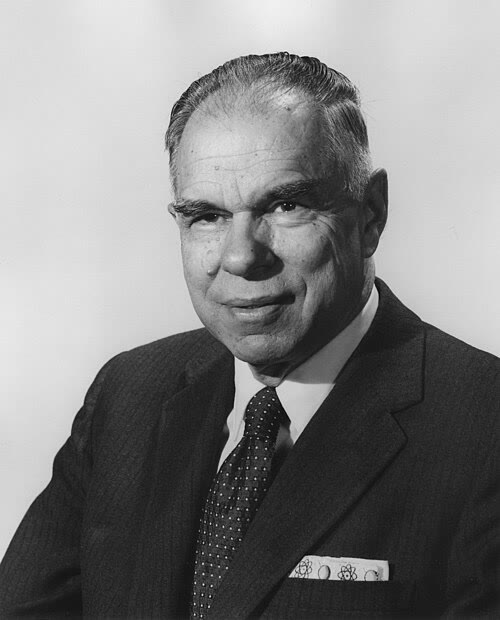
Glenn T. Seaborg
American chemist (1912–1999)
नेपालीमा पढ्नुहोस् · हिंदी में पढ़ें
- नेपाली · English · हिंदीRead in your language
- CitedEvery fact sourced
- Ad-freeNo ads, no tracking
Glenn Theodore Seaborg ( SEE-borg; April 19, 1912 – February 25, 1999) was an American chemist whose involvement in the synthesis, discovery and investigation of ten transuranium elements earned him a share of the 1951 Nobel Prize in Chemistry. His work in this area also led to his development of the actinide concept and the arrangement of the actinide series in the periodic table of the elements.
Quick facts
Awards wd
- Nobel Prize in Chemistry (1951)
- Priestley Medal (1979)
- Perkin Medal (1957)
- John Scott Award (1952)
- Franklin Medal (1963)
- ACS Award in Pure Chemistry (1947)
- Enrico Fermi Award (1959)
- Swedish American of the Year (1962)
- Legion of Honour (1973)
- National Inventors Hall of Fame (2005)
- Clark Kerr Medal (1986)
- Vannevar Bush Award (1988)
- National Medal of Science (1991)
- Royal Order of the Polar Star (1992)
- American Institute of Chemists Gold Medal (1973)
About
Seaborg spent most of his career as an educator and research scientist at the University of California, Berkeley, serving as a professor, and, between 1958 and 1961, as the university's second chancellor. He advised ten US presidents—from Harry S. Truman to Bill Clinton—on nuclear policy and was Chairman of the United States Atomic Energy Commission from 1961 to 1971, where he pushed for commercial nuclear energy and the peaceful applications of nuclear science. Throughout his career, Seaborg worked for arms control. He was a signatory to the Franck Report and contributed to the Limited Test Ban Treaty, the Nuclear Non-Proliferation Treaty and the Comprehensive Test Ban Treaty. He was a well-known advocate of science education and federal funding for pure research. Toward the end of the Eisenhower administration, he was the principal author of the Seaborg Report on academic science, and, as a member of President Ronald Reagan's National Commission on Excellence in Education, he was a key contributor to its 1983 report "A Nation at Risk".
Seaborg was the principal or co-discoverer of ten elements: plutonium, americium, curium, berkelium, californium, einsteinium, fermium, mendelevium, nobelium and element 106, then called unnilhexium, which while he was still living, was named seaborgium in his honor. He said about this naming, "This is the greatest honor ever bestowed upon me—even better, I think, than winning the Nobel Prize. Future students of chemistry, in learning…
People also search for
 Ahmed Zewail
 Aziz Sancar
 Frances Arnold
 Harold Urey
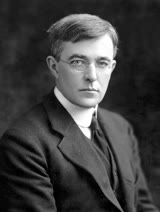 Irving Langmuir
 Jennifer Doudna
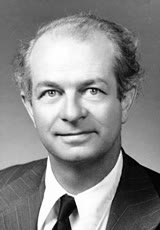 Linus Pauling
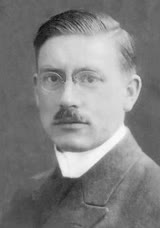 Peter Debye
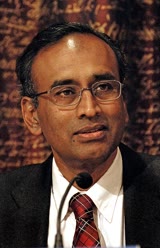 Venki Ramakrishnan
Questions
- When was Glenn T. Seaborg born?
- Glenn T. Seaborg was born on 19 April 1912 in Ishpeming.
- Where did Glenn T. Seaborg study?
- Glenn T. Seaborg was educated at University of California, Berkeley, University of California, Los Angeles, Jordan High School.
Sources
- Wikipedia (English): Glenn T. Seaborg · CC BY-SA 4.0
- Wikidata item Q48973 · CC0 1.0
- Image: Glenn Seaborg - 1964.jpg by Atomic Energy Commission. (1946 - 01/19/1975) (Public domain)

Last updated · facts checked 3 November 2026
Cite this page
"Glenn T. Seaborg". DigiNepal. Last updated 31 October 2026. https://diginpl.com/people/glenn-t-seaborg. Retrieved 4 November 2026.
Is this you, or do you work in this person's office? Claim this profile