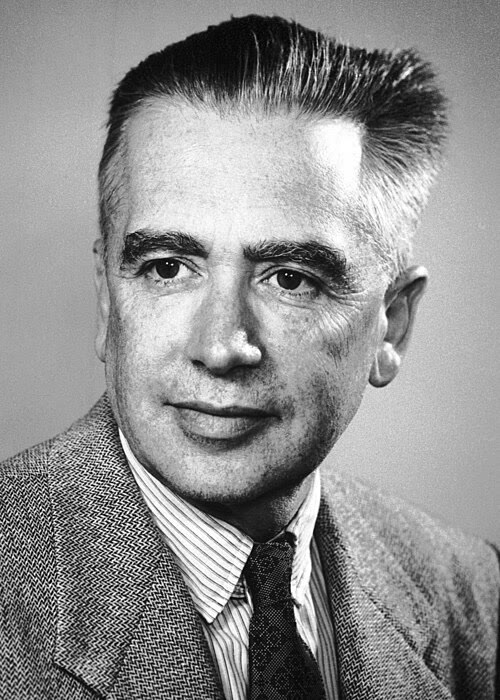
Emilio Segrè
Italian physicist and Nobel laureate
नेपालीमा पढ्नुहोस् · हिंदी में पढ़ें
- नेपाली · English · हिंदीRead in your language
- CitedEvery fact sourced
- Ad-freeNo ads, no tracking
Emilio Gino Segrè ( sə-GRAY; Italian: [eˈmiːljo ˈdʒiːno seˈgrɛ]; 1 February 1905 – 22 April 1989) was an Italian-American nuclear physicist and radiochemist who discovered the elements technetium and astatine, and the antiproton, a subatomic antiparticle, for which he was awarded the Nobel Prize in Physics in 1959, along with Owen Chamberlain.
Quick facts
Awards wd
- Guggenheim Fellowship (1958)
- Nobel Prize in Physics (1959)
- August Wilhelm von Hofmann Medal (1953)
- Richtmyer Memorial Lecture Award (1957)
- Fellow of the American Physical Society
About
Born in Tivoli, near Rome, Segrè studied engineering at the University of Rome La Sapienza before taking up physics in 1927. Segrè was appointed assistant professor of physics at the University of Rome in 1932 and worked there until 1936, becoming one of the Via Panisperna boys. From 1936 to 1938 he was director of the Physics Laboratory at the University of Palermo. After a visit to Ernest O. Lawrence's Berkeley Radiation Laboratory, he was sent a molybdenum strip from the laboratory's cyclotron accelerator in 1937, which was emitting anomalous forms of radioactivity. Using careful chemical and theoretical analysis, Segrè was able to prove that some of the radiation was being produced by a previously unknown element, named technetium, the first artificially synthesized chemical element that does not occur in nature.
In 1938 and while Segrè was visiting the Berkeley Radiation laboratory, Benito Mussolini's fascist government passed antisemitic laws barring Jews from university positions. As a Jew, Segrè was rendered an indefinite émigré. At the Berkeley Radiation Lab, Lawrence offered him an underpaid job as a research assistant. There, Segrè helped discover the element astatine and the isotope plutonium-239, which was later used to make the Fat Man nuclear bomb dropped on Nagasaki. From 1943 to 1946 he worked at the Los Alamos National Laboratory as a group leader for the Manhattan Project. He found in April 1944 that Thin Man, the proposed plutonium gun-type nuclear weapon, would not work due to the presence of…
People also search for
 Jan Koum
 Joe Gebbia
 Luke Nosek
 Miriam Adelson
 Adam Riess
 Alan J. Heeger
 Alfred G. Gilman
 Alfred Hershey
 Allan MacLeod Cormack
 Andrea M. Ghez
 Andrew Fire
 Andrew Schally
Questions
- When was Emilio Segrè born?
- Emilio Segrè was born on 1 February 1905 in Tivoli.
- Where did Emilio Segrè study?
- Emilio Segrè was educated at Sapienza University of Rome.
Sources
- Wikipedia (English): Emilio Segrè · CC BY-SA 4.0
- Wikidata item Q173028 · CC0 1.0
- Image: Segre.jpg by Nobel foundation (Public domain)

Last updated · facts checked 4 November 2026
Cite this page
"Emilio Segrè". DigiNepal. Last updated 1 November 2026. https://diginpl.com/people/emilio-segre. Retrieved 4 November 2026.
Is this you, or do you work in this person's office? Claim this profile