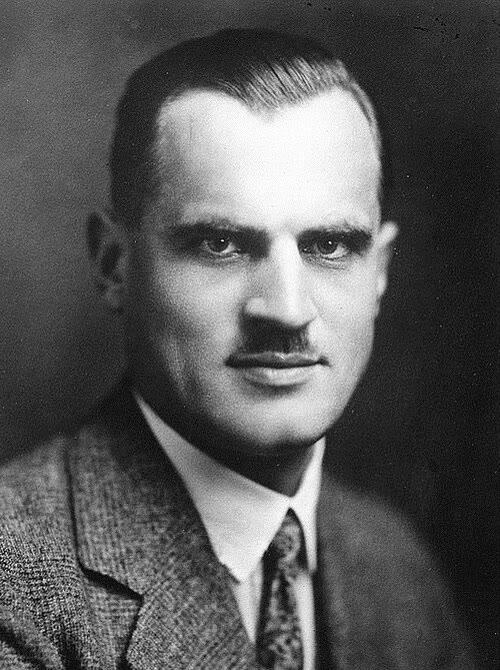
Arthur Compton
American physicist (1892–1962)
नेपालीमा पढ्नुहोस् · हिंदी में पढ़ें
- नेपाली · English · हिंदीRead in your language
- CitedEvery fact sourced
- Ad-freeNo ads, no tracking
Arthur Holly Compton (September 10, 1892 – March 15, 1962) was an American physicist who shared the 1927 Nobel Prize in Physics with C. T. R. Wilson for his discovery of the Compton effect, which demonstrated the particle nature of electromagnetic radiation. It was a significant discovery at the time; the wave nature of light had been well-demonstrated, but the idea that light had both wave and particle properties was not easily accepted.
Quick facts
- Born
- wd
- Place of birth
- Wooster wd
- Died
- wd
- Place of death
- Berkeley wd
- Citizenship
- United States wd
- Occupation
- physicist, university teacher, theoretical physicist, nuclear physicist wd
- Education
- Princeton University, College of Wooster, University of Chicago, University of Minnesota, Bluffton University, Cavendish Laboratory wd
- Spouse
- Betty Charity McCloskey wd
Positions held wd
- board member (14 March 1957 – 15 March 1962)
- board member (20 June 1938 – 20 September 1956)
Awards wd
- Pour le Mérite for Sciences and Arts order
- Guggenheim Fellowship (1926)
- Nobel Prize in Physics (1927)
- Hughes Medal (1940)
- Matteucci Medal (1930)
- Rumford Prize (1926)
- X-ray badge (1957)
- Franklin Medal (1940)
- Richtmyer Memorial Lecture Award (1941)
- Guthrie Lecture (1935)
- Fellow of the American Association for the Advancement of Science
- Honorary Fellow of the Royal Society Te Apārangi
About
In 1919, Compton was awarded one of the first two National Research Council Fellowships that allowed students to study abroad. He chose to go to the University of Cambridge's Cavendish Laboratory in England, where he studied the scattering and absorption of gamma rays. Further research along these lines led to the discovery of the Compton effect.
Compton used X-rays to investigate ferromagnetism, concluding that it was a result of the alignment of electron spins, and studied cosmic rays, discovering that they were made principally of positively charged particles.
During World War II, Compton was a key figure in the Manhattan Project that developed the first nuclear weapons. His reports were important in launching the project. In 1942, he became a member of the S-1 Executive Committee, and then head of the "X" projects overseeing the Metallurgical Laboratory, with responsibility for producing nuclear reactors to convert uranium into plutonium, finding ways to separate the plutonium from the uranium and to design an atomic bomb. Compton oversaw Enrico Fermi's creation of Chicago Pile-1, the first nuclear reactor, which went critical on December 2, 1942. The Metallurgical Laboratory was also responsible for the design and operation of the X-10 Graphite Reactor at Oak Ridge, Tennessee. Plutonium began being produced in the Hanford Site reactors in 1945.
After the War, Compton became Chancellor of Washington University in St. Louis.…
People also search for
 Millard Fillmore
 Alexander Graham Bell
 Al Gore
 Jefferson Davis
 Larry Ellison
 Lakshmi Mittal
Questions
- When was Arthur Compton born?
- Arthur Compton was born on 10 September 1892 in Wooster.
- What positions has Arthur Compton held?
- Positions held by Arthur Compton include: board member (1957–1962); board member (1938–1956).
- Where did Arthur Compton study?
- Arthur Compton was educated at Princeton University, College of Wooster, University of Chicago, University of Minnesota.
Sources
- Wikipedia (English): Arthur Compton · CC BY-SA 4.0
- Wikidata item Q127944 · CC0 1.0
- Image: Arthur Compton 1927.jpg by Unknown (Mondadori Publishers) (Public domain)

Last updated · facts checked 5 November 2026
Cite this page
"Arthur Compton". DigiNepal. Last updated 1 November 2026. https://diginpl.com/people/arthur-compton. Retrieved 5 November 2026.
Is this you, or do you work in this person's office? Claim this profile