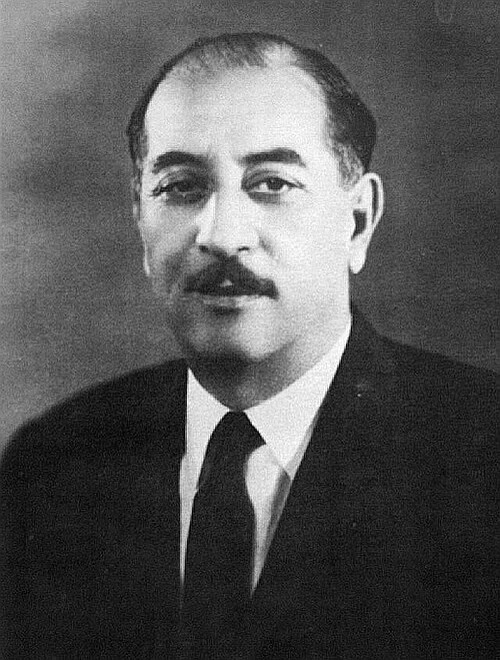
Ahmed Hassan al-Bakr
अहमद हसन अल बकर
Iraqi president (1914–1982)
नेपालीमा पढ्नुहोस् · हिंदी में पढ़ें
- नेपाली · English · हिंदीRead in your language
- CitedEvery fact sourced
- Ad-freeNo ads, no tracking
Ahmed Hassan al-Bakr (1 July 1914 – 4 October 1982) was an Iraqi military officer and politician who served as the fourth president of Iraq from 1968 to 1979. He was a leading member of the revolutionary Arab Socialist Ba'ath Party and later the Baghdad-based Ba'ath Party and its regional organisation Ba'ath Party – Iraq Region (the Ba'ath Party's Iraqi branch), which espoused Ba'athism, a mix of Arab nationalism and Arab socialism.
Quick facts
- Born
- wd
- Place of birth
- Tikrit wd
- Died
- wd
- Place of death
- Baghdad wd
- Citizenship
- Ottoman Empire, Kingdom of Iraq wd
- Occupation
- politician, military personnel, head of government, statesperson wd
- Political party
- Arab Socialist Ba'ath Party – Iraq Region (1966–1982), Ba'ath Party (until 1966) wd
- Education
- Iraqi Military Academy Rustamiyah wd
Positions held wd
- Minister of Defense (11 November 1974 – 15 October 1977)
- Prime Minister of Iraq (31 July 1968 – 16 July 1979)
- President of Iraq (17 July 1968 – 16 July 1979)
- Vice President of Iraq (18 November 1963 – 4 January 1964)
- Prime Minister of Iraq (8 February 1963 – 18 November 1963)
- president
Awards wd
- Collar of the Order of Isabella the Catholic (1978)
- Grand Cross of the Order of Polonia Restituta
About
Al-Bakr first rose to prominence after the 14 July Revolution, which overthrew the monarchy. In the newly established government, he was involved in improving Iraqi–Soviet relations. In 1959 al-Bakr was forced to resign from the Iraqi military; the then Iraqi government accused him of anti-government activities. Following his forced retirement, he became the chairman of the Ba'ath Party's Iraqi branch's Military Bureau. Through this office he recruited members to the Ba'athist cause through patronage and cronyism. Prime Minister Abd al-Karim Qasim was overthrown in the Ramadan Revolution (8 February); al-Bakr was appointed prime minister, and later, Vice President of Iraq in a Ba'ath-Nasserist coalition government. The government lasted for less than a year, and was ousted in November 1963.
Al-Bakr and the party then pursued underground activities and became vocal critics of the government. During this period, al-Bakr was elected the Ba'ath Party's Iraqi branch's Secretary General (the head), and appointed his cousin, Saddam Hussein, the party cell's deputy leader. Al-Bakr and the Ba'ath Party regained power in the coup of 1968, later called the 17 July Revolution. In the coup's aftermath, he was elected the chairman of the Revolutionary Command Council and the president; he was later appointed the prime minister. Saddam, the Ba'ath Party's deputy, became the deputy chairman of the Revolutionary Command Council and vice president, and…
People also search for
 Nouri al-Maliki
 Abdul-Karim Qasim
 Nuri al-Said
 Yasin al-Hashimi
 Abdul Muhsin al-Sa'dun
 Tahir Yahya
 Saddam Hussein
 Jalal Talabani
 Masoud Barzani
 Haider al-Abadi
 Barham Salih
 Fuad Masum
Questions
- When was Ahmed Hassan al-Bakr born?
- Ahmed Hassan al-Bakr was born on 1 July 1914 in Tikrit.
- What positions has Ahmed Hassan al-Bakr held?
- Positions held by Ahmed Hassan al-Bakr include: Minister of Defense (1974–1977); Prime Minister of Iraq (1968–1979); President of Iraq (1968–1979); Vice President of Iraq (1963–1964); Prime Minister of Iraq (1963–1963).
- Where did Ahmed Hassan al-Bakr study?
- Ahmed Hassan al-Bakr was educated at Iraqi Military Academy Rustamiyah.
Sources
- Wikipedia (English): Ahmed Hassan al-Bakr · CC BY-SA 4.0
- Wikipedia (Nepali): अहमद हसन अल बकर · CC BY-SA 4.0
- Wikidata item Q238046 · CC0 1.0
- Image: Ahmad Hassan el Bakr.jpg by Unknown author Unknown author (Public domain)

Last updated · facts checked 18 November 2026
Cite this page
"Ahmed Hassan al-Bakr". DigiNepal. Last updated 11 November 2026. https://diginpl.com/people/ahmed-hassan-al-bakr. Retrieved 20 November 2026.
Is this you, or do you work in this person's office? Claim this profile