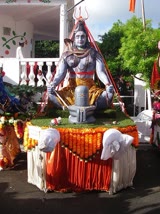
Maha Shivaratri
महाशिवरात्रि
Public holidayHindu
Dates
| 2083 BS | 6 Mar 2027 (22 Falgun 2083 BS) · in 145 days | Official holiday list source |
| 2083 BS | 6 Mar 2027 (22 Falgun 2083 BS) · in 145 days | Reported by Wikipedia source |
| 2084 BS | Maha Krishna Chaturdashi — date to be announced | Date to be announced |
When: Maha Krishna Chaturdashi (Wikipedia)
Maha Shivaratri is a Hindu festival celebrated annually to worship the deity Shiva, between February and March. According to the Hindu calendar, The festival is observed on the caturdaśī (the 14th lunar day) of kṛṣṇapakṣa (waning fortnight) of the month of Māgha (in the Amānta reckoning of months) or Phālguṇa (in the Pūrṇimānta reckoning of months). The discrepancy is only in the name of the month and the festival is observed on the same lunar night across the regions. The festival commemorates the marriage of Shiva and Parvati, and the occasion of Shiva performing his ritual dance called tandava.
It is a notable festival in Hinduism, marking a remembrance of "overcoming darkness and ignorance" in life and the world. It is observed by remembering Shiva and chanting prayers, fasting, and meditating on ethics and virtues such as honesty, non-injury to others, charity, forgiveness, and the discovery of Shiva. Ardent devotees stay awake throughout this night. Others visit one of the Shiva temples or go on a pilgrimage to the Jyotirlingams. The festival is believed to have originated in 5th century BCE.
In Kashmir Shaivism, the festival is called Har-ratri or phonetically simpler Haerath or Herath by Shiva devotees of the Kashmir region.
नेपालीमा
महाशिवरात्री अथवा शिवरात्री हिन्दु धर्मावलम्बीहरूको चाड हो। भगवान शिवको उत्पत्ति भएको रातका नामबाट नामकरण भएको यो पर्व कालरात्री, मोहरात्री, सुखरात्री र शिवरात्री नामक चार प्रमुख रात्री मध्ये एक पवित्र पर्वका रूपमा विभिन्न पुराणहरूमा वर्णित छ। फागुन कृष्ण चतुर्दशीका दिन मनाइने यस पर्वलाई सम्पूर्ण दीन दुःखी र कष्टपूर्ण अवस्थामा रहेका प्राणीहरूको हृदयमा धर्मको उदय गराउने आशुतोष(छिटै खुसी हुने) भगवान् शिवको अति प्यारो दिनका रूपमा पनि लिइने गरिन्छ। व्रत उत्सव मध्ये सर्वोत्तम कहलिएको महाशिवरात्रीका दिन भक्तजनहरूले शुद्ध भई शिव मन्दिरमा पूजा-अर्चना गरि व्रत बस्ने र भगवान् शिवको प्रिय वस्तु दूध, धतुरो र बेलपत्र भगवानलाई चढाउने गर्दछन्। यस पर्वका दिन उपवास गरी " ॐ नमः शिवाय" मन्त्र जप गरेमा सर्वसिद्धि लाभ भई यमलोक जानु नपर्ने धार्मिक विश्वास रहेको छ। ब्रह्माले रूद्ररूपी शिवजीलाई उत्पन्न गरेको दिन, शिव पार्वतीको विवाहको दिन शिवरात्री पर्व कृष्ण चतुर्दशीमा मनाइन्छ। निर्जल व्रत, रात्री जागरण, चार प्रहरको पूजा, शिवलिंगमा दूधको अभिषेक र शिव महिमा कीर्तन शिवरात्रीको पूजा अर्चनाका मुख्य अङ्ग मानिन्छन्। शिवरात्री पर्वलाई पर्वको राजा भनिन्छ र शिवरात्रीको पालनाले भोग र मोक्ष दुवैको प्रप्ति हुन्छ भन्ने मान्यता जनमानसमा रहेको छ। शिवरात्री पूजामा व्रतकालमा भगवान शिवको ध्यान, पूजन र जप गरिन्छ भने जागरण कालमा भक्तको सम्पूर्ण सत्ता जागरणबाट शिवमय बन्दछ। पूजन वा शिवार्चनमा इशान मूर्तिलाई दूधले स्नान गराइन्छ। फागुन कृष्ण चतुर्दशीमा मनाइने यस पर्वमा सृष्टिको प्रारम्भमा यसै दिन मध्यरात्रि कालमा भगवान् शङ्कर ब्रह्माबाट रुद्रका रूपमा अवतरण भएका थिए भन्ने धार्मिक विश्वास रहेको छ। प्रलयकालमा यसै दिन…
Observed by: Hindus
Textual origins
The origin of Maha Shivaratri is mentioned mainly in Puranic literature. One of the first mentions appears in the Shiva Purana, which links the story of the hunter Gurudruha with Shivaratri. The story of Gurudruha, who is also referred to as Lubdhaka, is later found in the Javanese didactic text Siwaratrikalpa, which is dated to being composed between 1466 and 1478. The festival is also mentioned in the Linga Purana and the Skanda Purana.
Archeological origins
According to some scholars, the Lubdhaka (hunter) legend associated with Maha Shivaratri may find its roots in the Indus Valley Civilization. Archaeological evidence such as the Pashupati seal has been widely interpreted by researchers as indicating early forms of Shiva or proto-Shaiva worship. Archaeologist Gregory Possehl identified at least eighteen examples of a recurring "human and tiger" motif in Harappan glyptic art from sites including Harappa, Mohenjo-daro, and Chanhu-daro. These seals closely resemble the story of Gurudruha (Lubdhaka) that appears in the Shiva Purana. Maha Shivaratri is particularly important in the Shaivism tradition of Hinduism. Shivaratri ("Night of Shiva") refers to the monthly observance that falls on the 14th night (chaturdashi) of every lunar fortnight during the waning phase of the moon. Each lunar month therefore contains one Shivaratri. Devotees observe fasting, night vigil (jagarana), and worship of the linga on these days. Thus, Maha Shivaratri may be understood as the "great" or preeminent Shivaratri among the twelve monthly Shivaratris in a lunar year. Unlike most Hindu festivals that are celebrated during the day, Maha Shivaratri is celebrated at night. It is a festival notable for its fasting and meditation on Shiva and an all-night vigil at Shiva temples.
Legends
Maha Shivaratri is mentioned in several Puranas, particularly the Skanda Purana, Linga Purana, and Padma Purana. These medieval era Shaiva texts present different versions associated with this festival, such as fasting, and offering reverence to a lingam—an emblematic figure of Shiva. Different legends describe the significance of Maha Shivaratri. According to one legend in the Shaivism tradition, this is the night when Shiva performs the heavenly dance of creation, preservation and destruction. The chanting of hymns, the reading of Shiva scriptures and the chorus of devotees joins this cosmic dance and remembers Shiva's presence everywhere. According to another legend, this is the night when Shiva and Parvati got married. It is also believed that on this particular day, Shiva gulped the Halahala produced during the Samudra Manthana and held it in his neck, which bruised and turned blue. As a result, he acquired the epithet Nilakantha.
The Lingodbhava legend
The Linga Purana describes another legend known as Lingodbhava (the emergence of the linga) in connection with Maha Shivaratri. In this account, Brahma and Vishnu dispute their supremacy. To settle the debate, a luminous pillar of fire suddenly appeared in front of them. This event was known as lingodbhava (the birth of the Linga). Brahma took the form of a swan and ascended, trying to find its top, while Vishnu took the form of a boar and descended, seeking its bottom. After thousands of years of fruitless search, both conceded that neither could find an end. At that moment, Shiva emerged from within the flame, and the first Linga was born. The day Shiva appeared and declared his eternal nature is believed to be the day of Maha Shivaratri.
The legend of Gurudruha
The Shiva Purana contains the popular and detailed story of a forest hunter named Gurudruha (also called Lubdhaka in Balinese texts), which narrates one of the earliest textual explanations for the ritual practice of bilipatra (bilva) leaf offerings during Maha Shivaratri. On one Maha Shivaratri night, Gurudruha, a hunter with no formal religious background, went to the forest to hunt and bring home food for his parents. To escape the threat of wild animals, he climbed a bilva tree. During the first quarter of the night, a hind deer came to drink from the lake. Gurudruha aimed his bow at her. The frightened deer pleaded for her life, explaining that she had young fawns at home and requesting permission to entrust them to her husband before returning to face death. After some hesitation, he agreed. While waiting for the deer to return and to keep himself awake the whole night, he plucked bilva leaves and dropped them to the forest floor. Unknown to Gurudruha, a lingam rested directly beneath the tree. When dawn arrived, thousands of leaves lay upon the lingam. At dawn, the deer returned with her family and told the hunter that if he wished to kill her, he would also have to take their lives. As he raised his bow once more, additional bilva leaves fell upon the lingam. The accumulated punya (spiritual merit) from the worship he had unknowingly performed throughout the night had destroyed his sins and transformed his heart. Thus, he released the deer. Pleased by Gurudruha's accidental vigil and devotion, Shiva appeared before him and granted a boon.
