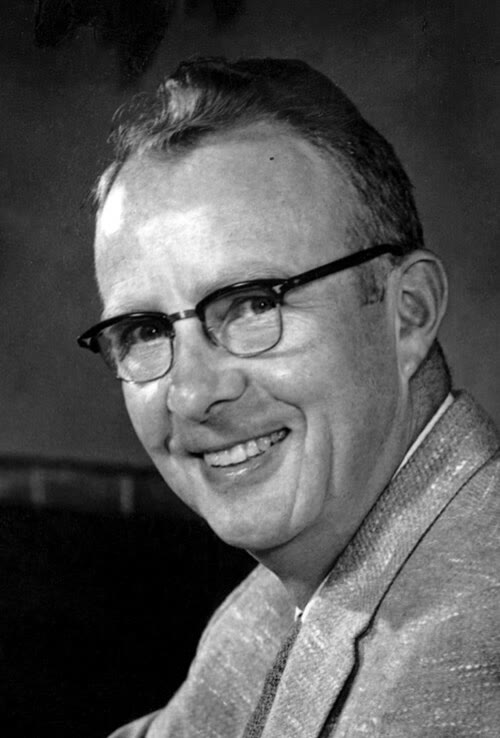
Luis Walter Alvarez
American experimental physicist, inventor, and professor (1911–1988)
नेपालीमा पढ्नुहोस् · हिंदी में पढ़ें
- नेपाली · English · हिंदीRead in your language
- CitedEvery fact sourced
- Ad-freeNo ads, no tracking
Luis Walter Alvarez (June 13, 1911 – September 1, 1988) was an American experimental physicist, inventor, and professor who was awarded the Nobel Prize in Physics in 1968 for his discovery of resonance states in particle physics using the hydrogen bubble chamber. In 2007 the American Journal of Physics commented, "Luis Alvarez was one of the most brilliant and productive experimental physicists of the twentieth century."
Quick facts
Positions held wd
- university teacher
- president
Awards wd
- Nobel Prize in Physics (1968)
- National Medal of Science (1963)
- Collier Trophy (1945)
- Medal for Merit (1947)
- California Scientist of the Year (1960)
- Albert Einstein Award (1961)
- Michelson–Morley Award (1965)
- honorary doctor of the University of Chicago (1967)
- honorary doctor of Carnegie-Mellon University (1968)
- National Inventors Hall of Fame (1978)
- Fellow of the American Physical Society
- John Scott Award (1952)
- Enrico Fermi Award (1987)
- Fellow of the American Academy of Arts and Sciences
- honorary doctorate of the Autonomous University of Madrid
About
After receiving his PhD from the University of Chicago in 1936, Alvarez went to work for Ernest Lawrence at the Radiation Laboratory at the University of California, Berkeley. Alvarez devised a set of experiments to observe K-electron capture in radioactive nuclei, predicted by the beta decay theory but never before observed. He produced tritium using the cyclotron and measured its lifetime. In collaboration with Felix Bloch, he measured the magnetic moment of the neutron.
In 1940, Alvarez joined the MIT Radiation Laboratory, where he contributed to a number of World War II radar projects, from early improvements to Identification friend or foe (IFF) radar beacons, now called transponders, to a system known as VIXEN for preventing enemy submarines from realizing that they had been found by the new airborne microwave radars. The radar system for which Alvarez is best known and which has played a major role in aviation, most particularly in the post war Berlin airlift, was Ground Controlled Approach (GCA). Alvarez spent a few months at the University of Chicago working on nuclear reactors for Enrico Fermi before coming to Los Alamos to work for Robert Oppenheimer on the Manhattan Project. Alvarez worked on the design of explosive lenses, and the development of exploding-bridgewire detonators. As a member of Project Alberta, he observed the Trinity nuclear test from a B-29 Superfortress, and later the bombing of Hiroshima from the B-29 The Great…
People also search for
 Joe Biden
 Woodrow Wilson
 William Howard Taft
 Mahmoud Ahmadinejad
 Mohamed Morsi
 Manmohan Singh
 Donald Trump
 Ronald Reagan
 Abraham Lincoln
 George W. Bush
 Mustafa Kemal Atatürk
 Franklin D. Roosevelt
Questions
- When was Luis Walter Alvarez born?
- Luis Walter Alvarez was born on 13 June 1911 in San Francisco.
- What positions has Luis Walter Alvarez held?
- Positions held by Luis Walter Alvarez include: university teacher; president.
- Where did Luis Walter Alvarez study?
- Luis Walter Alvarez was educated at University of Chicago, San Francisco Polytechnic High School.
Sources
- Wikipedia (English): Luis Walter Alvarez · CC BY-SA 4.0
- Wikidata item Q178344 · CC0 1.0
- Image: LWA Picture Final.jpg by Donald Cooksey / Lawrence Berkeley National Laboratory (per [3] (Public domain)

Last updated · facts checked 5 November 2026
Cite this page
"Luis Walter Alvarez". DigiNepal. Last updated 1 November 2026. https://diginpl.com/people/luis-walter-alvarez. Retrieved 5 November 2026.
Is this you, or do you work in this person's office? Claim this profile