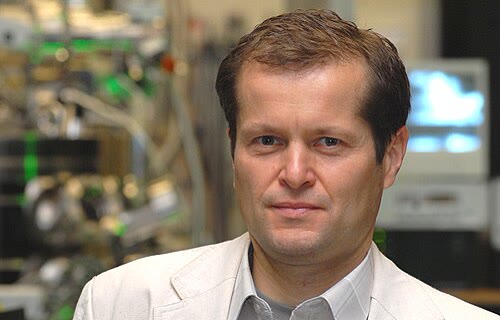
Klaus Hasselmann
German climate researcher, meteorologist, and oceanologist (born 1931)
नेपालीमा पढ्नुहोस् · हिंदी में पढ़ें
- नेपाली · English · हिंदीRead in your language
- CitedEvery fact sourced
- Ad-freeNo ads, no tracking
Klaus Ferdinand Hasselmann (German pronunciation: [klaʊs ˈhasl̩man] ; born 25 October 1931) is a German oceanographer and climate modeller. He is Professor Emeritus at the University of Hamburg and former Director of the Max Planck Institute for Meteorology. He was awarded the 2021 Nobel Prize in Physics jointly with Syukuro Manabe and Giorgio Parisi.
Quick facts
Positions held wd
- deputy chairperson (until 2018)
Awards wd
- Körber European Science Prize (1990)
- BBVA Foundation Frontiers of Knowledge Award (2009)
- James B. Macelwane Medal (1964)
- Nobel Prize in Physics (2021)
- Knight Commander's Cross of the Order of Merit of the Federal Republic of Germany (2022)
- Sverdrup Gold Medal Award (1971)
- Vilhelm Bjerknes Medal (2002)
- Fellow of the American Geophysical Union (1964)
About
Hasselmann grew up in Welwyn Garden City, England and returned to Hamburg in 1949 to attend university. Throughout his career he has mainly been affiliated with the University of Hamburg and the Max Planck Institute for Meteorology, which he founded. He also spent five years in the United States as a professor at the Scripps Institution of Oceanography and the Woods Hole Oceanographic Institution, and a year as a visiting professor at the University of Cambridge.
He is best known for developing the Hasselmann model of climate variability, where a system with a long memory (the ocean) integrates stochastic forcing, thereby transforming a white-noise signal into a red-noise one, thus explaining (without special assumptions) the ubiquitous red-noise signals seen in the climate (see, for example, the development of swell waves).
People also search for
 André Santini
 Jean-Jacques Chevallier
 Antoine François Passy
 Zuzana Čaputová
 Philippe Diallo
Questions
- When was Klaus Hasselmann born?
- Klaus Hasselmann was born on 25 October 1931 in Hamburg.
- What positions has Klaus Hasselmann held?
- Positions held by Klaus Hasselmann include: deputy chairperson (until 2018).
- Where did Klaus Hasselmann study?
- Klaus Hasselmann was educated at University of Göttingen, University of Hamburg, Max Planck Society.
Sources
- Wikipedia (English): Klaus Hasselmann · CC BY-SA 4.0
- Wikidata item Q109370 · CC0 1.0
- Image: Ferenc Krausz.jpg by Thorsten Naeser (uploaded to en.wikipedia by C.laschinger , Transfered by Syp ) (CC BY 2.0)

Last updated · facts checked 4 November 2026
Cite this page
"Klaus Hasselmann". DigiNepal. Last updated 1 November 2026. https://diginpl.com/people/klaus-hasselmann. Retrieved 5 November 2026.
Is this you, or do you work in this person's office? Claim this profile