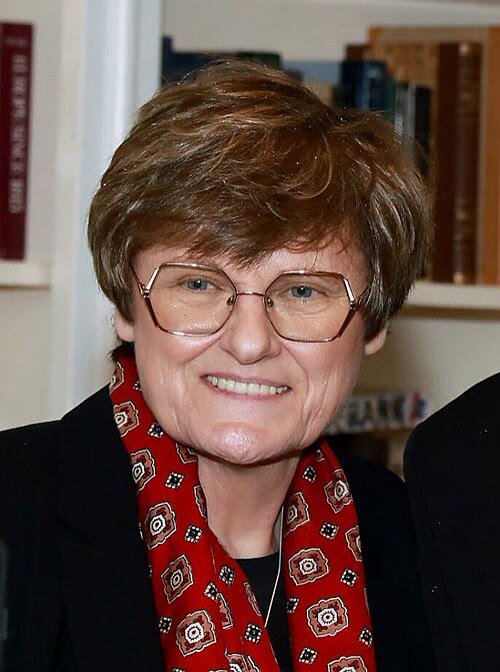
Katalin Karikó
Hungarian biochemist
नेपालीमा पढ्नुहोस् · हिंदी में पढ़ें
- नेपाली · English · हिंदीRead in your language
- CitedEvery fact sourced
- Ad-freeNo ads, no tracking
Katalin "Kati" Karikó (born 17 January 1955) is a Hungarian and American biochemist who specializes in ribonucleic acid (RNA)-mediated mechanisms, particularly in vitro-transcribed messenger RNA (mRNA) for protein replacement therapy. Karikó laid the scientific groundwork for mRNA vaccines, overcoming major obstacles and skepticism in the scientific community. Karikó received the Nobel Prize in Physiology or Medicine in 2023 for her work, along with American immunologist Drew Weissman.
Quick facts
- Born
- wd
- Place of birth
- Szolnok wd
- Citizenship
- Hungary, United States wd
- Occupation
- researcher, biochemist, university teacher, inventor, consultant, neuroscientist wd
- Education
- Móricz Zsigmond Gimnázium és Közgazdasági Szakközépiskola, University of Szeged, University of Szeged wd
- Official website
- pennmedicine.org/providers/profile/katalin-kariko wd
Awards wd
- Rosenstiel Award (2020)
- Széchenyi Prize (2021)
- For Human Dignity Award (2021)
- Wilhelm Exner Medal (2021)
- Princess of Asturias Award for Technical and Scientific Research (2021)
- Breakthrough Prize in Life Sciences (2022)
- Fellow of the American Association for the Advancement of Science (2021)
- Keio Medical Science Prize (2021)
- Louisa Gross Horwitz Prize (2021)
- Grand Prize of the French Academy of Science (2021)
- Time 100 (2021)
- Paul Ehrlich and Ludwig Darmstaedter Prize (2022)
- Fellow of the American Academy of Arts and Sciences (2022)
- Pearl Meister Greengard Prize (2022)
- Jessie Stevenson Kovalenko Medal (2022)
About
Karikó co-founded and was CEO of RNARx from 2006 to 2013. From 2013 to 2022, she was associated with BioNTech RNA Pharmaceuticals, first as a vice president and promoted to senior vice president in 2019. In 2022, she left BioNTech to devote more time to research. In 2021, she received an honorary doctorate from the University of Szeged in Hungary, where she has since become a professor. While Karikó has also been associated with the University of Pennsylvania, which would benefit financially from her eventual discovery, the university had actively discouraged her from pursuing research by underfunding and deprioritizing work on mRNA. After being demoted by the University of Pennsylvania in 1995, Karikó was never granted tenure and joined BioNTech in 2013 after the university had declined to reinstate her.
Karikó's work includes scientific research on RNA-mediated immune activation, resulting in the co-discovery with Drew Weissman of the nucleoside modifications that suppress the immunogenicity of RNA. This is seen as a further contribution to the therapeutic use of mRNA. Together with Weissman, she holds United States patents for the application of non-immunogenic, nucleoside-modified RNA. This technology has been licensed by BioNTech and Moderna to develop their protein replacement technologies, but it was also used for their COVID-19 vaccines.
The messenger RNA-based technology…
People also search for
 Avram Hershko
 Dennis Gabor
 Georg von Békésy
 George Andrew Olah
 George de Hevesy
Questions
- When was Katalin Karikó born?
- Katalin Karikó was born on 17 January 1955 in Szolnok.
- Where did Katalin Karikó study?
- Katalin Karikó was educated at Móricz Zsigmond Gimnázium és Közgazdasági Szakközépiskola, University of Szeged, University of Szeged.
Sources
- Wikipedia (English): Katalin Karikó · CC BY-SA 4.0
- Wikidata item Q88608397 · CC0 1.0
- Image: Katalin Karikó at the United States Embassy Sweden, 2023 Nobel Reception (cropped).jpg by US Embassy Sweden (CC BY 2.0)

Last updated · facts checked 5 November 2026
Cite this page
"Katalin Karikó". DigiNepal. Last updated 1 November 2026. https://diginpl.com/people/katalin-kariko. Retrieved 5 November 2026.
Is this you, or do you work in this person's office? Claim this profile