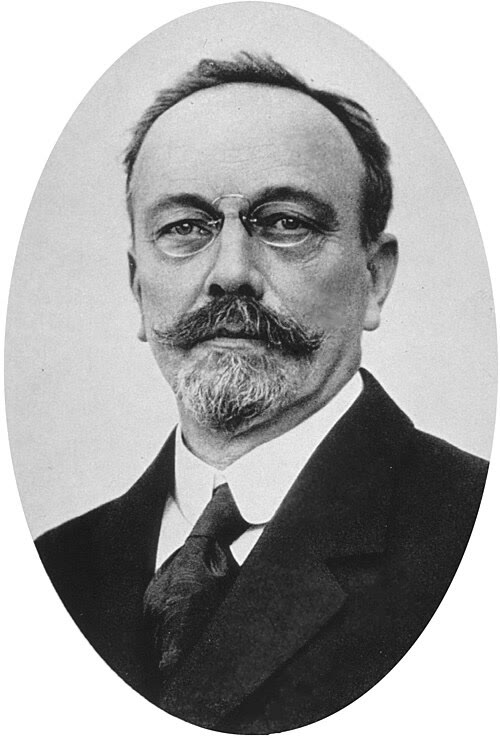
Johannes Fibiger
Danish physician
नेपालीमा पढ्नुहोस् · हिंदी में पढ़ें
- नेपाली · English · हिंदीRead in your language
- CitedEvery fact sourced
- Ad-freeNo ads, no tracking
Johannes Andreas Grib Fibiger (23 April 1867 – 30 January 1928) was a Danish physician and professor of anatomical pathology at the University of Copenhagen. He was the recipient of the 1926 Nobel Prize in Physiology or Medicine "for his discovery of the Spiroptera carcinoma". He claimed to have shown that the roundworm which he called Spiroptera carcinoma (but is correctly named Gongylonema neoplasticum) could cause stomach cancer (squamous cell carcinoma) in rats and mice. His experimental results were later proven to be a case of mistaken conclusion.
Quick facts
Positions held wd
- rector (1925–1926)
Awards wd
- Nobel Prize in Physiology or Medicine (1926)
- doctor honoris causa from the University of Paris (1927)
- commander of the Order of the Dannebrog (1926)
About
While working at the Institute of Pathological Anatomy of University of Copenhagen, Fibiger discovered new roundworms in 1907 from wild rats. He suspected that the roundworms were responsible for stomach cancer in those rats. In 1913, he reported that he could experimentally induce cancer in healthy rats using the roundworms. His discovery was considered "the greatest contribution to experimental medicine" at the time. In 1926, he was nominated for the Nobel Prize in Physiology or Medicine along with Katsusaburo Yamagiwa, who had experimentally induced carcinoma by painting crude coal tar on the inner surface of rabbits' ears in 1915. However, they were considered undeserving, and the 1926 prize was not given. In the next year Fibiger alone was retrospectively chosen for the 1926 Nobel Prize.
After his death, independent researches proved that G. neoplasticum cannot cause cancer. Tumours and cancer produced by Fibiger were due to vitamin A deficiency. Historical reassessment of Fibiger's data revealed that he had mistaken non-cancerous tumours for cancerous tumours. Erling Norrby, who had served as the Permanent Secretary of the Royal Swedish Academy of Sciences and Professor and Chairman of Virology at the Karolinska Institute, in 2010 declared Fibiger's Nobel Prize as "one of the biggest blunders made by the…
People also search for
 Camillo Golgi
 Paul Karrer
 Claude Goasguen
 Francesco Brioschi
 Paolo Ruffini
 Pierre Mandonnet
Questions
- When was Johannes Fibiger born?
- Johannes Fibiger was born on 23 April 1867 in Silkeborg.
- What positions has Johannes Fibiger held?
- Positions held by Johannes Fibiger include: rector (1925–1926).
- Where did Johannes Fibiger study?
- Johannes Fibiger was educated at University of Copenhagen.
Sources
- Wikipedia (English): Johannes Fibiger · CC BY-SA 4.0
- Wikidata item Q216324 · CC0 1.0
- Image: J Fibiger.jpg by Unknown author Unknown author (CC BY 4.0)

Last updated · facts checked 5 November 2026
Cite this page
"Johannes Fibiger". DigiNepal. Last updated 1 November 2026. https://diginpl.com/people/johannes-fibiger. Retrieved 5 November 2026.
Is this you, or do you work in this person's office? Claim this profile