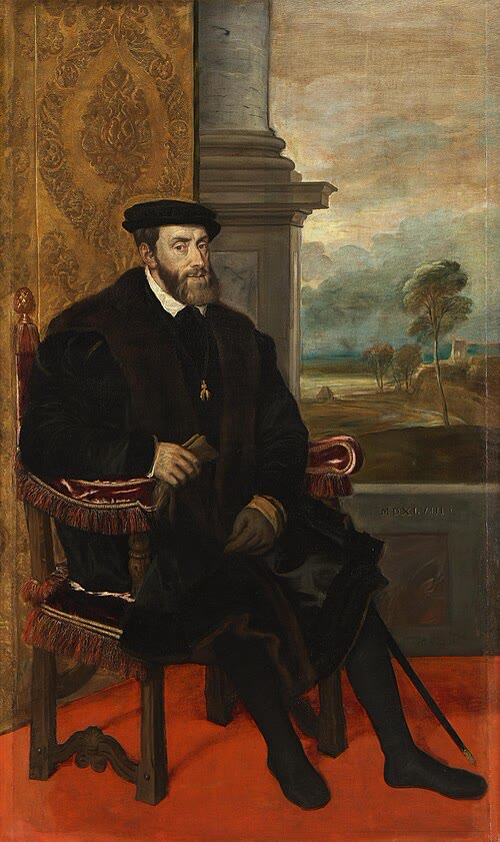
Charles V, Holy Roman Emperor
Holy Roman Emperor from 1519 to 1556 (1500–1558)
नेपालीमा पढ्नुहोस् · हिंदी में पढ़ें
- नेपाली · English · हिंदीRead in your language
- CitedEvery fact sourced
- Ad-freeNo ads, no tracking
Charles V (24 February 1500 – 21 September 1558) was Holy Roman Emperor and Archduke of Austria from 1519 to 1556, King of Spain (as Charles I) from 1516 to 1556, King of Sicily and Naples from 1516 to 1554, and also Lord of the Netherlands and titular Duke of Burgundy (as Charles II) from 1506 to 1555. He was heir to and then head of the rising House of Habsburg. His dominions in Europe included the Holy Roman Empire, extending from Germany to northern Italy with rule over the Austrian hereditary lands and Burgundian Low Countries, and Spain with its possessions of the southern Italian kingdoms of Sicily, Naples, and Sardinia. In the Americas, he oversaw the continuation of Spanish colonisation and a short-lived German colonisation. The personal union of the European and American territories he ruled was the first collection of realms labelled "the empire on which the sun never sets".
Quick facts
Positions held wd
- Holy Roman Emperor (1519–1556)
- monarch of the Crown of Aragon (2 February 1516 – 16 January 1556)
- King of Sardinia (2 February 1516 – 16 January 1556)
- Monarch of Castile and Leon (1516–1556)
- Lord of the Netherlands
Awards wd
- Knight of the Order of the Golden Fleece
- Order of Alcántara
- Order of Calatrava
- Order of Santiago
- Knight of the Garter (1508)
- illustrious son
About
Charles was born in Flanders to Habsburg Archduke Philip the Handsome, son of Maximilian I, Holy Roman Emperor and Mary of Burgundy, and Joanna of Castile, third child of Isabella I of Castile and Ferdinand II of Aragon, the Catholic Monarchs of Spain. Heir of his grandparents, Charles inherited his family's dominions at a young age. After his father's death in 1506, he inherited the Habsburg Netherlands in the Low Countries. In 1516, he became King of Spain as co-monarch of Castile and Aragon with his mother. Spain's possessions included the Castilian colonies of the Spanish West Indies and the Spanish Main, as well as Naples, Sicily and Sardinia. At the death of his paternal grandfather Maximilian in 1519, he inherited the Austrian hereditary lands and was elected as Holy Roman Emperor. He adopted the Imperial name of Charles V as his main title, and styled himself as a new Charlemagne.
Charles revitalised the medieval concept of universal monarchy. With no fixed capital, he made…
People also search for
 Henry VI, Holy Roman Emperor
 Charles VI, Holy Roman Emperor
 Henry VII, Holy Roman Emperor
 Charles IV, Holy Roman Emperor
 Leopold II, Holy Roman Emperor
 Ferdinand II of Aragon
 Charles II of Spain
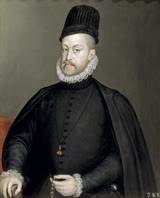 Philip II of Spain
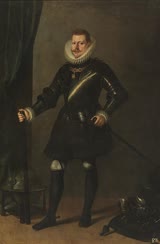 Philip III of Spain
 Philip V of Spain
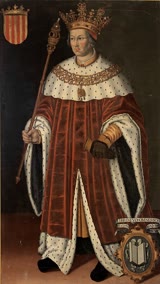 John II of Aragon
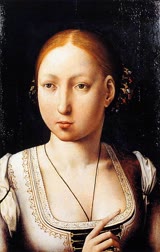 Joanna of Castile
Questions
- When was Charles V, Holy Roman Emperor born?
- Charles V, Holy Roman Emperor was born on 24 February 1500 in Ghent.
- What positions has Charles V, Holy Roman Emperor held?
- Positions held by Charles V, Holy Roman Emperor include: Holy Roman Emperor (1519–1556); monarch of the Crown of Aragon (1516–1556); King of Sardinia (1516–1556); Monarch of Castile and Leon (1516–1556); Lord of the Netherlands.
Sources
- Wikipedia (English): Charles V, Holy Roman Emperor · CC BY-SA 4.0
- Wikidata item Q32500 · CC0 1.0
- Image: Portrait of Charles V, Holy Roman Emperor, seated (1500–1558), formerly attributed to Titian (Alte Pinakothek, Munich).jpg by Attributed to Titian (Public domain)

Last updated · facts checked 5 November 2026
Cite this page
"Charles V, Holy Roman Emperor". DigiNepal. Last updated 31 October 2026. https://diginpl.com/people/charles-v-holy-roman-emperor. Retrieved 5 November 2026.
Is this you, or do you work in this person's office? Claim this profile