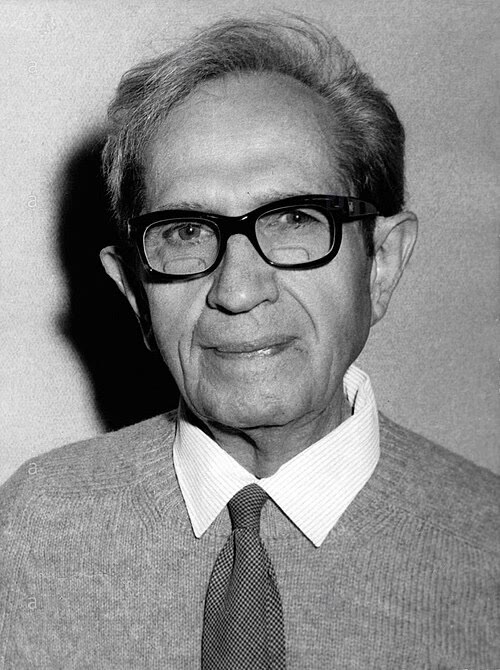
Albert Claude
Belgian-American cell biologist (1899–1983)
नेपालीमा पढ्नुहोस् · हिंदी में पढ़ें
- नेपाली · English · हिंदीRead in your language
- CitedEvery fact sourced
- Ad-freeNo ads, no tracking
Albert Claude (French pronunciation: [albɛʁ klod]; 24 August 1899 – 22 May 1983) was a Belgian-American cell biologist and medical doctor who shared the Nobel Prize in Physiology or Medicine in 1974 with Christian de Duve and George Emil Palade. His elementary education started in a comprehensive primary school at Longlier, his birthplace. He served in the British Intelligence Service during the First World War, and got imprisoned in concentration camps twice. In recognition of his service, he was granted enrolment at the University of Liège in Belgium to study medicine without any formal education required for the course. He earned his Doctor of Medicine degree in 1928. Devoted to medical research, he initially joined German institutes in Berlin. In 1929 he found an opportunity to join the Rockefeller Institute in New York. At Rockefeller University he made his most groundbreaking achievements in cell biology. In 1930 he developed the technique of cell fractionation, by which he discovered the agent of the Rous sarcoma, as well as components of cell organelles such as the mitochondrion, chloroplast, endoplasmic reticulum, Golgi apparatus, ribosome, and lysosome. He was the first to employ the electron microscope in the field of biology. In 1945 he published the first detailed structure of cell. His collective works established the complex functional and structural properties of cells.
Quick facts
Positions held wd
- professor
Awards wd
- Nobel Prize in Physiology or Medicine (1974)
- Louisa Gross Horwitz Prize (1970)
- British War Medal (1918)
- Inter-Allied Victory medal (Belgium)
About
Claude served as director at Jules Bordet Institute for Cancer Research and Treatment and Laboratoire de Biologie Cellulaire et Cancérologie in Louvain-la-Neuve; Professor at the Free University of Brussels, the University of Louvain, and Rockefeller University. For his pioneering works he received the Louisa Gross Horwitz Prize in 1970, together with his student George Palade and Keith Porter, the Paul Ehrlich and Ludwig Darmstaedter Prize in 1971, and the Nobel Prize in Physiology…
People also search for
 Alexander Graham Bell
 C. K. Prahalad
 Arjun Narasingha KC
 Masatoshi Koshiba
 Rolf M. Zinkernagel
Questions
- When was Albert Claude born?
- Albert Claude was born on 24 August 1898 in Longlier.
- What positions has Albert Claude held?
- Positions held by Albert Claude include: professor.
- Where did Albert Claude study?
- Albert Claude was educated at University of Liège.
Sources
- Wikipedia (English): Albert Claude · CC BY-SA 4.0
- Wikidata item Q233943 · CC0 1.0
- Image: Albert Claude 1974.jpg by Keystone (Public domain)

Last updated · facts checked 4 November 2026
Cite this page
"Albert Claude". DigiNepal. Last updated 31 October 2026. https://diginpl.com/people/albert-claude. Retrieved 5 November 2026.
Is this you, or do you work in this person's office? Claim this profile